Règles de Les Colons de Catane
Résumé
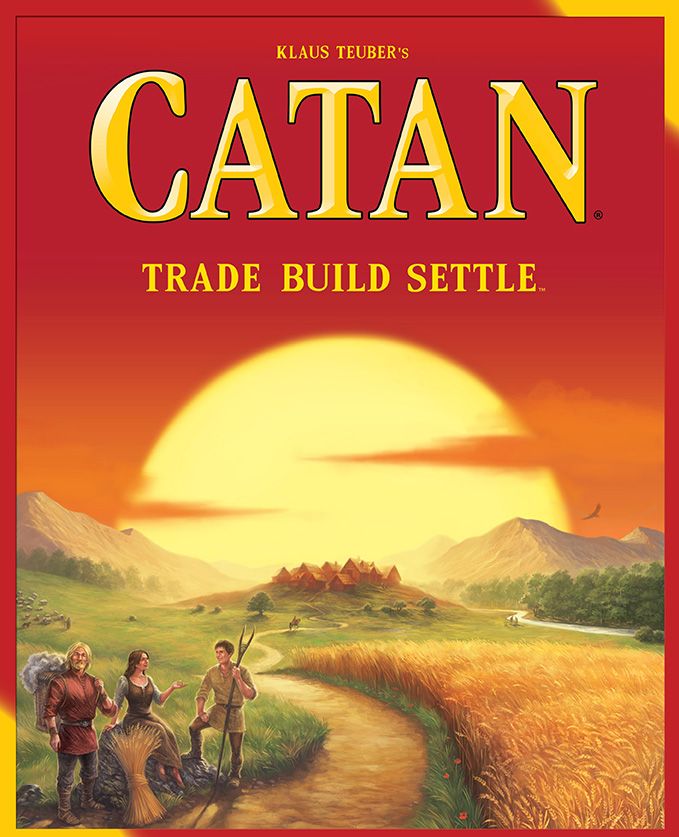
Catan is a game where players settle an island by building roads, settlements and cities on the board, collecting resource cards from dice rolls, trading, and buying development cards. The first player to reach 10 victory points on their own turn wins.
Mise en place
Assemble the frame and lay out the 19 terrain hexes, either in the fixed beginners' layout or as a randomized board using the variable set-up. Place the 18 number tokens on the land hexes (none on the desert), and place the 9 harbor pieces on the frame. Each player takes a color's 5 settlements, 4 cities, 15 roads and a building costs card; in a 3-player game, the unused color's starting position is left empty. Sort the resource cards into 5 stacks, shuffle the development cards face down, and place the special cards and dice beside the board. Put the robber in the desert.
In the set-up phase, each player places a settlement and an adjoining road in a first round, in clockwise order, with the highest roller starting. In a second round, the last player of round one places first, and the others follow counterclockwise. Each player then takes resources from the hexes adjacent to their second settlement. Settlements must obey the Distance Rule throughout.
Un tour de jeu
On your turn, do these steps in order:
- Roll for resource production. Both dice are rolled and every settlement or city bordering a hex with the rolled number collects resources. A city collects two cards. If a roll of 7 occurs, see the robber rules below.
- Trade. You may trade with other players (domestic trade) and with the bank (maritime trade). Other players may only trade with the player whose turn it is. The bank accepts 4 identical cards for any 1; a harbor you own lowers that to 3:1, or 2:1 for a matching special harbor.
- Build. Pay the costs shown on the building costs card to build roads, settlements, cities, or buy development cards. Roads must connect to your network, and settlements must connect to your road and obey the Distance Rule. A city replaces one of your settlements, which returns to your supply.
You may play one development card at any time during your turn, but not one bought that same turn (except a victory point card). Then pass the dice to the player on your left.
A roll of 7 means no one collects resources. Players holding more than 7 cards discard half, rounded down. The roller then moves the robber to another hex or the desert and steals one random card from an adjacent opponent. The robber blocks production from its hex until moved.
Fin de la partie
The game ends when a player has 10 or more victory points on their own turn, and they win. If a player reaches 10 points during another player's turn, the game continues until someone reaches 10 on their turn. Victory point cards may be revealed only when a player claims victory.
Décompte des points
Victory points come from settlements (1 each), cities (2 each), the Longest Road card (2), the Largest Army card (2), and victory point cards (1 each). Each player starts with 2 points from their starting settlements. Ties are not addressed beyond the special card rules: if the longest road is broken and two or more players tie for the new longest road, the Longest Road card is set aside until one player holds the longest road of at least 5 segments. The same applies to Largest Army cases where players are tied.
Variantes
The rulebook gives a fixed beginners' layout, a variable board for experienced players with randomized terrain and number tokens (a fully random token placement is also allowed), and a combined trade and build phase for advanced players, in which trading and building may alternate in any order after the roll. The rulebook gives no solo or team variants.
Modifications
- Variantes, par le brouillon tiré du livret de règles, le 23 novembre 2026 (affichée maintenant)
- Décompte des points, par le brouillon tiré du livret de règles, le 23 novembre 2026 (affichée maintenant)
- Fin de la partie, par le brouillon tiré du livret de règles, le 23 novembre 2026 (affichée maintenant)
- Un tour de jeu, par le brouillon tiré du livret de règles, le 23 novembre 2026 (affichée maintenant)
- Mise en place, par le brouillon tiré du livret de règles, le 23 novembre 2026 (affichée maintenant)
- Résumé, par le brouillon tiré du livret de règles, le 23 novembre 2026 (affichée maintenant)