Loading the page…
Diese Seite auf Deutsch ansehen
Vedi questa pagina in italiano
Skip to content
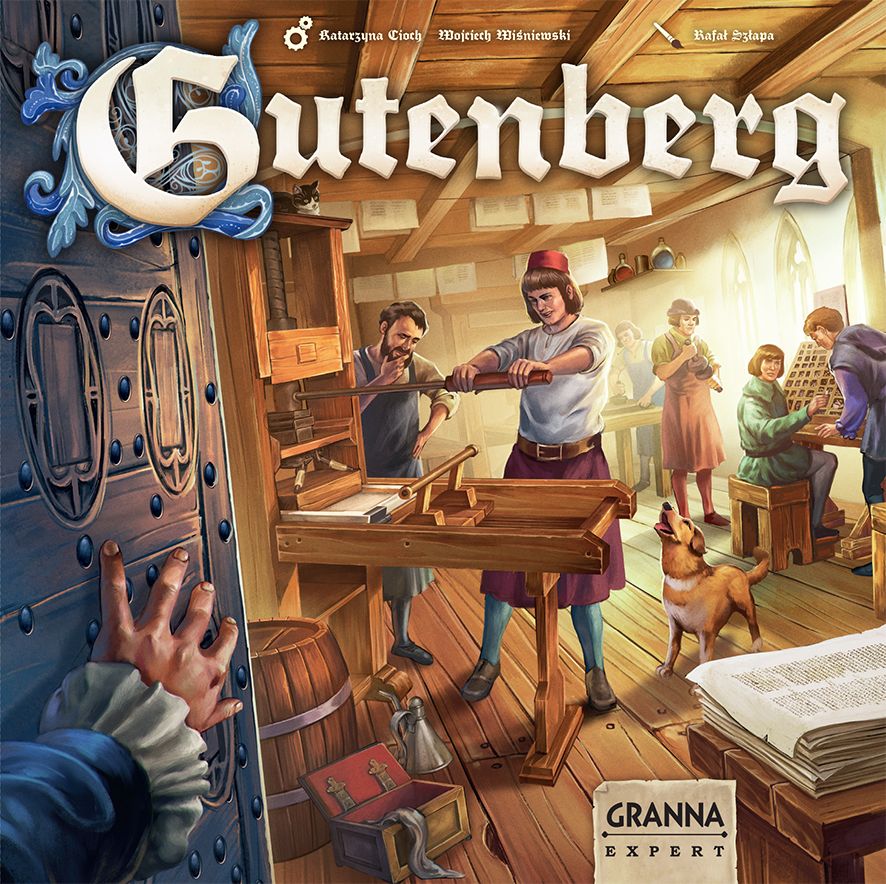
Gutenberg is a game for 1 to 4 players who act as early printing pioneers. They acquire and fulfill orders for books, develop specialties, upgrade their printing houses, and gain patronage. Over six rounds, players earn fame points, and the player with the most fame points wins.
Each player chooses a color and takes a printing house board, an initiative board, a screen, and the matching initiative markers (first player 7, second 8, third 9, fourth 10). They also take 3 gray cylinders and push them into the gear axle holes on their printing house board, plus 5 player markers. Place one marker on the lowest space of each of the four specialty tracks and keep one beside the printing house. Take 2 player disks: one on 0 of the fame track and one on the leftmost space of the reward track. Take 10 guilders and 3 used gear markers.
Each player draws 2 character tiles, keeps one, and returns the other. Starting with the first player and going clockwise, each player picks one printing card and one refinement card as an order. Then, in reverse order, each player picks a second order. Return the four unpicked cards to their discard piles. Finally, each player chooses 3 types from the pool.
The rulebook suggests a simpler first game without characters.
Each round has these steps in order: turn gears, plan, execute plans, fulfill orders, and prepare the next round. The round count is 6.
1. Turn gears: Turn the top gear on your printing house board one sector clockwise; connected gears turn too. Skip this in round 1.
2. Plan: Secretly place your initiative markers, left to right, on the five action rows of your initiative board. Each row holds at most 6 markers. When everyone is ready, reveal plans.
3. Execute plans: Resolve the five actions from top to bottom. For each action, players act in order of their marker count on that row, most markers first. Ties go by round player order. You must have at least one marker on an action to perform it, and performing it is always optional.
- Take orders: Pick one printing card and one refinement card to form an order and place it in a free slot. You may hold up to 4 orders. Any inks left on the board return to the bag afterward.
- Take inks: Pick a set of 3 inks and take them from left to right. The first is free, the second costs 1 guilder, and the third costs 2 guilders. Leftover cards are discarded afterward.
- Develop specialties: Pick a specialty card and either advance the marked specialties by one level per symbol, or advance any one specialty by one level. The first time a track reaches a reward level, take that reward. Level VI is the maximum; extra development there gives 3 guilders.
- Improve printing houses: Take a gear from the board or move one of your installed gears. A printing house holds up to 3 gears. Only sectors next to the shaded crescents are active. Place a used gear marker on an active sector to claim its reward, once per gear per round.
- Patronage: Either take one available reward (an order, a specialty advance, 3 guilders, or any 2 inks) by placing your marker on it, or take one patronage card if you meet its requirements and it lies on or left of the round marker. Patronage cards cost the listed inks, which return to the bag. Specialties and types are not spent.
4. Fulfill orders: Going clockwise from the first player, each player may fulfill any of their orders. The printing card needs its listed types and pays guilders. Refinements are optional and give fame points for colors and decorations. Completing both gives an extra reward. Inks are used up, while types and specialties stay with you. All orders in this step are resolved at the same time, so rewards from one order cannot fund another in the same round.
5. Prepare the next round: Refill the board's empty spaces, move the round marker forward, return patronage markers, remove used gear markers and initiative markers, and pass the first player token clockwise. The player receiving it gets one marker from each other player.
The game ends after the sixth round. Players then add up their final fame points.
Final scoring adds these bonuses to fame points already gained during the game:
- Specialties: 6 points for each at level VI, 3 for each at level V, and 1 for each at level IV.
- Patronage cards: 8 points for each one you acquired.
- Guilders: 1 point for every 3 guilders.
The player with the most fame points wins. Ties go to the player with fewer types, then to the player with fewer inks. If still tied, the tie remains.
Solo play and automa: The automa is an abstract extra player that can play alone or join a 2- or 3-player game. It uses an unused initiative board, 7 initiative markers, one player marker of an unused color, and automa planning and execution cards. During setup, count the automa as a player, give it the first player token, and place one fewer order than usual. Each round, reveal a planning card, rearrange the automa's markers, and resolve the automa's actions by drawing execution cards. The automa does not accumulate resources. Solo players can earn guild titles from their scores: under 100 is Student, 101 to 110 is Senior Student, 111 to 120 is Apprentice, 121 to 130 is Senior Apprentice, 131 to 140 is Junior Master, 141 to 150 is Master of Printing, and above 150 is Guildmaster.
Characters: Character tiles add special abilities. Players can skip them for a simpler first game.