Rules of Viticulture
Summary
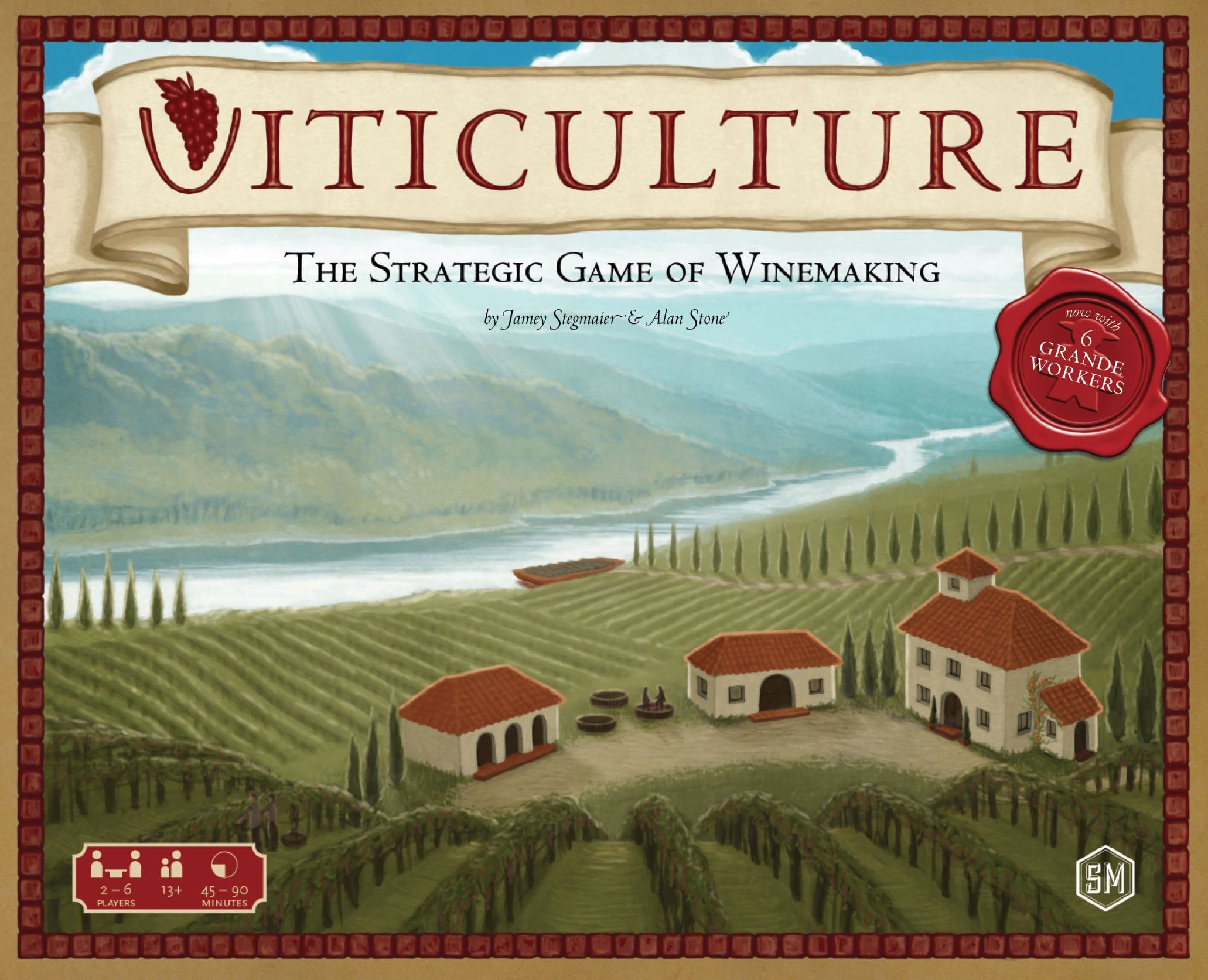
Viticulture is a worker-placement game in which players run vineyards in old-world Tuscany by planting vines, harvesting grapes, making wine, and filling wine orders. The first player to reach 20 victory points triggers the end of the game once the current year is finished, and the player with the most points wins.
Setup
Each player takes a vineyard mat and places their three starting field cards field side up on it. Shuffle the four small card decks (green, yellow, purple, blue) and place them on the board. Each player puts their rooster token above the wake-up chart, their cork token on the start space of the victory point track, and their wine bottle token in the middle of the residual payment tracker.
Deal one mama card and one papa card face up to each player and gain the starting workers, cards, lira, or structures they show. Then discard the mama and papa cards. To pick the first player, gather the rooster tokens, shake them, and draw one at random; that player takes the first-player token.
A turn
A year has four seasons, played in order.
- Spring: Starting with the first-player token holder and going clockwise, each player places their rooster on an open row of the wake-up chart. Row 1 is the earliest wake-up and row 7 the latest. Later rows give bonuses, and that row sets player order for the rest of the year.
- Summer: Going down the wake-up chart, each player either places one worker on an open summer action space and takes that action, or passes. A player who passes places no more workers that season. This repeats until everyone has passed.
- Fall: Going down the wake-up chart, each player draws one summer or winter visitor card. Players with a cottage may draw an extra card.
- Winter: Going down the wake-up chart, each player places one worker on an open winter action space and takes that action. This repeats until all workers are placed.
Rules for workers: each worker is used once per year, and a worker must be placed in the current season. Taking the action is mandatory, but any bonus shown on the space is optional. A grande worker may also be placed on an occupied action space to perform that action, and it gives a bonus only if placed on a bonus space.
At year end, age all grape and wine tokens by one step, return workers to the vineyard mats, collect residual lira from the residual payment tracker, discard down to 7 cards, remove the rooster tokens, and pass the first-player token counterclockwise.
Scoring
The player with the most victory points wins. Points can be gained from filling wine orders, planting vines with a windmill, giving tours with a tasting room, and various visitor cards. A player's victory point total cannot go below -5.
If players are tied, the tie is broken in this order:
1. Most lira.
2. Greatest total value of wine in the cellar.
3. Greatest total value of grapes on the crush pad.
Variants
Advanced setup: Each player draws two mama cards and two papa cards and keeps one of each. Mamas give regular workers and cards, and papas give a grande worker, lira, and a choice of a structure, an extra worker, or a victory point. Players make these choices in clockwise order starting with the first player.
Friendly variant: A player may only choose a bonus action space if they complete that bonus, or if no other space is open for that action. This stops players from blocking others by placing workers on bonus spaces.
Solo play (Automa): You play against an artificial opponent for seven years and win by having more victory points than the Automa at the end. Automa cards decide how many workers the opponent places each season, and the game offers difficulty levels, an aggressive variant in which the Automa scores points each year, and a campaign mode of eight challenges.
Changes
- Variants, by the rulebook draft, 22 November 2026 (shown now)
- Scoring, by the rulebook draft, 22 November 2026 (shown now)
- A turn, by the rulebook draft, 22 November 2026 (shown now)
- Setup, by the rulebook draft, 22 November 2026 (shown now)
- Summary, by the rulebook draft, 22 November 2026 (shown now)