このゲームについて
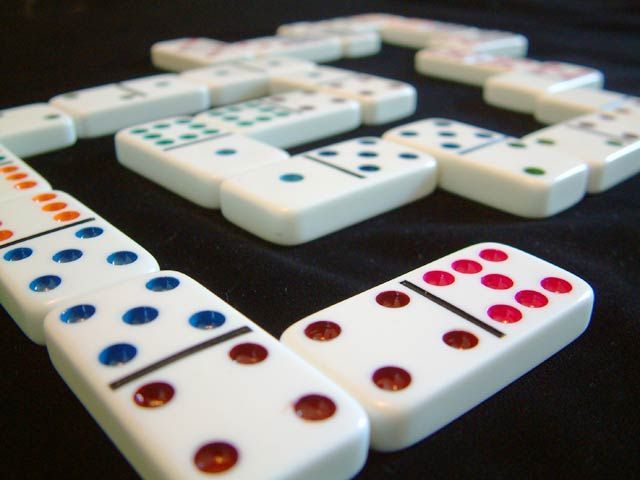
Pai gow is a gambling pastime from China, played with 32 Chinese dominoes for two to eight players. It is a betting game found in major casinos and in many Chinatown clubs around the world.
You are a player betting against the dealer, and every participant, the dealer included, works from the same tiles. Your aim is to build two hands that each beat the matching hand of the dealer.
The tiles are shuffled and laid out as a woodpile of eight face-down stacks, which can be rearranged before bets are placed. Each player then takes one stack of four tiles and divides it into two hands. Named pairs rank highest, then Gong and Wong combinations, and otherwise the pips are added modulo ten, so a mixed hand tops out at nine.
On a turn, each player splits four tiles into a lower front hand and a higher rear hand. Beating the dealer's front and rear hands pays even money, and losing both loses the stake. A split result is a push, returning only the bet.
The set has 32 tiles, and the double-one and double-six pieces carry special weight in forming Gong and Wong hands. The woodpile starts with eight stacks of four tiles each.
Every bet is settled on its own, with each player's front and rear hands compared only to the dealer's. Each result is a win, a loss or a push.
The named pairs follow a creation story, starting with Gee Joon as Supreme Creator and moving through heaven, earth, man, geese and plum flowers.
写真
- コンポーネント
ランキング
まだ投票がありません
ルール
動画
音楽
コメント
関連ゲーム
スピンオフ1
このゲームをAPIで取得
curl https://api.thebgdb.org/v1/games/9fbdfcc6-4ae3-417d-8531-baf1e00515f4最終更新 2026年11月27日