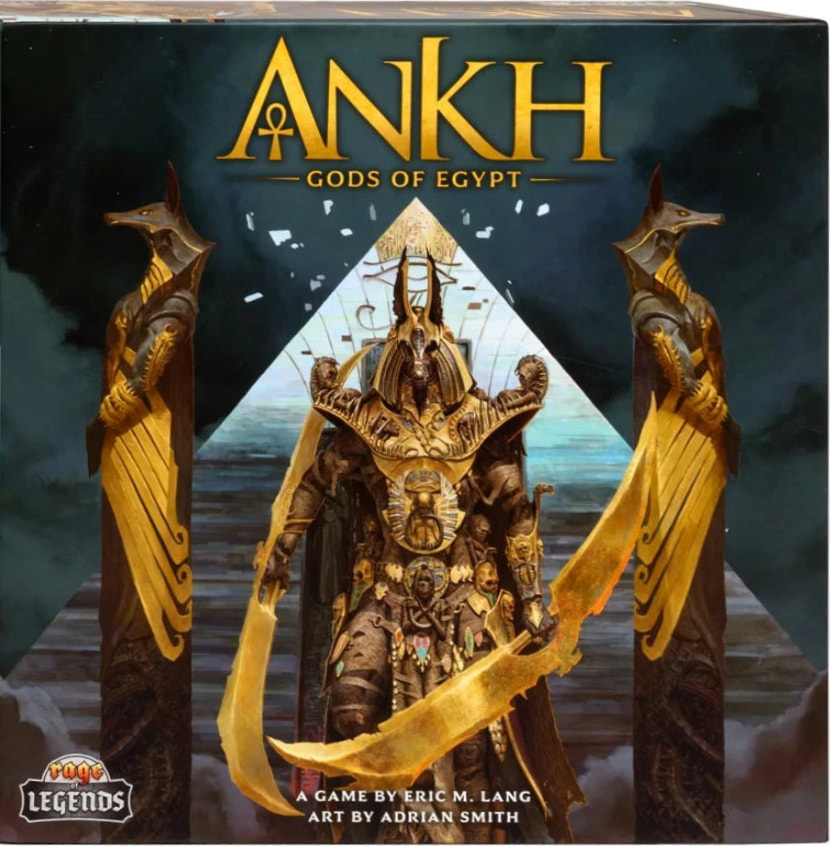
Regeln von Ankh: Gods of Egypt
Überblick
Ankh: Gods of Egypt is a competitive game for 2 to 5 players set in ancient Egypt, where each player controls a god trying to gather Devotion. Devotion comes from controlling Monuments and winning conflicts over regions. A player wins immediately by reaching the top of the Devotion track, by being the only god left after the fourth Conflict, or otherwise by having the most Devotion after the last event.
Spielaufbau
- Each player picks a god and takes its god figure, six Warriors, god dashboard, merged god dashboard, Ankh tokens, seven Battle cards and Player Aid card. Ra, Osiris and Amun players also take their special tokens. Each player starts with one Follower; the rest form a general supply.
- Each player places six of their Ankh tokens on the bottom row of their god dashboard, below the locked powers. The remaining Ankh tokens form their personal pool.
- Pick a first player, and seat the others clockwise. In reverse player order, each player places their Ankh token on the bottom space of the Devotion track, so the first player's token ends up on top of the stack.
- Set each Action marker on the starting space that matches the player count, and place the Event marker on the first Event space.
- Choose a scenario from the Scenario Book, making sure it supports the player count. Place the Monuments, Conflict Order tokens and camels as the scenario diagram shows, and set the rest aside.
- Place figures and Ankh tokens on controlled Monuments as the scenario shows.
- Choose one Level 1, one Level 2 and one Level 3 Guardian card and place Guardian figures beside them: one of each type for 2 players, two of each for 3 players, and all available (three small-base, two large-base) for 4 or 5 players.
- Apply any additional setup rules from the scenario.
Ein Spielzug
On your turn you take one or two actions. To choose an action, move its Action marker one space to the right, then fully resolve that action. You may pick an action even if you cannot fully carry it out.
If your first action pushes its marker onto the rightmost white space, it triggers an event. Finish the action, then advance the Event marker one space and resolve that event. Your turn then ends with no second action.
If no event is triggered, you must choose a second action from a lower row of the dashboard than your first, and advance its marker the same way. You cannot repeat an action or pick a higher one. If the second action triggers an event, resolve it and end your turn. Otherwise your turn ends. You must still advance a second marker when possible, even if you cannot use its effect.
The four actions are:
- Move Figures: move each of your figures up to 3 spaces, through any space, but ending on an empty non-Water space.
- Summon Figure: place one figure from your pool on an empty non-Water space adjacent to one of your figures or a Monument you control.
- Gain Followers: gain one Follower for each Monument, neutral or controlled by you, that has one of your figures adjacent to it.
- Unlock Ankh Power: unlock the next Ankh power in the leftmost available column by sacrificing Followers equal to that power's level. If a Guardian symbol is revealed, take a Guardian figure of that level, give it a base of your color, and add it to your pool.
Spielende
The game ends in one of these ways:
- A player's Ankh token reaches the top space of the Devotion track, and that player wins immediately.
- After the fourth Conflict event, any god still in the red section of the Devotion track is forgotten and removed, along with its figures, Monuments and Followers. If only one god remains, that god's player wins. If two or more remain, play continues. If none remain, the game ends in a draw with no winner.
- If no god has won by then, the game ends after the last event on the track, which is the fifth Conflict event.
Wertung
Devotion is the score. Players gain it from dominating a region, winning Monument majorities, winning Battles, and certain Ankh powers, Battle cards and Guardian effects. When several players gain or lose Devotion at the same time, they resolve it starting with the player who has the least Devotion.
A player who reaches the top of the Devotion track wins at once. Otherwise, the player with the most Devotion after the final event wins. The rulebook does not say how a tie for most Devotion at game end is resolved.
Varianten
The rulebook offers scenarios from the separate Scenario Book. Each scenario lists the player counts it supports and may add its own setup rules and board layout. The rulebook does not describe a solo variant or a team variant as such. In games of 3 or more players, the two gods with the lowest Devotion merge after the third Conflict. The merged players then share a god and its pool, and each takes one action per turn. This is a standard rule, not an optional variant.
Änderungen
- Varianten, von dem Entwurf aus der Anleitung, 22. November 2026 (wird jetzt angezeigt)
- Wertung, von dem Entwurf aus der Anleitung, 22. November 2026 (wird jetzt angezeigt)
- Spielende, von dem Entwurf aus der Anleitung, 22. November 2026 (wird jetzt angezeigt)
- Ein Spielzug, von dem Entwurf aus der Anleitung, 22. November 2026 (wird jetzt angezeigt)
- Spielaufbau, von dem Entwurf aus der Anleitung, 22. November 2026 (wird jetzt angezeigt)
- Überblick, von dem Entwurf aus der Anleitung, 22. November 2026 (wird jetzt angezeigt)