Regeln von Antike Duellum
Überblick
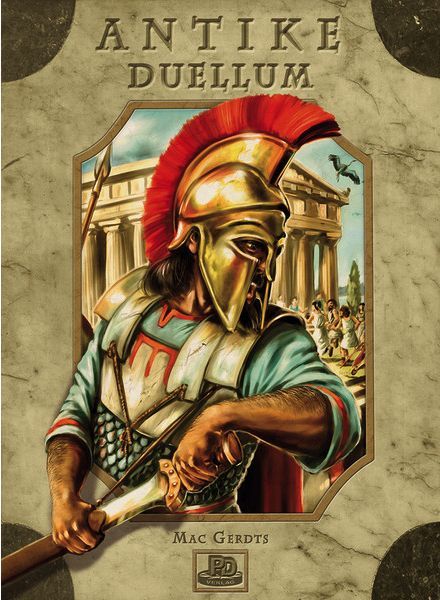
Antike Duellum is a two-player game in which two ancient empires found cities, build temples and town walls, develop Know-Hows, and fight over territory. The first nation to own 9 personages wins the game.
Spielaufbau
Each player takes the wooden pieces of their color: 12 galleys, 12 legions, an octagonal game stone, and 6 wooden disks, plus one town wall. Each player places one disk at zero on the VP track. Both recruitment boxes receive 1 legion and 1 galley each. Each player's three starting cities get city tokens matching their resource, and each player starts with 3 marble, 3 iron, and 3 gold chips. The start player is chosen at random and the other player receives 1 coin. Place the chips, coins, temples, town walls and city tokens near the board as the bank. Sort the 21 personage cards into five stacks. Shuffle the 25 event cards into a draw deck and draw 3 to form the open display.
Ein Spielzug
Each turn has three steps, taken in order:
- Action selection: Place the game stone on the rondel and perform that action. On your first turn you may choose any field. Afterward the stone moves clockwise. Any of the next three fields is free; each further field costs one resource chip or coin of your choice. You may not stay on the same field two turns in a row.
- Founding cities: Found one or more cities in regions where you have a military unit (foreign units do not block this). Each new city costs one marble, one iron and one gold, plus one coin for each adjacent city producing the same resource, whoever owns it. Coins can replace missing chips.
- Winning personages: At the end of the turn, collect any personages you qualify for, if the bank still has them. Your opponent then takes one event card per personage you receive.
The rondel actions are: producing marble, iron or gold (you get the chips plus one coin, with 3 chips per city that has a temple, otherwise 1); Templum (build temples for 6 marble each plus coins for adjacent temples, and/or town walls for 1 marble each); Militia (arm units from the recruitment box for 2 iron each, with limits of 1 per city without a temple and 3 per city with one); Scientia (develop Know-Hows with gold, and recruit units from your supply at 1 gold per legion and 2 per galley); and Duellum (move units, resolve battles, then conquer cities). Opposing units of the same type cancel each other one for one when they meet. A city's defense strength is 1 (3 with a temple), plus 1 per defending unit in the region, plus 1 for a town wall, plus 1 if the defender owns Res Publica. Conquest needs at least that many attacking units in the region. The conqueror takes the defending units and the city's temple and town wall effects follow the rulebook.
Spielende
The game ends as soon as a nation acquires 9 personages.
Wertung
There is no points total. Victory goes to the first nation to own 9 personages. Personages are gained for reaching goals: a King for every 5 cities (at 5, 10, 15, and so on), a Citizen for every 3 temples (at 3, 6, 9 and 12), a Scholar for each new Know-How, a General for each temple destroyed, and a Navigator for controlling 7 sea areas, where sea regions without a city count double. Personages are awarded at the end of a turn and cannot be lost once won.
Varianten
The rulebook gives a Duellum variant with two special units: each player gets an Admiral (beige) or a Commander (brown) in the recruitment box at the start. Arming them costs 3 iron each and they can only be added to cities with a temple. An Admiral moves like a galley and a Commander like a legion. A special unit present in a conquest lowers the attacked city's defense by 1, or raises a defended city's defense by 1. It survives the battle, but it can only be destroyed by hostile units of its type during movement, and only after its accompanying units of that type are eliminated. The rulebook also lists a rule set for players who already know Antike, with changed costs and coin rules. It is not a separate variant.
Änderungen
- Varianten, von dem Entwurf aus der Anleitung, 23. November 2026 (wird jetzt angezeigt)
- Wertung, von dem Entwurf aus der Anleitung, 23. November 2026 (wird jetzt angezeigt)
- Spielende, von dem Entwurf aus der Anleitung, 23. November 2026 (wird jetzt angezeigt)
- Ein Spielzug, von dem Entwurf aus der Anleitung, 23. November 2026 (wird jetzt angezeigt)
- Spielaufbau, von dem Entwurf aus der Anleitung, 23. November 2026 (wird jetzt angezeigt)
- Überblick, von dem Entwurf aus der Anleitung, 23. November 2026 (wird jetzt angezeigt)