Regeln von Antike II
Überblick
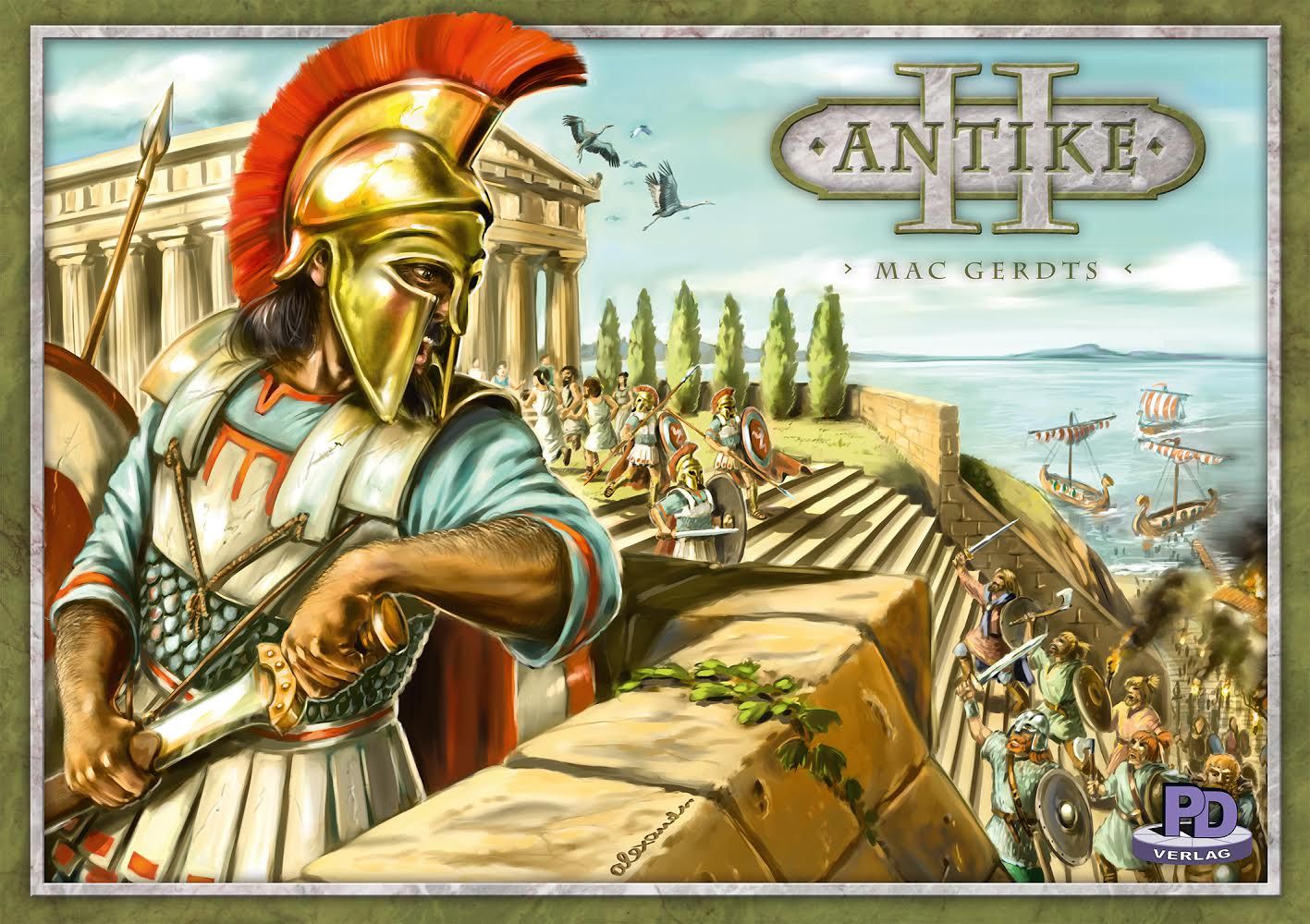
Antike II is a civilization game in which each player leads an ancient nation. Nations develop by producing resources, building temples, arming military units, founding cities, learning Know-Hows, and conquering rival cities. The first nation to collect the required number of ancient personages wins.
Spielaufbau
The starting nation is chosen at random. The last nation in turn order receives the BELLONA card. Each nation starts with 3 cities, one producing marble, one iron and one gold. The bank's supply of legions, galleys, city tokens, coins and temples is limited, while resource chips are unlimited. Game stones and markers are placed as the quick intro describes.
Ein Spielzug
Nations take turns in clockwise order. Each turn has three steps, taken in order.
- Action selection: Place the octagonal game stone on the rondel and carry out that action. On a nation's first turn the stone may go to any field. After that it moves clockwise. Up to three fields ahead are free, and each additional field costs 1 resource chip or coin of the nation's choice. A nation may not choose the same action on two turns in a row.
- Founding cities: A nation with at least one military unit in a region may found cities there. Each new city costs 1 marble, 1 iron and 1 gold, and coins can replace any of these. A region can hold only 1 city. Neutral temples in a region must be destroyed before a city can be founded there.
- Winning personages: At the end of the turn, a nation receives each personage it has qualified for, if the bank still has it.
Rondel actions:
- MARMOR, FERRUM and AURUM produce marble, iron or gold: 1 per city, or 3 per city with a temple. The nation also receives 1 coin.
- TEMPLUM builds temples for 5 marble each, at most one per city.
- MILITIA arms legions or galleys for 2 iron each. New units go into the nation's own cities, 1 per city or 3 per city with a temple. Legions go only where a city has land borders, and galleys only where it has sea borders.
- SCIENTIA develops Know-Hows with gold. Some require another Know-How first, and the first nation to develop one pays a higher price.
- MOVERE is a military action with two phases. First, legions and galleys move across their own border types, and hostile units of the same type may fight, destroying one another 1 for 1. Second, the nation may conquer hostile cities whose defense strength is met by the units in the region.
Spielende
The game ends when a nation owns the number of ancient personages needed to win. That number depends on the player count and is marked with a laurel wreath on the victory point track. If a nation is short by only 1 personage, it may win by destroying a temple even when the bank has no general left. Once won, a personage is never lost, even if the city or temple that earned it is lost.
Wertung
Personages are the victory points, tracked with an octagonal marker on the victory point track:
- Kings: 1 for every 5 cities owned (at 5, 10, 15 and so on).
- Generals: 1 for each temple destroyed, including neutral temples. A temple is destroyed when its city is conquered.
- Citizens: 1 for every 3 temples owned (at 3, 6, 9 and so on).
- Scholars: 1 for each new Know-How developed first, with the ninth scholar going to the first nation to own all 8 Know-Hows.
- Navigators: 1 for controlling 7 sea areas. Sea regions without a city count double, and sea areas are counted at the end of the turn after all fights and conquests.
The rulebook does not describe how ties are decided.
Varianten
- Ninth scholar: Pliny the Elder goes to the first nation that owns all 8 Know-Hows, rather than being a standard scholar.
- Free choice of city type: When founding a city, the owner chooses which resource the city produces. The resource shown on the board does not matter.
- Opening strategies: The rulebook suggests growth (MARMOR, then TEMPLUM), progress (AURUM first for an early Know-How) and military (FERRUM, AURUM, then MILITIA) openings. These are suggestions, not separate rules.
The rulebook gives no solo, team or short-game variants.
Änderungen
- Varianten, von dem Entwurf aus der Anleitung, 23. November 2026 (wird jetzt angezeigt)
- Wertung, von dem Entwurf aus der Anleitung, 23. November 2026 (wird jetzt angezeigt)
- Spielende, von dem Entwurf aus der Anleitung, 23. November 2026 (wird jetzt angezeigt)
- Ein Spielzug, von dem Entwurf aus der Anleitung, 23. November 2026 (wird jetzt angezeigt)
- Spielaufbau, von dem Entwurf aus der Anleitung, 23. November 2026 (wird jetzt angezeigt)
- Überblick, von dem Entwurf aus der Anleitung, 23. November 2026 (wird jetzt angezeigt)