Regeln von Antike
Überblick
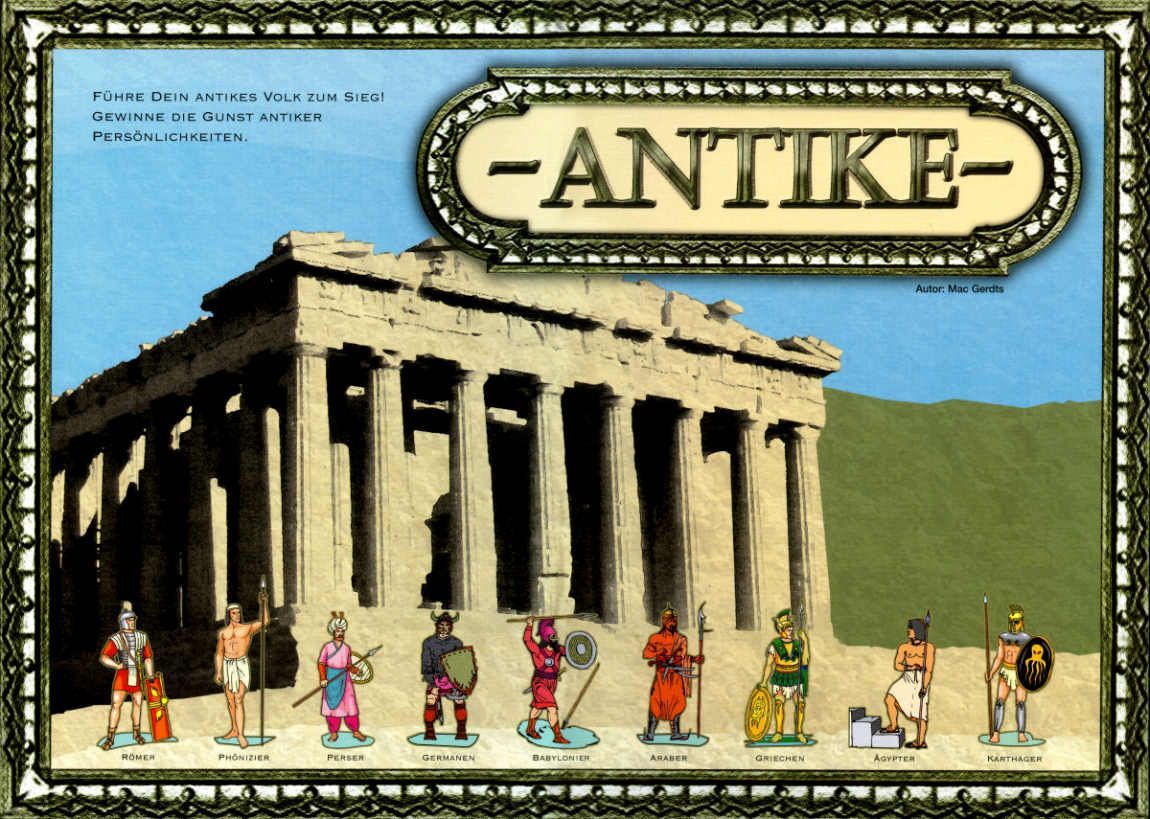
Antike is a strategy game for 2 to 6 players about rival ancient civilizations. Nations do not compete to hold the most land. Instead, they try to win ancient personages (kings, scholars, generals, citizens and navigators). The first nation to reach the target number of personages wins: 10 with 3 nations, 9 with 4, 8 with 5, and 7 with 6.
Spielaufbau
Sort the 35 personage cards into five numbered stacks (kings, scholars, generals, citizens, navigators) and place the chips, coins and white temples beside the board as the bank.
Choose a board side and the number of nations. With 2 players, 4 nations take part, and each player runs two of them. With 3 to 6 players, each player runs one nation. The nation cards in use are drawn face down or picked face up in clockwise order. The card lists the resources each nation starts with and its three start cities for the chosen number of nations.
Each nation receives its starting resources and a color set of legions, galleys, city stones and game stones. Nations take turns choosing their three start cities and placing city stones on them. The starting player is the nation whose card has a red dot matching the number of nations. That nation also receives the starting player card.
Ein Spielzug
On a nation's turn, move its game stone clockwise on the rondel. The first turn may use any wedge. After that, the stone moves 1 to 3 wedges free. Each extra wedge costs one resource paid to the bank. Reusing the same wedge requires moving eight wedges and paying five resources.
After the rondel action, the nation may found cities. Each new city needs one of the nation's military units in that province and costs one marble, one iron and one gold unit. Coins can replace missing chips.
Production wedges give resources for each city, with a temple tripling a city's output. Utilization wedges let the nation build temples (5 marble each, one per city), set up military units (1 iron each, with per-turn limits), or buy know-hows with gold.
The Maneuver wedge allows movement, then conquest. Movement can trigger mutual-destruction battles between like units. Conquest needs active units equal to the city's defense strength.
At the start of each new round, each nation takes a coin from the bank. Personages are awarded at the end of the turn.
Spielende
The game ends when a nation reaches the personage target for its player count.
When 5 or 6 nations play, all 35 personages may be awarded without a winner. In that case, the first nation to destroy a temple wins from then on.
Wertung
Personages are won as follows:
- Kings: one for every five cities, then one more at each further five.
- Scholars: one for each new know-how introduced first.
- Generals: one for each temple destroyed.
- Citizens: one for every three temples, then one more at each further three.
- Navigators: one for every seven provinces sailed, counted at the end of a turn when a galley is present, then one more at fourteen.
A nation holding all eight know-hows gets one extra personage from the stack with the most cards left. Awarded personages are never lost. The rulebook does not give a tie-break rule.
Varianten
Two players: each player runs two nations, and the game ends when one nation wins 9 personages. Alternatively, each player runs one nation in two colors with doubled materials, and the first to 15 personages wins.
Longer game: each nation starts with only one city, chosen from its three start cities.
Three players: the target can be set at 10 or 12, and 12 is recommended only for experienced players.
Expert variant: the nation with all eight know-hows receives no extra personage.
Military variant: scoring uses victory points instead of personages. Each general is worth 2 points and every other personage 1 point, for 42 in total. The target is 8 with 6 nations, 9 with 5, 11 with 4, and 13 with 3. No personage is awarded for eight know-hows.
Änderungen
- Varianten, von dem Entwurf aus der Anleitung, 23. November 2026 (wird jetzt angezeigt)
- Wertung, von dem Entwurf aus der Anleitung, 23. November 2026 (wird jetzt angezeigt)
- Spielende, von dem Entwurf aus der Anleitung, 23. November 2026 (wird jetzt angezeigt)
- Ein Spielzug, von dem Entwurf aus der Anleitung, 23. November 2026 (wird jetzt angezeigt)
- Spielaufbau, von dem Entwurf aus der Anleitung, 23. November 2026 (wird jetzt angezeigt)
- Überblick, von dem Entwurf aus der Anleitung, 23. November 2026 (wird jetzt angezeigt)