Regeln von Caesar: Rome vs. Gaul
Überblick
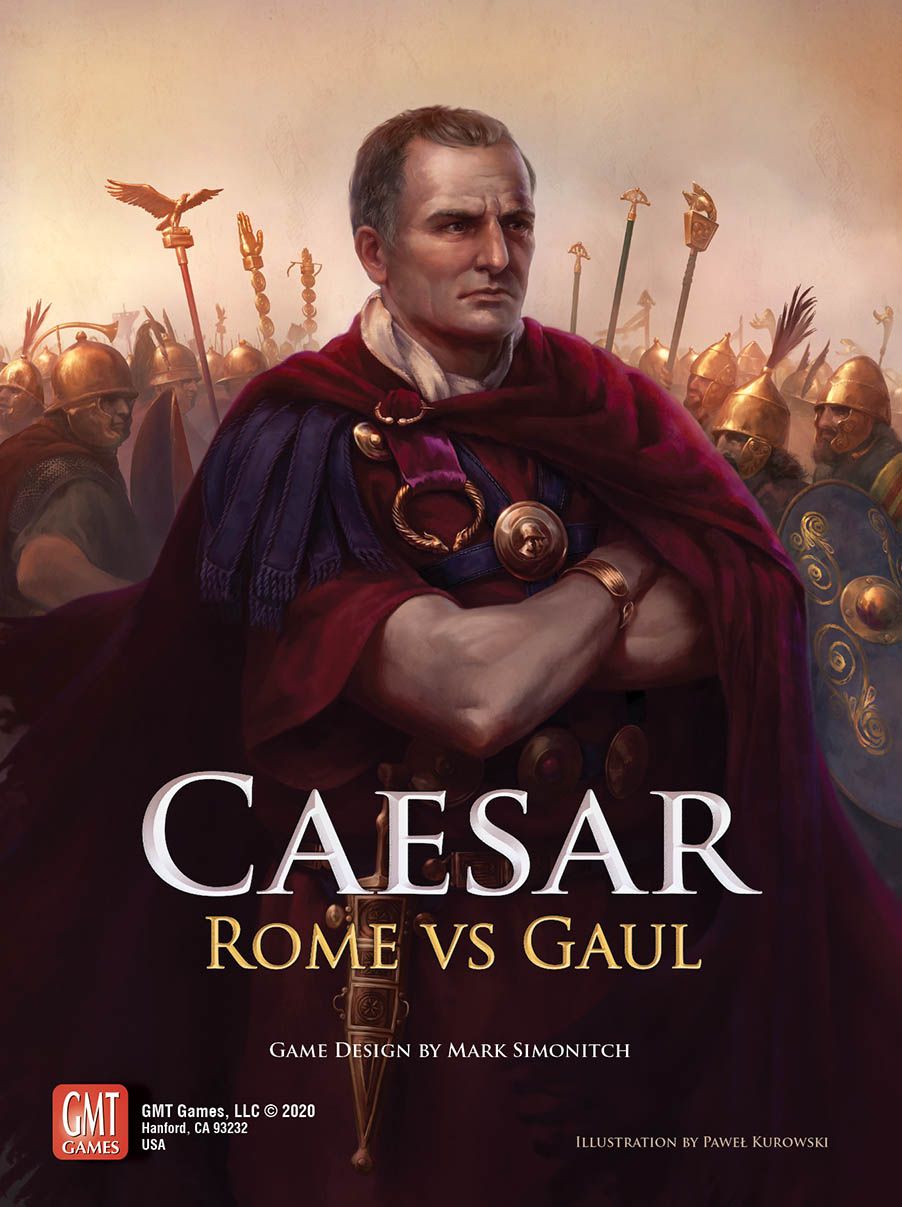
Caesar: Rome vs Gaul is a two-player game simulating Caesar's Roman conquest of Gaul from 57 to 52 BC. One player commands the Roman forces under Caesar, and the other controls the Gallic tribes. The Roman player wins by accumulating Victory Points through governance, subjugating key strongholds, invading Germania and Britannia, and eliminating tribes, or by achieving an automatic victory during the Political Segment. The Gallic player wins if Rome falls short of the required Victory Points or Rome's governance collapses.
Spielaufbau
Roman setup: Place a Roman Influence marker in each Town of the Aedui and Sequani Provinces, Burdigala, and each Town in Provincia. Place the Walled City markers on their Roman side in the three Walled Cities of Provincia. Place Caesar, the Elite X Legion, and five Legions in one Town of the Aedui Province. Place the XIII and XIV Legions in Vienne. Place the V and VI Legions on Turn 5 of the Turn Track. Put the six Legates in an opaque container, draw two, and place one with Caesar and one in Vienne.
Gallic setup: Place the nine Gallic Stronghold markers on the nine Stronghold spaces. Place Gallic Influence markers in the four starred Towns of Germania and Britannia. Set the remaining Control markers aside. Place the Aedui Tribe in its Holding Box, the reduced Sequani Tribe in the Submitted Tribes Box, the Arverni Tribe in the Gallic Council Box, and the German Tribe in its Holding Box. Put the other 20 Tribes in an opaque cup as the Tribe Pool. Gallic Tribes do not start on the map. Place Ambiorix on Turn 4 and Vercingetorix on Turn 5 of the Turn Track.
Other: Place the Gallic Minor Tribe, Militia, German Cavalry, and two Gallic Mercenary markers in their Holding Boxes. Place the Turn Marker on Turn 1, the Naval Supremacy markers Gallic side up, and the Britannia, Germania, and Caesar's Pass VP markers in their Holding Boxes. Place the six Governance markers below the Turn Track and set the Siege markers aside. Shuffle the 55-card Strategy Deck and place it within reach of both players.
Ein Spielzug
Each game turn follows a fixed sequence:
- Reinforcement Phase: Gallic reinforcements arrive (three random Tribes from the Tribe Pool, each placed with a Fortified Town, sent to the Gallic Council Box, or reduced and sent to the Submitted Tribes Box). From Turn 2 the Roman player receives replacements and reinforcements, places Caesar (on Turns 2–6, a die roll of 1 delays him to the start of the Roman player's second card play), and draws Legates. Both players are then dealt eight cards.
- Gallic Spring Muster: All Gallic Tribes and Leaders may move up to 3 MPs with no Action Points. They may not remove Influence markers, besiege, enter a space with a Roman CU or the German Tribe, end in a Roman-controlled space, enter a space where they could be intercepted, or enter Germania or Britannia.
- Strategy Phase: Players alternate playing one card at a time, with the Gallic player going first unless the Roman player plays the Winter Campaign event. There are eight rounds. In each round the active player places a card face up, uses its Event, Bonus, or Action Points, and then Supply is checked for Out-of-Supply units, which suffer Attrition. Each Action Point allows one action such as moving a Leader or CU, placing an Influence marker, or converting an enemy one. Actions must be completed one at a time, and each Leader or CU can move only once per card play.
- Winter Phase: Sieges end, Mercenaries are removed, and Tribes return to their Fortified Towns. Leaders are relocated, and Caesar returns to Rome. The Roman player marches Legions to winter camp, and Roman Legions may suffer Winter Attrition depending on the forage level of their space. Isolated Influence markers are removed. The Political Segment scores Governance Victory Points and checks for victory. At the End of Winter, Devastation markers are removed, Roman Influence markers are placed in spaces with Legions and no other Control marker, and Fading Promises are resolved.
- End Turn: Reshuffle the Strategy Deck after Turn 3, end the game after Turn 6, and otherwise advance the Turn marker.
Spielende
The game ends immediately if an Automatic Victory occurs during the Political Segment. The Gallic player wins at once if the Roman player's Governance points total 3 or less. The Roman player wins at once if no Fortified Towns are on the map and the Roman player controls the majority of the Provinces in Belgica (5), Celtica (7), and Aquitania (1), and all of Provincia (3).
Otherwise, the game ends after Turn 6, when End Game Victory is determined.
Wertung
Governance: During the Political Segment, the Roman player adds Governance points for Dominance or Presence in Celtica, Belgica, and Aquitania, then subtracts points for Gallic control of Provincia's Volcae, Allobroges, and Narbonensis. A total of 9 or 10 earns 2 VP, 7 or 8 earns 1 VP, 4 to 6 earns nothing, and 3 or less is an automatic Gallic win.
End-game VP: The Roman player earns 1 VP for opening Caesar's Pass by subjugating Octodurus, 1 VP for every four Tribes in the Eliminated Box (fractions ignored), 2 VP for a successful invasion of Germania, and 2 VP for a successful invasion of Britannia. Tribes in the Submitted Box and the two Gallic Leaders do not count.
At the end of Turn 6, the Roman player wins with at least 12 VP. Otherwise the Gallic player wins. The rulebook gives no separate tie-breaker, since the Roman player must reach 12 VP to win.
Änderungen
- Wertung, von dem Entwurf aus der Anleitung, 22. November 2026
- Spielende, von dem Entwurf aus der Anleitung, 22. November 2026
- Ein Spielzug, von dem Entwurf aus der Anleitung, 22. November 2026
- Spielaufbau, von dem Entwurf aus der Anleitung, 22. November 2026
- Überblick, von dem Entwurf aus der Anleitung, 22. November 2026
- Wertung, von dem Entwurf aus der Anleitung, 22. November 2026 (wird jetzt angezeigt)
- Spielende, von dem Entwurf aus der Anleitung, 22. November 2026 (wird jetzt angezeigt)
- Ein Spielzug, von dem Entwurf aus der Anleitung, 22. November 2026 (wird jetzt angezeigt)
- Spielaufbau, von dem Entwurf aus der Anleitung, 22. November 2026 (wird jetzt angezeigt)
- Überblick, von dem Entwurf aus der Anleitung, 22. November 2026 (wird jetzt angezeigt)