Regeln von Carcassonne: Gold Rush
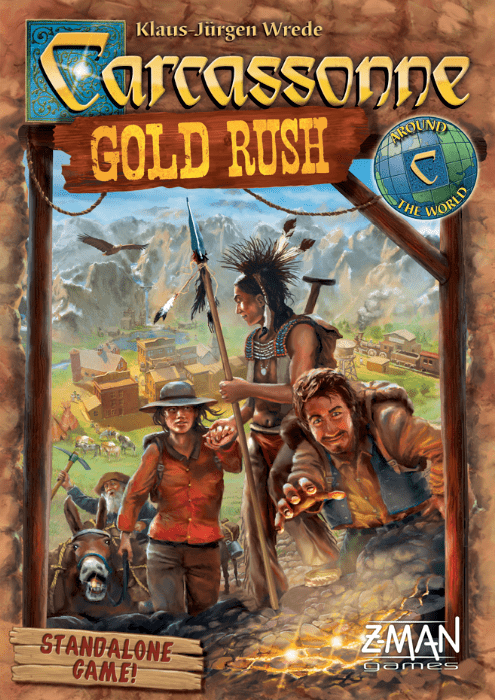
Überblick
A tile-laying game set in a Wild West gold rush for 2 to 5 players. Players take turns adding land tiles to build prairies, mountains, cities and railroads, then place cowboys, tents and Mining tokens to score points. When the last Land tile is placed and final scoring is done, the player with the most points wins.
Spielaufbau
Place the start tile in the middle of the table and put one Mining token facedown on its mountain. Shuffle the other Land tiles into several facedown piles within reach. Set the remaining Mining tokens facedown nearby, ideally with one player handling them. Each player takes 5 cowboys and 1 tent in their color and places one cowboy on space 0 of the scoreboard. The youngest player starts, and play goes clockwise.
Ein Spielzug
On your turn, take these steps in order.
- Draw a Land tile and place it so it touches at least one existing tile by a full edge, not just a corner. Railroads, mountains and prairies must continue across every shared edge. If a drawn tile cannot be legally placed, discard it and draw another. Each mountain segment placed gets Mining tokens equal to its gold nugget symbols.
2. Take at most one of these actions, or none:
- Place one cowboy from your supply on the new tile, on a feature that no other cowboy occupies. Cowboys on prairies become farmers and stay until the end of the game.
- Place or move your tent onto a vacant mountain segment of an incomplete mountain. Tents may share a mountain with cowboys.
- Take the topmost Mining token from a mountain where your tent sits. Keep it facedown; its value counts only at the end.
- Score any railroads, mountains or cities this tile completed. Then play passes to the next player.
Spielende
The game ends immediately after the turn in which the last Land tile is placed. Players then carry out final scoring.
Wertung
During play, when a feature is completed, it is scored and its cowboys return to their owners' supplies.
- Railroad: the player whose railwayman alone occupies it scores 1 point per tile. A railroad with exactly one locomotive scores double. Two or more locomotives do not double it.
- City: the player whose merchant occupies it scores 3 points for each completed railroad connected to it.
- Mountain: the player with the most gold miners takes all remaining Mining tokens there, then scores 1 point per gold nugget symbol. Tents have no effect on this. On a tie, the tied players share the tokens in turn, starting clockwise from the current player, and all of them score full points.
If several cowboys share a completed feature, the player with the most cowboys scores it alone, and ties score in full for everyone tied.
Final scoring then covers the following.
- Incomplete features: railroads score 1 point per tile (locomotives do not count). Cities score 3 points per connected completed railroad. Mountains are scored by majority with 1 point per gold nugget, after all tents and Mining tokens are removed.
- Prairies: each prairie is worth 2 points per tipi camp and 4 points per herd of wild horses on it. The player with the most farmers there scores that value. Ties score in full for each tied player.
- Mining tokens: flip them over and score 1 point per gold nugget. Gravel scores nothing.
Track points on the scoreboard, which runs 0 to 49. When you pass 50, lay your cowboy flat to show a completed lap. The player with the most points wins. If there is a tie, the tied players settle it with a staring contest, and the last one to blink wins.
Varianten
The rulebook suggests that a first game be played without farmers and prairie scoring, which simplifies the game. It gives no other variants, such as solo or team play.
Änderungen
- Varianten, von dem Entwurf aus der Anleitung, 23. November 2026 (wird jetzt angezeigt)
- Wertung, von dem Entwurf aus der Anleitung, 23. November 2026 (wird jetzt angezeigt)
- Spielende, von dem Entwurf aus der Anleitung, 23. November 2026 (wird jetzt angezeigt)
- Ein Spielzug, von dem Entwurf aus der Anleitung, 23. November 2026 (wird jetzt angezeigt)
- Spielaufbau, von dem Entwurf aus der Anleitung, 23. November 2026 (wird jetzt angezeigt)
- Überblick, von dem Entwurf aus der Anleitung, 23. November 2026 (wird jetzt angezeigt)