Regeln von Carolus Magnus
Überblick
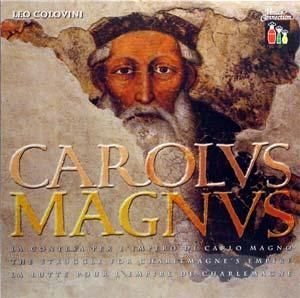
Players compete to build castles in the territories of an empire, using paladin cubes of five colors and numbered discs that also control how far the Emperor moves. A player builds castles by controlling a majority of paladins in a territory where the Emperor stops. The game ends when a player has 10 castles in play, or when fewer than 4 territories remain, and the player with the most castles then wins.
Spielaufbau
- Arrange the 15 territory segments in a circle, leaving small gaps between them.
- Place the Emperor figure on one territory.
- Empty the paladin cube bag into the middle of the circle, then place the 5 clan markers there.
- Take 3 cubes of each color from the middle and place them randomly on the territories, one per territory.
- Each player chooses a color and takes 10 castles, 5 numbered discs in that color, and a court board.
- Each player rolls 3 dice twice and 1 die once to form a starting reserve of 7 paladins; a crown lets the player pick any color.
- Return unused equipment to the box.
Ein Spielzug
Each round has an Opening Phase followed by an Action Phase.
Opening Phase: Each player, in turn, plays one of his numbered discs face up inside the circle. The two discs must have different numbers. The lower number plays first in the action phase and sets the Emperor movement limit for that player. The first round's starting player is chosen by lot; afterward, the player who placed the lower number in the previous round starts. Discs are stacked so the latest is on top. After every fifth round, players retrieve their discs.
Action Phase: Players act in the order chosen. Each player performs three steps:
1. Play 3 paladins from his reserve, placing them in his court (next to the matching colored dots) or in territories, in any split he likes. Paladins played are in play and cannot be moved. A player controls a color if he has more paladins of that color in his court than his opponent; ties keep the previous controller. Controlling a color places the matching clan marker on his court.
2. Move the Emperor clockwise at least one step and no more than the number on the disc played. Each territory, or merged territory, counts as one step. Check control of the territory where the Emperor stops and build or take over a castle if the rules allow.
3. Roll the 3 dice and take paladins from the center matching the colors rolled, replacing those played. A crown lets the player choose any color. If a color runs out in the center, each player returns an equal number of that color from his court to the center.
Castles: A player builds a castle in a territory only if he controls a majority of paladins there and the Emperor stops there. Ties or uncontrolled territories get no castle. If a territory already has castles, castles count as paladins of their owner; if the majority changes, all castles there are replaced with the new majority holder's castles. A player does not add a castle to a territory that already has one. When a castle is built or taken in a territory adjacent to territories with castles of the same color, those territories merge into one larger territory, which is not rechecked for majority and counts as one step for movement.
Wertung
The winner is the player with the most castles in play in the territories when the game ends. The rulebook gives no separate tiebreak for this count.
Varianten
- Three players: each player uses 8 castles of each color, 4 dice, a court board, and a disc set in his color, with 3 courts and 3 disc sets. Each player starts with 9 paladins and plays 4 paladins per turn, replenishing 4 dice each turn. The goal is 8 castles. Majority checks require having more paladins than each of the other two players. Discs decide turn order, with the order of the next turn set by the numbers of the three discs.
- Four players in two partnerships: partners sit opposite or next to each other, sharing one set of castles and playing from their own courts with their own paladins. Partners use discs of the same color, and the gray castles and gray discs are removed. Color control is individual, but territory majorities compare the total paladins of each partnership. Partners may talk only if they agree before the game; a serious game forbids talking.
Änderungen
- Varianten, von dem Entwurf aus der Anleitung, 23. November 2026 (wird jetzt angezeigt)
- Wertung, von dem Entwurf aus der Anleitung, 23. November 2026 (wird jetzt angezeigt)
- Ein Spielzug, von dem Entwurf aus der Anleitung, 23. November 2026 (wird jetzt angezeigt)
- Spielaufbau, von dem Entwurf aus der Anleitung, 23. November 2026 (wird jetzt angezeigt)
- Überblick, von dem Entwurf aus der Anleitung, 23. November 2026 (wird jetzt angezeigt)