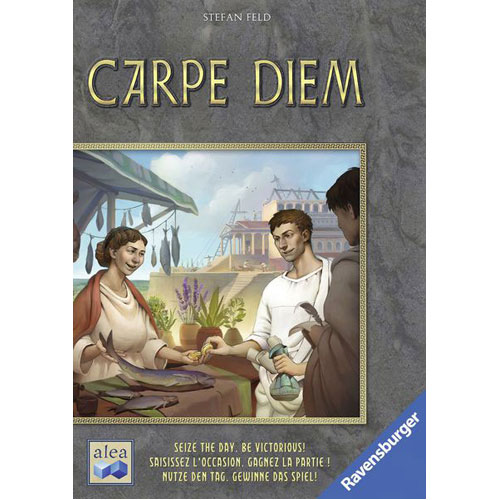
Regeln von Carpe Diem
Überblick
Players are wealthy builders in ancient Rome, adding building tiles to their own city district over four phases. Each phase ends with a scoring period, and a final scoring follows the fourth. The player with the most victory points at the end wins.
Spielaufbau
Each player receives 4 frame parts, which they assemble into a square, plus a building board placed inside the frame, 9 banderoles on the banderole spaces, an overview board, a patrician meeple, and 5 discs in their color.
Place the game board in the center. Put one meeple on an unoccupied semi-circular space. Place 1 disc on the banderole bar and 4 on your storage space.
Shuffle the 60 scoring cards by back letter and deal a number of each type based on player count (8, 10, or 12 cards total). Place them face up on the card spaces on the game board. Return unused cards to the box.
Shuffle the fountain cards into a face down pile. Sort the victory point cards by value into five piles. Shuffle the light and dark green building tiles into separate face down piles. Place 4 random light green tiles on each large blueprint space (28 tiles, all face up), and 1 random dark green tile on each seal space (all face up). Set out wares, coins, and bread tokens.
The player born farthest from 1 B.C. takes the starting player token and places a disc on the 0 space of the banderole bar. Others follow clockwise, stacking discs on top. Each player also takes victory point cards as a starting bonus: the starting player 8 points, then 9, 10, and 11 for the others in turn order (in a 3-player game the values are 8, 9, and 13).
Ein Spielzug
On your turn, move your meeple to one of the two opposite semi-circular spaces connected to its current space by a black line. Meeples may share spaces, but they must move every turn. If the space you land on has no tile next to it, you keep moving until you reach one that does.
Then pick one tile from the blueprint space next to your meeple. Integrate it into your district if you can. Otherwise place it face down on your storage space, where it stays until the end of the game.
Placement rules:
- The first tile goes on the shovel space. Later tiles must touch an existing tile orthogonally, not diagonally.
- All touching sides must match (pond to pond, grass to grass, and so on). The frame counts as grass.
- Tiles can be rotated freely.
- If a tile lands on a banderole space, remove that banderole from the game and move your disc one space up the banderole bar.
Completing a dwelling or landscape usually gives a reward. Placing a market gives a coin, a bakery gives a bread, and a fountain lets you look at the top two fountain cards and keep one.
Optional bread use: At the start of your turn, you may pay one bread to move your meeple to any space and pick from there.
Spielende
The game has four phases of seven rounds each. Each phase ends with a scoring period, and after the fourth, a final scoring period ends the game.
At the end of each phase, players score in order of their progress on the banderole bar. Each player places one disc on an empty circle space to trigger the two adjacent scoring cards. Phases two and three use the light green tiles, and phase four uses the dark green tiles. The starting token passes to the left after each phase.
Wertung
Each scoring card is either green (you must own what it shows) or red (you must pay what it shows, with coins or 3 bread able to replace wares). If you meet a requirement several times over, you get the reward that many times. A card's requirement is met with bread, as shown on each card.
If you cannot fully meet a scoring card's requirement, you gain no points for it and instead lose 4 victory points.
During a scoring period, the rewards are as follows:
- Cards A and B: pay wares for victory points.
- Cards C: depend on chimneys and completed villas.
- Cards D: depend on landscapes, dwellings, markets, bakeries, and fountains.
Final scoring:
- Completed villas: points based on the chimneys in each completed villa. Incomplete villas are ignored.
- Remaining items: wares, coins, bread, and unplaced building tiles on your storage space, divided by 2 and rounded down.
- Banderole bar: points for the space your disc occupies.
- Fountain cards: points based on your achievements. Both cards count if you hold two of the same type.
- Frame achievements: each frame part has two goals. A goal is met when a line from the golden arrow crosses at least one completed building or landscape of that type.
If players are tied on victory points, the tied player furthest along the banderole bar wins.
Varianten
The rulebook has no solo or team variant. It does give rules for different player counts:
- 2 players: 8 scoring cards and 9 spaces for scoring discs. The last two building tiles are removed from a space once the second-to-last has been picked.
- 3 players: 10 scoring cards and 13 spaces for scoring discs. The last building tile on a space is removed once the penultimate tile has been picked. Starting victory points are 8, 9, and 13.
- 4 players: 12 scoring cards and 17 spaces for scoring discs. Starting victory points are 8, 9, 10, and 11.
Änderungen
- Varianten, von dem Entwurf aus der Anleitung, 22. November 2026 (wird jetzt angezeigt)
- Wertung, von dem Entwurf aus der Anleitung, 22. November 2026 (wird jetzt angezeigt)
- Spielende, von dem Entwurf aus der Anleitung, 22. November 2026 (wird jetzt angezeigt)
- Ein Spielzug, von dem Entwurf aus der Anleitung, 22. November 2026 (wird jetzt angezeigt)
- Spielaufbau, von dem Entwurf aus der Anleitung, 22. November 2026 (wird jetzt angezeigt)
- Überblick, von dem Entwurf aus der Anleitung, 22. November 2026 (wird jetzt angezeigt)