Regeln von Churchill
Überblick
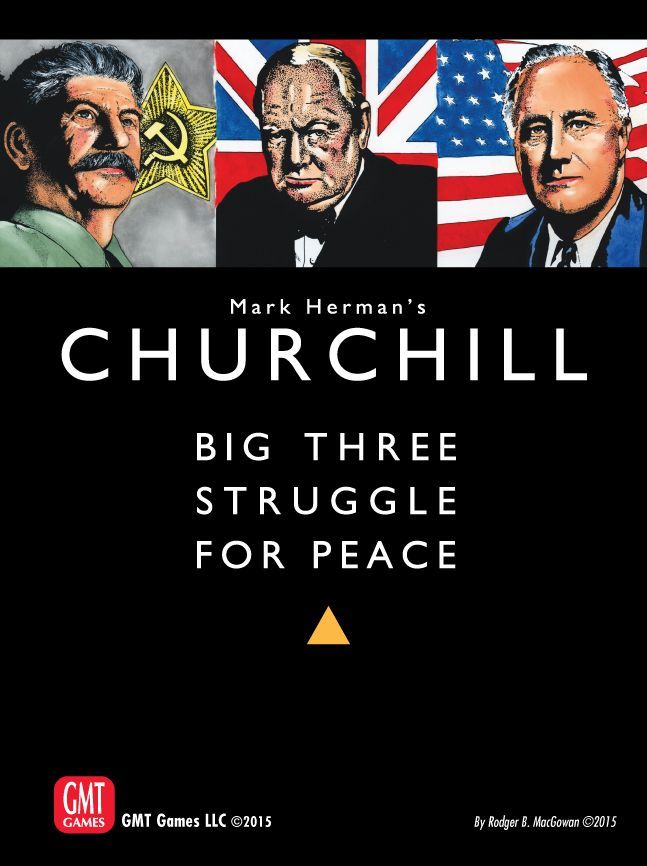
Churchill is a one-to-three player game in which each player takes one of the Big Three Allied leaders (Churchill, Roosevelt, or Stalin) and tries to steer the end of World War II to their nation's advantage. Play is a series of conferences where players nominate, advance, and debate issues, while also competing for influence in countries and colonies. The game ends when both Axis powers surrender or after the tenth conference, and the player with the most victory points wins, subject to end-game adjustments.
Spielaufbau
Choose a scenario (training, tournament, or campaign) and build the conference deck by picking one random copy of each conference in that scenario, starting from the last conference and working backward. Place the Front, naval support, Clandestine Network, Political Alignment, and other markers as the chosen scenario lists. Each player takes their Leader card and staff deck, and Global Issue markers start in the neutral position.
Ein Spielzug
Each conference has three phases: Conference, War, and Post-Mortem.
Conference phase:
- Agenda Segment: Reveal the top conference card and carry out its instructions. Each player secretly plays one staff card; the highest value wins the segment and chooses the first issue, then players take turns nominating issues until seven are on the table.
- Meeting Segment: Starting left of the Agenda winner, players play a staff card to advance an issue toward their chair, and other players may debate it by moving it back toward the center. Play continues until all staff cards are used.
- Decision Segment: Players resolve won issues in order: Directed Offensives, conditional issues, production, production allocation, theater leadership, A-Bomb research, and the Global Issue.
War phase: Players place Clandestine Networks, then Political Alignment markers, then Axis reserves are deployed and each Front attempts to advance by rolling a ten-sided die.
Spielende
The game ends when both Germany and Japan have surrendered, or at the conclusion of the tenth conference (Potsdam), whichever comes first. Final victory points are then tallied and end-game conditions are applied to decide the winner.
Wertung
Victory points are earned from Political Alignment markers in countries and colonies, Clandestine Networks in countries without Political Alignment markers, Global Issues in a player's advantage position, conference victory markers, Axis surrender and Front positions, theater and Pacific objectives, and A-Bomb status. The scoring track may optionally track points during play.
At the end of the game, if the Axis have both surrendered and the score spread is 15 or less, the highest score wins. If the spread is greater, a die roll (added to 15) decides whether the leader or second-place player wins. If an Axis power remains unsurrendered, each player rolls a die to adjust their score, and the highest adjusted score wins.
Ties for the lead are broken by the US A-Bomb at Trinity, then the Soviet tank in Germany, and otherwise Churchill wins. Ties during conferences are broken by a Leader card played first, then by the US national characteristic.
Varianten
Training, tournament, and campaign scenarios differ in starting conference, number of conferences, and setup. Tournament scoring changes the final adjustments: the second-place player wins if the score spread exceeds 15, and in the unsurrendered case five points are subtracted from the first-place player.
Secret Agenda variant: each player secretly draws three Secret Agenda markers, which are revealed before final scoring to award five points per matching Political Alignment marker.
Solitaire and two-player play: the game can be played alone or with fewer players using 'Bot decision charts that control the non-human sides, with human judgment used for situations the charts do not cover.
Änderungen
- Varianten, von dem Entwurf aus der Anleitung, 22. November 2026
- Wertung, von dem Entwurf aus der Anleitung, 22. November 2026
- Spielende, von dem Entwurf aus der Anleitung, 22. November 2026
- Ein Spielzug, von dem Entwurf aus der Anleitung, 22. November 2026
- Spielaufbau, von dem Entwurf aus der Anleitung, 22. November 2026
- Überblick, von dem Entwurf aus der Anleitung, 22. November 2026
- Varianten, von dem Entwurf aus der Anleitung, 22. November 2026 (wird jetzt angezeigt)
- Wertung, von dem Entwurf aus der Anleitung, 22. November 2026 (wird jetzt angezeigt)
- Spielende, von dem Entwurf aus der Anleitung, 22. November 2026 (wird jetzt angezeigt)
- Ein Spielzug, von dem Entwurf aus der Anleitung, 22. November 2026 (wird jetzt angezeigt)
- Spielaufbau, von dem Entwurf aus der Anleitung, 22. November 2026 (wird jetzt angezeigt)
- Überblick, von dem Entwurf aus der Anleitung, 22. November 2026 (wird jetzt angezeigt)