Regeln von Fief: France 1429
Überblick
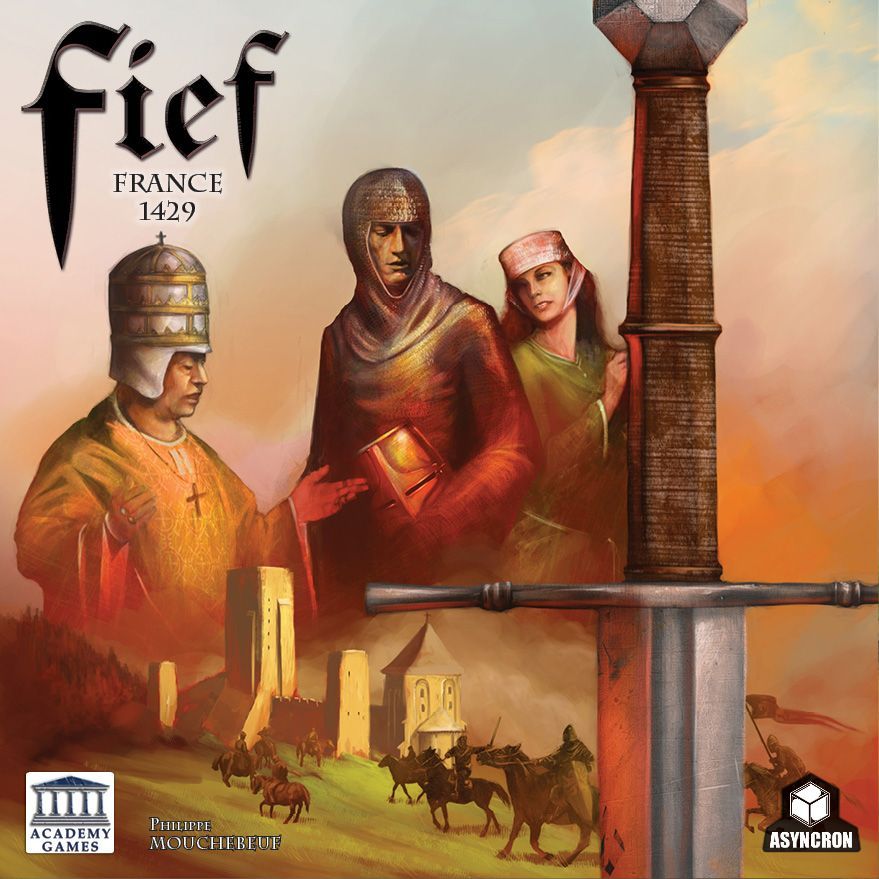
Fief (France 1429) is a game of diplomacy in which each player leads a noble family competing to control Fiefs and gain Titles such as Fief Titles, Bishop, Pope and King. A player wins alone by reaching 3 Victory Points (VP) at the end of a round. Two players allied through marriage can instead win together with 4 VP, but only in games of four or more players.
Spielaufbau
Place the board in a central spot. Shuffle the Fortune and Disaster cards into one deck and the Lord cards into another. Each player draws a Lord card, returning any Cardinal or d'Arc card to the deck and drawing again, then takes the matching Lord token. Each player takes the counters of one colour: 8 Knights, 13 Men at Arms, 2 Siege Engines, 3 Diplomacy markers, 2 Vote markers, 3 Tax markers and 1 Marriage marker. Each player starts with 5 Deniers, 1 Knight, 3 Men at Arms and 1 Stronghold. Place the Cardinal Biretta counters, the purchasable Cardinal counter, the d'Arc counter, the Fief and Bishop Title counters, and the King, Queen, Pope and Crown Prince counters on their spaces. Keep Lord tokens, Strongholds, Mills, markers and Deniers within easy reach. The starting player takes the First Player card and chooses a starting Village, where he places his Knight, Men at Arms, Stronghold and Lord token. The other players do the same in clockwise order, each in any unoccupied Village. The starting player then begins the first round.
Ein Spielzug
The game is played in rounds of seven phases, with each player acting in clockwise order within each phase. 1. Hear Ye: announce marriage alliances, then hold elections for Bishops, the Pope and the King, in that order. 2. Draw and Play Cards: players may discard and draw, either up to two Fortune cards or one Lord and one Fortune card, and may never draw two Lords. A hand holds at most 3 cards. Drawn Disasters are placed on the Disaster track and resolved afterwards. Players then play Lord and Fortune cards from their hands. 3. Income: collect simultaneously. Each player gets 1 Denier per Village controlled and 2 per Mill, plus bonuses from Bountiful Harvest and Good Weather. Tallage and Tithe taxes pay out as listed in the rules, and the Queen collects 2 Deniers. Then all Tax markers and Fortune cards on the map are removed. 4. Purchase: buy Men at Arms (1 Denier), Knights (3), Mills (3), Strongholds (10), Fief Titles (2 Deniers per Village in the Fief) and the purchasable Cardinal Title (5). Ransoms are paid first. Up to four new Troops may be added to each Village. 5. Movement: each Lord may move up to two Villages, and Troops may only move when carried by a Lord. Moving through an enemy Village requires permission, or a Cavalcade battle. 6. Battles: wherever opposing Troops share a Village, the players may fight. Each Men at Arms gives 1 Strength Point, each Knight 3, and each male or titled female Lord 1. Strength Points set the Battle Dice (1 die for 1 to 6 points, 2 for 7 to 12, 3 for 13 or more). Battles repeat until one side is gone, surrenders, or a truce is declared, and sieges and pillaging may also occur here. 7. End Round: remove Disaster cards, check for winners, and if there is none, pass the First Player card to the left.
Spielende
The game ends at the end of a round in which a player has 3 VP alone, or an allied pair has 4 VP together. If no winner is found, the First Player card passes to the left and a new round starts.
Wertung
Victory points are earned at the end of each round. A player gets 1 VP for each Fief Title he controls, 1 VP for holding the King title, and 1 VP for holding the Pope title. The Queen and Queen Regent earn no VP. A solo win always beats an alliance win. If players are tied, the tie is broken in this order: the King title, the Pope title, the Queen Regent title, the most Fiefs controlled, the most Bishoprics, and then the most Villages.
Varianten
The rulebook offers three optional rules. Holy Relics: five relics are placed on the Principal Villages of the Bishoprics, and only ecclesiastical Lords can take them. Each relic gives a special bonus, and the rulebook suggests not using them in a new player's first game. Fog of War: Troop counters are placed face down and revealed only when a battle begins, and players announce what they buy but not where they place it. The rulebook recommends this only for experienced players. Open Diplomacy: Diplomacy markers are removed, so players may trade Deniers and cards and hold private talks freely. The rulebook warns that this can lengthen the game. The rulebook also states that in 3-player games, marriage is allowed but only solo victory is possible.
Änderungen
- Varianten, von dem Entwurf aus der Anleitung, 22. November 2026 (wird jetzt angezeigt)
- Wertung, von dem Entwurf aus der Anleitung, 22. November 2026 (wird jetzt angezeigt)
- Spielende, von dem Entwurf aus der Anleitung, 22. November 2026 (wird jetzt angezeigt)
- Ein Spielzug, von dem Entwurf aus der Anleitung, 22. November 2026 (wird jetzt angezeigt)
- Spielaufbau, von dem Entwurf aus der Anleitung, 22. November 2026 (wird jetzt angezeigt)
- Überblick, von dem Entwurf aus der Anleitung, 22. November 2026 (wird jetzt angezeigt)