Regeln von Arler Erde
Überblick
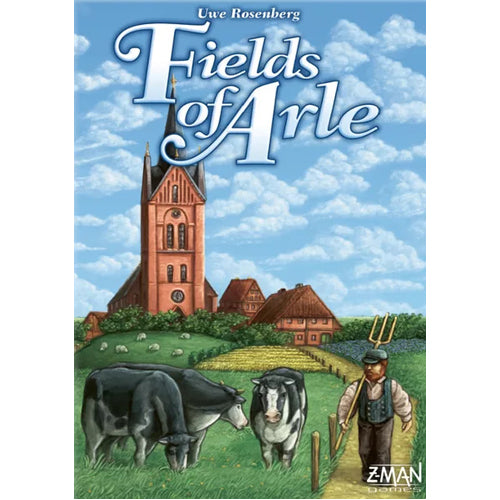
Fields of Arle is a development game for 1-2 players set in the East Frisian village of Arle. Over nine half years, alternating summer and winter, players place Workers on action spaces to farm, breed animals, cut peat, dike land, collect goods, and build prestigious buildings. The player with the most Victory Points (VP) at the end wins.
Spielaufbau
Place the Supply Board between the players and fill its spaces with the indicated tiles, or stack them nearby if the table is small. Place the large Game Board next to it and put the orange Half Year Counter on space 1 of the Half Year Track. Each player chooses a color, takes the round Tool Indicators in that color, and places one on the leftmost space of each of the 10 Tool Tracks. Randomly choose a Starting Player, who takes the Starting Player Marker. Place one Worker of each color on each Month Space from July to October, with the Starting Player's Workers on top. Distribute the Buildings to the matching colored spaces on the Game Board. In 3 of the 5 building colors there are 3 extra Buildings, so randomly remove 3 from each of those colors. For the first game, use the 4 light green small houses; later, choose 4 of the 7 dark green ones. Each player takes a Home Board, places the indicated tiles, 1 Horse, 4 Peat Tokens and 6 Goods Indicators on it, and receives a Travel Destinations and Barn Storage Board with the Travel Destinations in their color placed on the matching spaces. Each player also receives an Overview Sheet, 4 Wood, 4 Clay and 3 Peat for their personal supply. Sort the remaining Wood, Timber, Clay, Bricks, Animal and Peat tokens within reach. The Scoring Pad is needed only at the end.
Ein Spielzug
Each Half Year has three phases. In Phase 1, Preparations, Workers are placed on the four Month Spaces, with the Starting Player's Workers on top. In Phase 2, Work Phase, players alternate placing Workers on empty action spaces of the current half year, taking Workers from the Month Spaces from left to right; in each month the Starting Player goes first. Summer action spaces are used in odd-numbered half years and winter action spaces in even-numbered ones, with 15 action spaces available per half year. After placing a Worker, carry out that action immediately. An occupied space stays blocked until the Work Phase ends. A player may also skip by removing a Worker without acting. The Laborer lets a player imitate an occupied action space. Spaces showing costs must be paid to use them, or to build the Building beneath them or move a Tool Indicator one space right. Timber can replace Wood and Bricks can replace Clay in any payment. Special Action: once per half year, one of the 8 Workers may use an action space from the other season; the opponent then becomes Starting Player for the next half year. If no one uses it, the Starting Player Marker changes hands automatically. At any time during the Work Phase, players may load Vehicles, rearrange Animals on the Home Board, and, with a Peat Boat, exchange Peat for goods at 1:1. The Work Phase ends once all 8 Workers are used and both players declare it over. In Phase 3, Inventorying, players take stock in November (after summer) and May (after winter). In November, empty the Vehicles, move Travel Destination tiles onto the Travel Experience Track, resolve Milking for Food from Sheep and Cattle (max 6 Food), Harvest Grain, Flax and Wood, then Sustenance: pay 3 Food and 2 Peat, substituting Grain, Animals, Wood or Timber for missing items. In May, empty the Vehicles and move Travel Destinations, resolve Baby Animals in pairs of Stalls and Stables, Sheering for Wool, then Sustenance paying 3 Food with substitutes. Missing items cost 2 VP each, recorded in the Supply Bottlenecks category. At the end of each half year, move the Half Year Counter forward.
Spielende
The game lasts nine half years. It ends after the November Inventorying at the end of the last summer half year. Animals do not breed in that final November. Each player may then use a Peat Boat, if they have one, to exchange their remaining Peat for goods on the Goods Track. Then players score their VP.
Wertung
Score each category on the Scoring Pad. Goods tiles: Bricks, Linen, Woolen and Leather are worth 1 VP each, Summer, Winter and Leather Wear 2 VP each, and Timber half a VP each; do not round the total. Equipment and Vehicles: add their VP, then subtract 3 unless you have at least one Large Vehicle in your Barn. Travel Experience: the first empty space from the bottom of the track shows your VP, up to 10. Tools: add the VP shown on your Tool Tracks. Goods Track: a Goods Indicator on space 15 is worth 3 VP, on spaces 11-14 2 VP, and on spaces 7-10 1 VP; you may split your Food between the two Food Indicators to optimize this. A Depot doubles this category once, regardless of how many you have. Home Board: add VP from Buildings, Stalls, Stables, Forests and Parks, then subtract 4 VP per hydrated Moor Section, 1 VP per dehydrated Moor Section, and 1 VP per top-row Tidal Flat Space left on the Home Board. Dikes may cover the negative VP in the Tidal Flat Area. Animals: the type you have the least of is worth 2 VP per Animal, the second least 1 VP per Animal, and the third type 0 VP. Animals used to pay for Plows or Vehicles do not count. Supply Bottlenecks were tracked during the game and are not scored again. The player with the most VP wins. In a tie, the Starting Player of a hypothetical tenth half year breaks it, meaning the player who would start the next round.
Varianten
Solo game: there is no Special Action, and a player cannot use an action space from the other season. Otherwise, place your Workers one by one and try to score as many points as possible. The rulebook calls 110 VP a remarkable solo score. For experienced players, the rulebook suggests using 4 of the 7 dark green small houses instead of the light green ones.
Änderungen
- Varianten, von dem Entwurf aus der Anleitung, 22. November 2026 (wird jetzt angezeigt)
- Wertung, von dem Entwurf aus der Anleitung, 22. November 2026 (wird jetzt angezeigt)
- Spielende, von dem Entwurf aus der Anleitung, 22. November 2026 (wird jetzt angezeigt)
- Ein Spielzug, von dem Entwurf aus der Anleitung, 22. November 2026 (wird jetzt angezeigt)
- Spielaufbau, von dem Entwurf aus der Anleitung, 22. November 2026 (wird jetzt angezeigt)
- Überblick, von dem Entwurf aus der Anleitung, 22. November 2026 (wird jetzt angezeigt)