Regeln von First Train to Nuremberg
Überblick
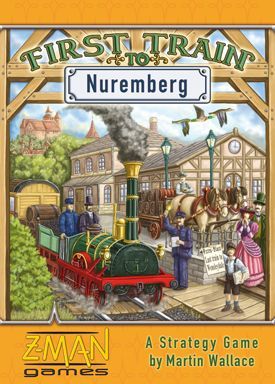
A railway-building game for two to four players in which each player is a railway promoter. You build track, lay out a network, and earn victory points by moving passengers and goods, while managing influence with two rival companies, the government, and engine works. The game ends after four or five turns, and the player with the most victory points after final adjustments wins.
Ein Spielzug
A turn has ten phases.
- Investment cubes: Each player takes up to twelve cubes from their stock. A player may hold at most fifteen, and unspent cubes are kept.
- Influence points: Influence tokens are placed in the influence boxes. With three or four players all tokens go into the bag. With two or three players, a reduced set is used. One token is drawn for each box and added to the fixed points already printed there.
- Auction: In player order, each player bids cubes on one box, until everyone has bids in two boxes or no more bids are possible. A bid must exceed any cubes already in that box, and an outbid player's cubes are returned. Minimum bids are three cubes in the top row and two in the lower row. Points are then taken in box-number order and recorded on the influence tracks, with stacking rules for tokens.
- Player order: Turn order for building track is set by government influence. Turn order for buying trains and transporting is set by train influence. Ties go to the player higher in the stack.
- Build track: In turn order, each player builds one unbroken series of links with no forks at the time of building, starting from a red or green town, or from an area already connected to the player's network. Links cannot enter or leave hill or hop areas, and cannot be built into The South. Each link crosses one border, and only one link may cross a given border. Building costs build points, paid with cubes first and then influence points at 1:1 only if cubes run short. Each link into or out of a company town also costs one influence point of that company's colour.
- Buy trains and move goods/passengers: In turn order, each player takes one action: buy a train, transport one good or passenger, or pass. Trains cost train influence points according to their row. A player may own at most one train per category, and each train can be bought by only one player. Passengers must be carried to a town of the matching company, and goods are moved by connecting to the right area. Pieces that cannot be legally moved are removed from the board. The phase ends when all players pass.
- Victory points and profit/loss: Players score victory points for transported goods and passengers and record profit or loss. Players then remove their cargo and trains, keeping the cargo for the end-game set bonus.
- Player order: Turn order is reset by position on the profit and loss track.
- Takeovers: In player order, each player may sell one unforked series of their links to the red or green company. Each influence point spent in that company lets it take over up to two links. The series must start and end at towns of the appropriate colour.
- End of turn: The turn marker advances. The game ends after the final space on the turn track. Otherwise, influence tokens still in the boxes return to the bag and a new turn begins.
Spielende
The game ends once the turn marker reaches the final space of the Turn Track. This happens after four or five turns, depending on the number of players.
Wertung
Final victory points are calculated as follows:
- Add the victory points earned during the game for transported goods and passengers.
- Add 2 VP for each complete set held. A set is one stone or beer, one cheese or post, one red passenger, and one green passenger.
- Add the current profit, or subtract the current loss, shown on the profit and loss track.
- Subtract 1 VP for each of your own track links still on the board.
The player with the highest total wins. A tie is broken in favour of the tied player higher on the profit and loss track.
During the game, transported goods are worth 1 VP each, or 2 VP for stone or beer on some boards. On the three- to four-player board, each passenger is worth 1 VP. On the two- to three-player board, each passenger is worth the train-influence cost of the train it travels on, i.e. 1 to 3 VP. The first connection between Nuremberg and Fürth grants 1 VP per contributing link to each player who helps make it, using the shortest route, with forks shared by all players involved. Links belonging to the red or green company do not score.
Profit per turn is earned from cheese or post (+1), passengers (+1), and stone or beer (+2). Each of your own links on the board costs 1. Profit is capped at +5 and losses are capped at -13.
Varianten
The rulebook gives these options:
- Player count: Different influence token setups and board sides are used for two-to-three and three-to-four players. The two-to-three player side includes passenger class scoring, and the three-to-four player side does not.
- Map: The Nuremberg map adds goods types, the Nuremberg-Fürth bonus, and river crossings. The original Wensleydale map is printed on the reverse of the board, with some rule changes, including the building cost between lowland and valley areas.
- Expanded South: On either map, players may optionally open the dark red extension of The South, which gives more players access to that part of the map.
The rulebook also mentions a short-rules summary and a setup supplement, but their content is not included in this text.
Änderungen
- Varianten, von dem Entwurf aus der Anleitung, 23. November 2026 (wird jetzt angezeigt)
- Wertung, von dem Entwurf aus der Anleitung, 23. November 2026 (wird jetzt angezeigt)
- Spielende, von dem Entwurf aus der Anleitung, 23. November 2026 (wird jetzt angezeigt)
- Ein Spielzug, von dem Entwurf aus der Anleitung, 23. November 2026 (wird jetzt angezeigt)
- Überblick, von dem Entwurf aus der Anleitung, 23. November 2026 (wird jetzt angezeigt)