Regeln von Kanagawa
Überblick
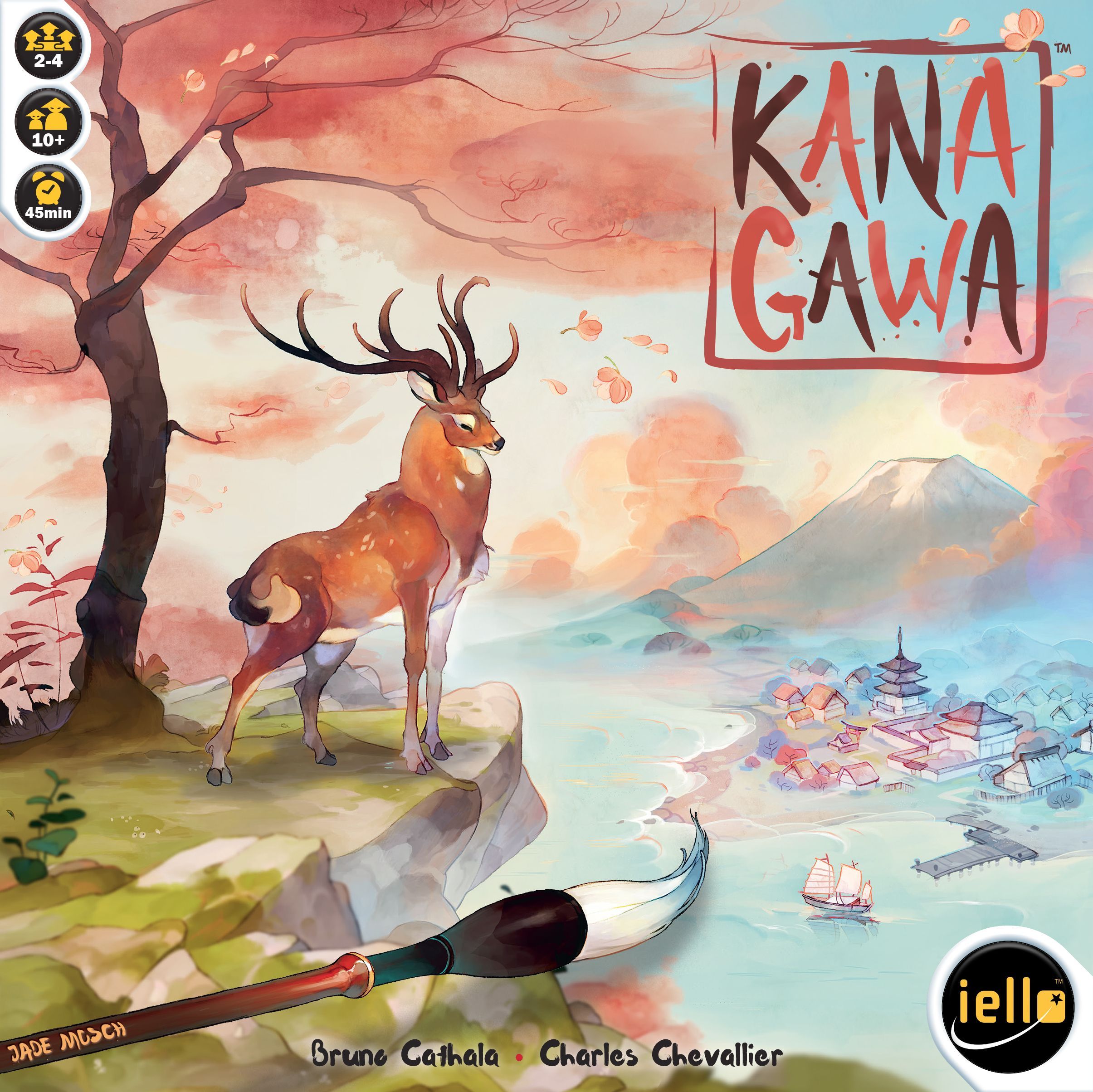
Kanagawa is a game for 2 to 4 players in which you are a disciple of Master Hokusai, building your Studio and expanding your Print over several rounds. You gain Lesson cards from the School board and use them to improve your Studio and paint Prints. Diploma tiles reward your Print and Studio, and the player with the most Harmony points wins.
Spielaufbau
The first player is chosen however you like and takes the Grand Master and Assistant pawns.
- Place the School board in the middle of the table.
- Shuffle the Lesson cards into a face-down draw deck beside the board.
- Sort the Diploma tiles by color and place them face-up above the board in two rows: the top row for Print Diplomas and the bottom row for Studio Diplomas. Within each color, sort them by Harmony value.
- Randomly distribute the Starting tiles.
- Each player places two Brush pawns in front of them.
Ein Spielzug
A round has three steps.
- Follow the teachings of the Master: The first player (holder of the Grand Master pawn) draws one Lesson card per player and places them on the first row of the School board, face-up or face-down as the board indicates.
2. Broaden your knowledge or put it into practice: Starting with the first player and going clockwise, each player still at school chooses one of two actions.
- Broaden your knowledge: Pass and take no cards yet. You may wait for more cards to appear, but other players may take the cards you want. If you are the only player still at school, you must put your knowledge into practice.
- Put it into practice: Take all Lesson cards in one column. You cannot take more cards until the next round. Then add the cards to your Studio and/or Print in any order you like, and take any Diploma you qualify for.
- New lesson: If players are still at school, draw one Lesson card per such player and add them to the next empty row, below the existing cards.
Studio rules:
- You can always add a card to your Studio. Its Studio side goes under your Starting tile, and its effects apply immediately.
- Brushes are placed on empty Landscape icons in your Studio. Each Landscape icon holds one Brush.
- Each arrow symbol lets you move one Brush to a different empty Landscape icon once per round. Each Landscape icon can be used only once per round.
Print rules:
- To add a Print card, you need Brushes on Landscape icons that match the combination shown on the card.
- Each Brush can paint only one Landscape per round.
- Once a Lesson card is played to your Print or Studio, it cannot be moved.
Diplomas:
- When your Print meets a Diploma's requirement, you must decide right away whether to take it or leave it.
- You may take only one Diploma of each color.
- Leaving a Diploma means you cannot take it later, but you can aim for a harder one in the same category.
At the end of a round, the player holding the Assistant pawn takes the Grand Master pawn and becomes the first player for the next round.
Spielende
The game ends when either of these happens:
- The last card is drawn from the deck. Play then finishes the current round, with players still at school taking their final columns in turn order.
- At the end of a complete round, one or more players have at least 11 cards in their Print.
Wertung
Before counting, place each Storm token on a card in your Print and choose the Season it becomes.
Add the following for each player:
- 1 point per Lesson card in your Print, including the Starting tile.
- 1 point per card in your longest sequence of identical Seasons, including the Starting tile.
- The Harmony symbols printed on the Lesson cards in your Print and Studio.
- The Harmony value on each Diploma tile you took.
- 2 points if you hold the Grand Master pawn.
- Each End of game bonus on your Print cards: +1 Harmony Point for a bonus that grants one, -1 for a bonus that subtracts one.
Subtract points where a symbol is crossed out.
The player with the most Harmony points wins. If players are tied, they share the victory.
Änderungen
- Wertung, von dem Entwurf aus der Anleitung, 22. November 2026 (wird jetzt angezeigt)
- Spielende, von dem Entwurf aus der Anleitung, 22. November 2026 (wird jetzt angezeigt)
- Ein Spielzug, von dem Entwurf aus der Anleitung, 22. November 2026 (wird jetzt angezeigt)
- Spielaufbau, von dem Entwurf aus der Anleitung, 22. November 2026 (wird jetzt angezeigt)
- Überblick, von dem Entwurf aus der Anleitung, 22. November 2026 (wird jetzt angezeigt)