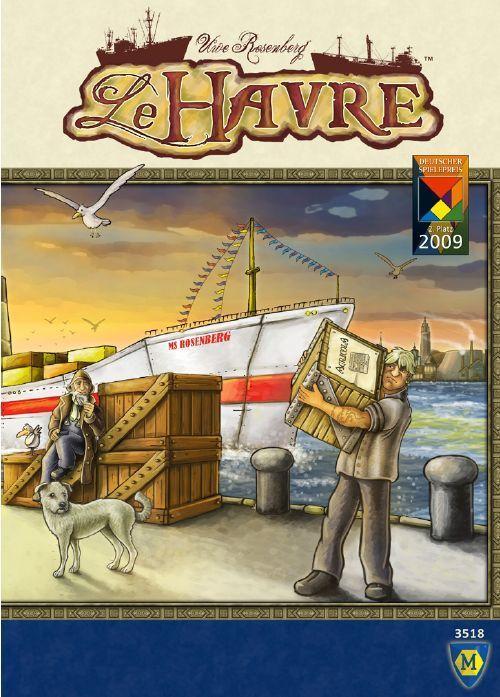
Regeln von Le Havre
Überblick
Le Havre is a trading and building game in which players supply goods to a harbor town, upgrade goods, buy and build buildings and ships, and manage food and money. The game lasts a fixed number of rounds, after which players add up their wealth. The player with the largest fortune wins.
Spielaufbau
- Place the three game boards side by side in the center: Treasury on the left, Building Proposals in the middle, Ship spaces on the right.
- Shuffle the seven Supply tiles and place them face down on the round spaces. Place the ship markers beside the first tile.
- Place the starting goods and Francs on their Offer spaces, and stock the Supply spaces with goods tokens.
- Shuffle the Special building cards and place 6 face down on the Special buildings space. Return the rest to the box.
- Remove the starting buildings (the Construction Firm and two Building Firms) and place them beside the boards, owned by the town.
- Sort the Standard building cards by the ticks for your player count and remove the rest. Split the remaining cards into 3 piles, sort each by sort order number, and fan them on the Building Proposals spaces.
- Sort the Round cards by round number for your player count, with the Round 1 card on top, and place them on game board 3. Place the Round overview card matching your player count and the Food production tokens beside the board.
- Each player takes a Person disc, a Ship marker and a Game turn overview card in their color, and starts with 5 Francs and 1 coal.
Ein Spielzug
Each turn has two mandatory parts, in this order:
1. Supply action: Move your ship marker to the next free Supply tile. Take one token from each of its two Supply spaces and place them standard side up on the matching Offer spaces.
2. Main action: Choose one:
- Take all goods or Francs from one Offer space.
- Use a building: move your Person disc onto an unoccupied building you can enter, pay its entry fee to the owner (or the Treasury if owned by the town), and carry out its action. You may not enter a building that already holds your disc, and you may not enter buildings still in the Building Proposals piles.
At any time during your own turn, you may also buy buildings or ships from the tops of the piles or from town-owned buildings, paying the purchase price. You may also sell buildings and ships to the town at half their value, even during another player's turn but not during their action. Buildings are usually built with materials at a Construction or Building Firm as the Main action instead of bought.
Play proceeds clockwise. When the seventh turn of a round is taken, resolve the Round card: players receive grain and cattle during a Harvest, pay the food shown, and the town constructs any buildings shown. Then turn the Round card over to reveal a new ship. Loan interest is paid when an 'Interest' Supply tile is used.
Spielende
After the last Round card is resolved, the Final stage begins. Each player takes exactly one final Main action, starting with the Starting player and continuing in turn order. In this stage, Supply and buying actions are not allowed, interest is not paid, and a Person disc may move onto a building already occupied by others. Loans may still be repaid and buildings and ships sold. The game ends after the final actions.
Wertung
Each player's wealth is their cash, plus the values of their buildings and ships, plus any bonus values shown on buildings with a plus symbol. Subtract 7 Francs for each unpaid loan. Goods have no value, except through the Storehouse. The player with the highest wealth wins. If players are tied, they share the victory.
Varianten
- Full version: The standard rules described above, with rounds based on player count (7 for solo, 14 for two, 18 for three, 20 for four or five).
- Shortened version: Fewer rounds (4 for solo, 8 for two, 12 for three or four, 15 for five). Changes include a different starting setup, use of the lighter ticks and smaller circles on the cards, 6 Special buildings replaced by none, and a different initial offer. Round cards are sorted by their smaller numbers, and the Round overview card's shortened side is used.
- Solo shortened game: The player starts with an extra 2-value Wooden ship card, and a second one is placed on the Wooden ships space.
- Two-player shortened game: Each player starts with a 2-value Wooden ship card.
- The rulebook recommends the five-player game only for experienced players.
Änderungen
- Varianten, von dem Entwurf aus der Anleitung, 22. November 2026 (wird jetzt angezeigt)
- Wertung, von dem Entwurf aus der Anleitung, 22. November 2026 (wird jetzt angezeigt)
- Spielende, von dem Entwurf aus der Anleitung, 22. November 2026 (wird jetzt angezeigt)
- Ein Spielzug, von dem Entwurf aus der Anleitung, 22. November 2026 (wird jetzt angezeigt)
- Spielaufbau, von dem Entwurf aus der Anleitung, 22. November 2026 (wird jetzt angezeigt)
- Überblick, von dem Entwurf aus der Anleitung, 22. November 2026 (wird jetzt angezeigt)