Regeln von Mage Knight – Das Brettspiel
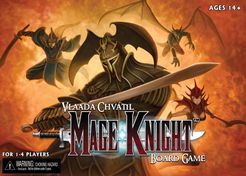
Überblick
Mage Knight is a board game in which each player leads a Hero exploring a kingdom. Players build a deck of cards, recruit Units, fight enemies, interact with locals and conquer sites and cities. Progress is mainly tracked as Fame, and Reputation modifies Influence when interacting. The chosen scenario sets the goal and end conditions. In competitive scenarios, the player with the most Fame usually wins.
Spielaufbau
- Choose a scenario, and optionally variant rules if all players agree.
- Players set the Hero order. The player who picks a Hero first takes the top Round Order token, and each player who picks a Hero after places a token in turn below it.
- Fame and Reputation board: each player puts a Shield token on the 0 space of the Fame track and one on the central 0 space of the Reputation track.
- Enemy and Ruin token piles: sort the round and hexagonal tokens by back and stack them in seven face-down piles, with a space for discards.
- Artifact deck, Wound pile (all Wounds identical, face up), Spell deck and Spell offer, Advanced Action deck and offer, and an empty Common Skill offer.
- Regular (silver) and Elite (gold) Unit decks, with the Regular Unit deck revealed to make the Unit offer: players plus 2 cards, plus any Advanced Action cards in the offer for monasteries on the map.
- Day/Night board, starting on Day. Roll mana dice equal to players plus 2 for the Source. At least half must be basic colours; reroll black and gold until this is true.
- Displayed Day Tactics, and the Night Tactics set aside unused.
- Tile deck built from the scenario's counts of Countryside, Core and non-City tiles, plus City tiles; then the starting tile is placed and revealed tiles are set up as the scenario and Site Description cards describe.
- City cards and figures, Site Description and Scoring cards, and the bank of mana tokens.
Each player takes his Hero card with its Level tokens, a Deed deck of 16 Basic Action cards, a starting hand of 5, his Shield and Skill tokens, and a Command token for his Unit area. His figure starts off the map until his first turn.
Ein Spielzug
Round preparation (skipped on the first Round):
- Flip the Day/Night board and reroll the Source dice that are not left there.
- Remove unclaimed Unit cards, then deal new ones to the offer. Refresh the Advanced Action and Spell offers.
- Collect Tactic cards and display the set for that time of day.
- Each player turns Banner Artifacts and Skill tokens face up, readies all his Units including Wounded ones, reshuffles his discarded Deed cards if needed, and draws up to his Hand limit.
Tactics: each player picks one Tactic, the lowest Fame picking first. Then Round Order tokens are rearranged so the lowest Tactic number goes first.
Player turns happen in Round Order. On a turn you can:
- Regular turn: move, then take one optional action, which may be combat, interacting with locals, or Player vs. Player combat. Playing cards and effects can happen at any point; you may play cards for their basic or strong effects, powered by mana.
- Rest: no movement or action. Take a Standard Rest by discarding one non-Wound card and any Wounds, or a Slow Recovery by discarding one Wound card, if you hold only Wounds.
You must play or discard at least one card during your turn. At the end of a turn, return used mana dice to the Source, put played cards in your discard pile, handle forced withdrawal if needed, claim rewards and level up, then draw up to your Hand limit.
Spielende
The Round ends when a player announces End of the Round, or when the scenario's end conditions are met, or when the Round limit is reached. When the scenario is over, all players who have not had their last turn get one more turn. If a player's Deed deck is empty at the start of his turn, he must announce the end of the Round, while a player with an empty Deed deck but cards in hand may choose to play on. Each scenario describes its own end conditions.
Wertung
Scoring follows the scenario's description and standard Achievements scoring, which includes Fame, Cities and other titles like Greatest Beating or Greatest Conqueror.
- In competitive scenarios, the player with the most Fame wins.
- Ties: in First Reconnaissance the players share the victory. In Conquer and Hold, the points are compared and no one wins if tied.
- In cooperative scenarios, the team's common score is the lowest Fame among its players, with Achievements compared by the higher value of both team members for each category.
- In solo scenarios, the player scores his Fame and the scenario's goal points, and succeeds or fails depending on the conditions.
Varianten
Solo and cooperative play use a Dummy player who takes his own Deed and Tactic choices, following the rules in the Scenario Book. Solo Conquest is a one-player scenario.
Team play: in four-player scenarios, players split into two teams with shared scoring and interaction rules.
Other variants include: Interactive Combat, where another player decides the enemy's colour; More Deckbuilding and Drafting at the Start, which change your deck; Auctioning the Heroes, which sets Hero choice by bidding Fame; Daytime Variability, which changes the Day/Night pattern; City Levels, Megapolis, Rampage and Friendly Game, which change difficulty or interaction.
Other scenarios include Blitz Conquest (shorter), Full Cooperation, Blitz Cooperation, Mines Liberation, Druid Nights, Dungeon Lords, Conquer and Hold, and One to Return.
Änderungen
- Varianten, von dem Entwurf aus der Anleitung, 22. November 2026 (wird jetzt angezeigt)
- Wertung, von dem Entwurf aus der Anleitung, 22. November 2026 (wird jetzt angezeigt)
- Spielende, von dem Entwurf aus der Anleitung, 22. November 2026 (wird jetzt angezeigt)
- Ein Spielzug, von dem Entwurf aus der Anleitung, 22. November 2026 (wird jetzt angezeigt)
- Spielaufbau, von dem Entwurf aus der Anleitung, 22. November 2026 (wird jetzt angezeigt)
- Überblick, von dem Entwurf aus der Anleitung, 22. November 2026 (wird jetzt angezeigt)