Regeln von Panamax
Überblick
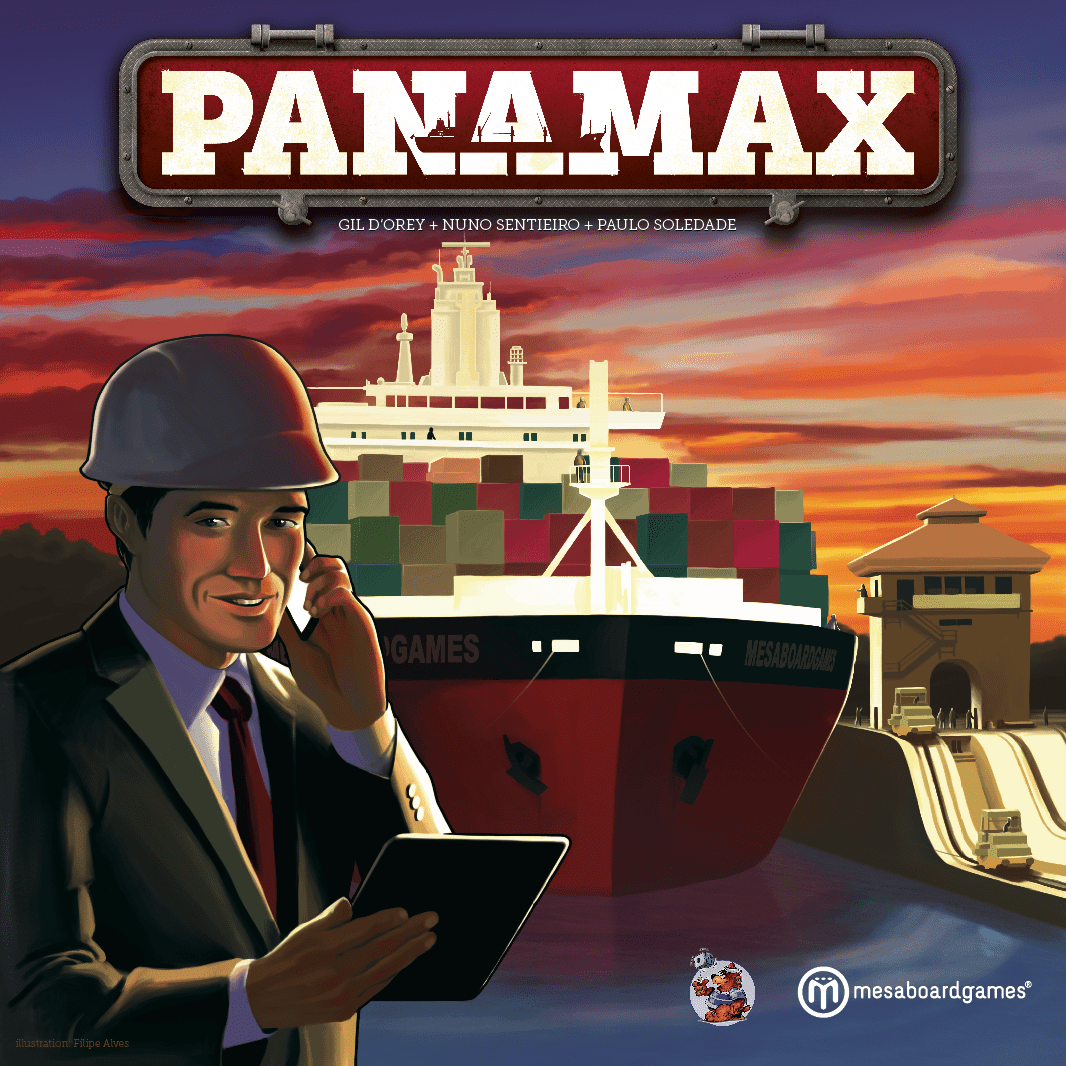
Panamax is a game for 2 to 4 players in which each player runs a shipping company that takes cargo contracts, moves ships through the Panama Canal, and buys company stock. Players keep their own money separate from their company's money. The player with the most personal money at the end of the game wins.
Spielaufbau
Split the bonus cards into piles and place them on the board. Roll 12 white dice for the action table, placing them in columns and cascading any extra or duplicate results into other columns. Roll the other 4 white dice as executive action dice. Place flags, Managing Director Awards, and the movement markers on their spaces. Each player picks a company color, takes 1 cube, a clipboard, and the ships of that color, then places a 1-slot ship (on a set space by turn order) and a 2-slot ship. Players start with money and shares as listed on the board. Each player also gets 9 dice of their color, split between the Warehouse and the Dice Pool. Shuffle the contracts, draw a set of 3 onto the action table, and set up the Draw and Inbound Cargo spaces. Setup contracts are dealt to each player, who chooses one and places it near the clipboard. A Mulligan rule lets all dice be re-rolled if four or fewer dice end up on either side of the action table.
Ein Spielzug
The game lasts 3 rounds, with each round giving every player 4 turns in train order. On a turn, a player does one action:
- Take a white die from the action table, paying $5 to transfer a die to the other side of the table if needed. Remove the lowest die from the chosen column or an executive die if no action dice remain in that column.
- On the grey side, choose a contract and load cargo onto it, or do nothing.
- On the blue side, perform the number of lock and waterway movements shown by the column. Ships must move in the direction of the arrows.
- Executive dice allow a Market action: buy one share, or raise the company stock value by $2.
Free actions earned from the clipboard flags can be used at any time, and players may build ships in Loading zones for $7 (3-slot) or $5 (1-slot) without it counting as an action. When a ship exits the Canal, its company earns $1 per pip of its own dice, and the owner may take a bonus card or money. A round ends when no action dice remain.
Spielende
At the end of each round, the rail table is updated, cargo fees are paid, dividends are paid, Managing Director Awards are given, and cargo is maintained. Then new action dice are rolled for the next round. After the third round and its end-of-round procedures, the game ends and final scoring takes place.
Wertung
Each player adds up their personal money only; company money is ignored. The player adds the value of their best 2 Financial Advisor bonus cards, including their secret goal card. Any Managing Director Awards they hold are counted. Each player then sells all their shares to the Bank at the current market price. Each player pays $15 for each Bailout token they took. The player with the most money wins. If there is a tie, the final turn order decides the winner.
Varianten
2 and 3 player games:
- With 3 players, use 9 dice for the action table and only 3 executive action dice.
- With 2 players, use 10 dice for the action table and only 2 executive action dice, giving each player 6 turns per round. Return the San Juan Prospector and Spiel of the Seas to the box, and place one 3-slot Cruise ship in each Waiting zone.
- The Mulligan rule is adjusted so that a re-roll happens if 3 or fewer dice cascade onto either side of the action table.
Advanced setup: players bid secretly for their starting investment (minimum $12, in $3 steps up to $24), with the bid becoming the company's starting capital. The starting stock value is one third of the bid, and each player gets a starting share and $6 in personal assets.
Änderungen
- Varianten, von dem Entwurf aus der Anleitung, 23. November 2026 (wird jetzt angezeigt)
- Wertung, von dem Entwurf aus der Anleitung, 23. November 2026 (wird jetzt angezeigt)
- Spielende, von dem Entwurf aus der Anleitung, 23. November 2026 (wird jetzt angezeigt)
- Ein Spielzug, von dem Entwurf aus der Anleitung, 23. November 2026 (wird jetzt angezeigt)
- Spielaufbau, von dem Entwurf aus der Anleitung, 23. November 2026 (wird jetzt angezeigt)
- Überblick, von dem Entwurf aus der Anleitung, 23. November 2026 (wird jetzt angezeigt)