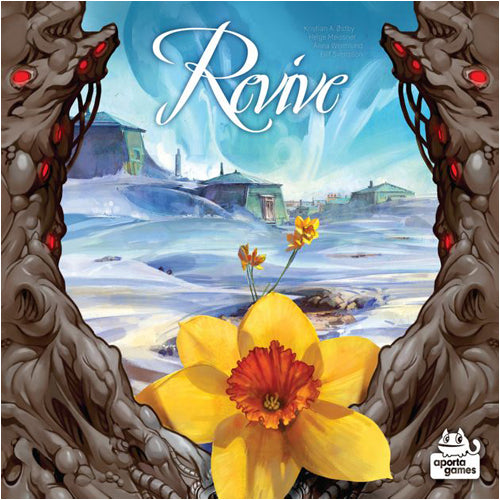
Regeln von Revive
Überblick
Each player leads a tribe that rebuilds the world by exploring new land, building, populating locations and collecting artifacts. The game ends when the last major artifact is taken from the game board. Players then score points from their collected artifacts, artifact card, researched technologies, progress track and populated locations. The player with the most points wins.
Spielaufbau
Place the game board in the middle of the table. Shuffle the starting area tiles and place them face up on their marked spaces. Shuffle the other area tiles and place them face down on the remaining spaces. Place one large location tile, random side up, on each corner space and return the unused tile to the box.
Shuffle the citizen cards into a facedown deck and reveal some cards beside it. Sort the machine tokens by color into three piles and flip some of each pile face up. Shuffle the slot modules into a facedown pile and reveal some beside it. The face-up citizen cards, machine tokens and slot modules form the display. Make a facedown stack of crates, a supply of energy, and place the action cubes nearby.
Make a stack of minor artifacts with the end game tile on top. Place the major artifacts face up on the crater area, using only those marked with your number of players, and return the rest to the box. Do not punch the red punchboards or bring out the falcon or campaign deck until the campaign tells you to.
Each player takes a player board, a random tribe board (sun side up, to the left of the player board), a switch token placed in the unused position, one energy, the machine and progress markers on their starting spaces, population figures, buildings, pawns, and resource markers in their color. Each player receives starting citizen cards of one letter: some go to the resting area and the rest to the active area. Each player also gets one secret artifact card and a player aid card. The starting player is chosen at random. Starting resources are then advanced: the starting player advances their leftmost resource marker one space, the second player advances their two leftmost, and so on up to four players.
In a solo game, begin with one crystal and do not use the end game tile.
Ein Spielzug
The starting player takes the first turn, and play proceeds clockwise. On your turn you either perform up to two actions or hibernate. You may perform two different actions or the same action twice.
The available actions are:
- Play a card from your active area into an empty card slot.
- Use your switch token to explore for one basic resource.
- Explore a facedown area tile by paying range and the tile's cost, then recruit a citizen.
- Populate a location you have not yet populated, paying range, the technology cost and books to other players already present.
- Build a small or large building on a vacant sand space, paying range and gears, then claiming rewards from adjacent terrain, crystals and new water spaces.
You may also take free actions at any time on your turn: trade crystals for other basic resources, activate unlocked machines by spending energy, and open crates.
If you cannot or do not want to take at least one action, you must hibernate. Hibernating returns energy and cards to their places, resets the switch token, advances your hibernation marker and grants that reward.
Spielende
The game ends when a player takes the last major artifact from the game board. That player also takes the end game tile. Each other player then takes one final complete turn. Any artifact a player is due to gain after the last major artifact has been taken is replaced by a minor artifact instead.
In a solo game, the game does not end when the last major artifact is taken. Minor artifacts are taken instead, and the game ends when the action cube moves beyond the top space of your progress track.
Wertung
Players first tally their purple points, which are scored only at game end and do not trigger track rewards. Each player scores:
- the lowest visible point value on their progress track
- points on unlocked technologies
- points from each large location where they have a population figure
- end game card bonuses, if unlocked
- points for the end game tile, minor artifacts and remaining resources (rounded down)
- points from the artifact card and major artifacts, where each of the three categories on the artifact card is scored once, plus once more for each major artifact of the matching color
The player with the most points wins. Ties are broken first by the most remaining unscored resources, then by the furthest advance on the three machine tracks combined. If still tied, the tied players share the victory.
In a solo game, compare your final score with the ranking table in the rulebook, which lists survivor, minor, regular, major, superior and utopia results.
Varianten
- Solo game: Play alone using a single action cube on your progress track to count card actions. Hibernating moves the cube further and lets you discard components from the display. The game ends when the cube passes the top of the track, and the score is compared to a ranking table.
- Long game: Use artifacts as if there were one extra player, and place two extra minor artifacts next to the craters. The game then ends when all major artifacts and these two minor artifacts have been taken.
- Campaign: Play through a series of chapters guided by the campaign deck. This unlocks additional content, such as the moon sides of tribe boards, the falcon and the red punchboards. You may also play with only the basic rules.
Änderungen
- Varianten, von dem Entwurf aus der Anleitung, 22. November 2026 (wird jetzt angezeigt)
- Wertung, von dem Entwurf aus der Anleitung, 22. November 2026 (wird jetzt angezeigt)
- Spielende, von dem Entwurf aus der Anleitung, 22. November 2026 (wird jetzt angezeigt)
- Ein Spielzug, von dem Entwurf aus der Anleitung, 22. November 2026 (wird jetzt angezeigt)
- Spielaufbau, von dem Entwurf aus der Anleitung, 22. November 2026 (wird jetzt angezeigt)
- Überblick, von dem Entwurf aus der Anleitung, 22. November 2026 (wird jetzt angezeigt)