Regeln von Schotten Totten 2
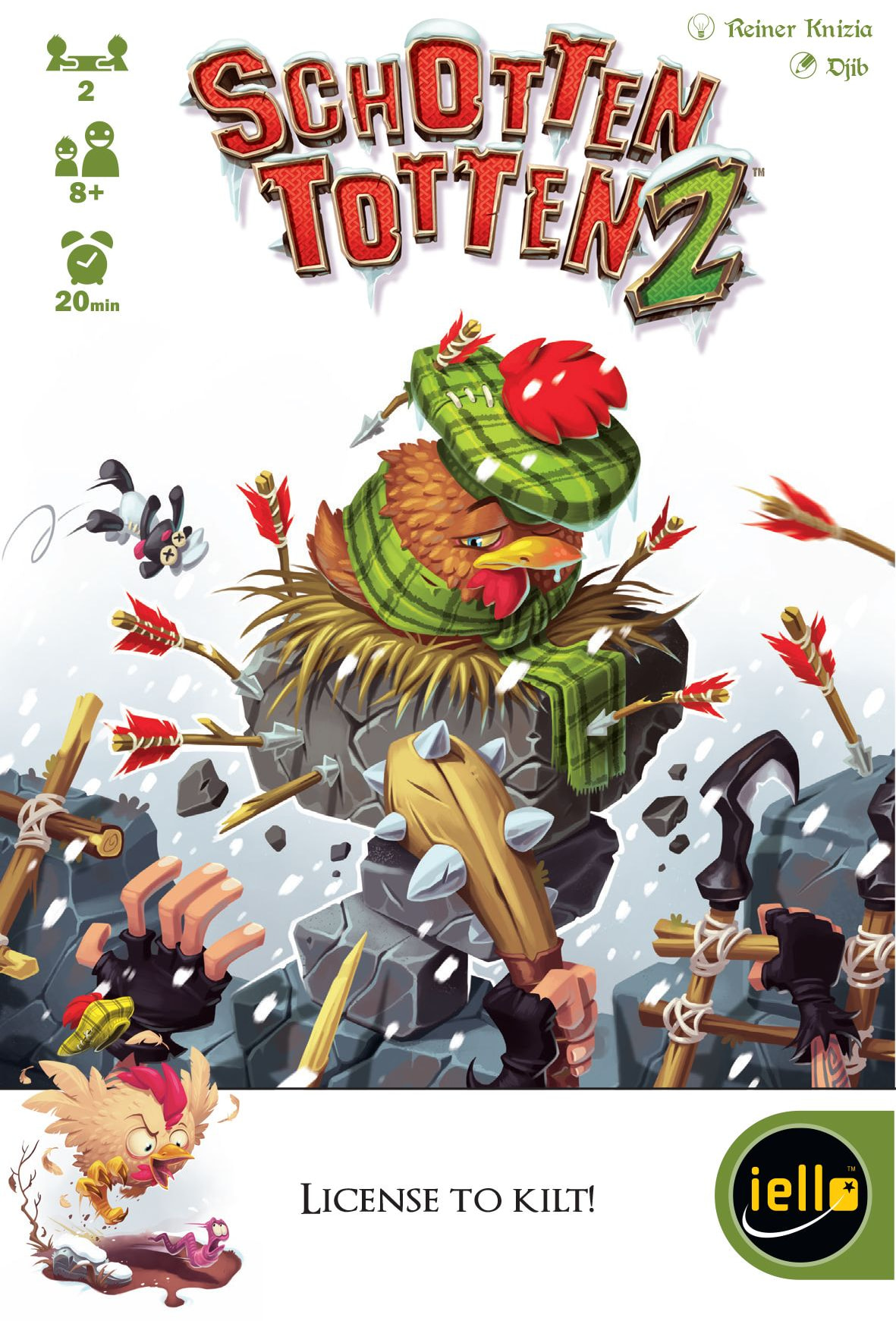
Überblick
A two-player game of siege in which one player attacks a castle wall while the other defends it. The Attacker wins by damaging 4 different wall tiles, or by damaging one tile twice. The Defender wins by holding out until the deck runs out.
Spielaufbau
- Sit across from each other and choose an Attacker (who takes the Cook figure). The other player is the Defender (who takes the Chicken figure and the 3 Oil Cauldron tokens).
- Place the 7 Wall tiles in a row in the order shown in the illustration, undamaged side up. The Attacker should face the outside of the castle, where the required combinations are printed.
- Shuffle the Siege cards into a face-down deck.
- Each player draws 6 Siege cards as a secret hand.
Ein Spielzug
The Attacker goes first, then players alternate. On your turn, go through these steps in order:
1. Preparation action (optional). The Attacker may Retreat from any tiles, discarding all of their cards on those tiles. The Defender may throw an Oil Cauldron: discard the Attacker's card closest to the wall on one tile and return one token to the box. Only one token can be used per turn, and up to 3 per game.
2. Play 1 card. Place a card from your hand in front of a tile. A side can never hold more cards than that tile requires. Stack later cards on top of earlier ones without changing their order. If you play a 0 onto a tile whose opposite side has an 11 of the same color (or the reverse), discard both cards.
3. Draw 1 card from the deck to refill your hand.
The Attacker may declare control at any time during their turn, but only for a tile where they have a complete formation (as many cards as the tile's required number). If both sides have complete formations, compare them. If only the Attacker is complete, they must show from the cards already played and discarded that the Defender cannot build a stronger formation. If control is declared successfully, flip the tile to its damaged side, then discard all cards on both sides of that tile so new formations can be built there.
Spielende
The game ends immediately if the Attacker declares control of a tile that is already damaged, or if they damage a 4th tile. If a player must draw and the deck is empty, the Attacker takes one final turn to try to win. If they fail, the Defender wins.
Wertung
There are no points. The winner is decided by the win conditions above.
Formations are compared by type first, from strongest to weakest: Color-Run, Same Strength, Color, Run, and Sum. Only the types a tile requires are considered, and the Sum is used when a formation does not match. If two formations share a type, the higher sum wins. If the sums are also equal, the formation completed first keeps control. Some tiles reverse the sum rule so that the lower sum wins.
To decide an overall champion, play two games back to back, switching roles. If the same player wins both, they are the champion. If each player wins one, compare the wins:
- If both won as Attacker, the winner with more cards left in the deck is the champion.
- If both won as Defender, the player with more undamaged wall tiles plus unused Oil Cauldron tokens is the champion.
- If still tied, play a rematch.
Varianten
Tactical variant: Use the normal rules with these changes.
- Shuffle the 11 Tactic cards into their own deck beside the Siege deck. Each player starts with 7 Siege cards.
- When drawing, choose which deck to draw from. If the Tactic deck is empty, you can no longer draw from it, but play continues.
- A hand may hold up to 7 cards of either type. When playing, choose a Siege or a Tactic card.
- You may never have played more Tactic cards than your opponent by more than one. You cannot play another Tactic card until your opponent plays one, if you are already one ahead.
- Action cards are resolved and discarded immediately; keep them beside your side to track the count. Elite Troop cards are played like Siege cards. Joker, Spy, and Shield cards take a color and strength chosen when the Attacker declares control.
- Actions include Redeployment, Recruitment, Desertion, Treason, Explosion, Support, and Exchange, each with the effect described in the rulebook.
Änderungen
- Varianten, von dem Entwurf aus der Anleitung, 23. November 2026 (wird jetzt angezeigt)
- Wertung, von dem Entwurf aus der Anleitung, 23. November 2026 (wird jetzt angezeigt)
- Spielende, von dem Entwurf aus der Anleitung, 23. November 2026 (wird jetzt angezeigt)
- Ein Spielzug, von dem Entwurf aus der Anleitung, 23. November 2026 (wird jetzt angezeigt)
- Spielaufbau, von dem Entwurf aus der Anleitung, 23. November 2026 (wird jetzt angezeigt)
- Überblick, von dem Entwurf aus der Anleitung, 23. November 2026 (wird jetzt angezeigt)