Regeln von Space Cadets: Dice Duel
Überblick
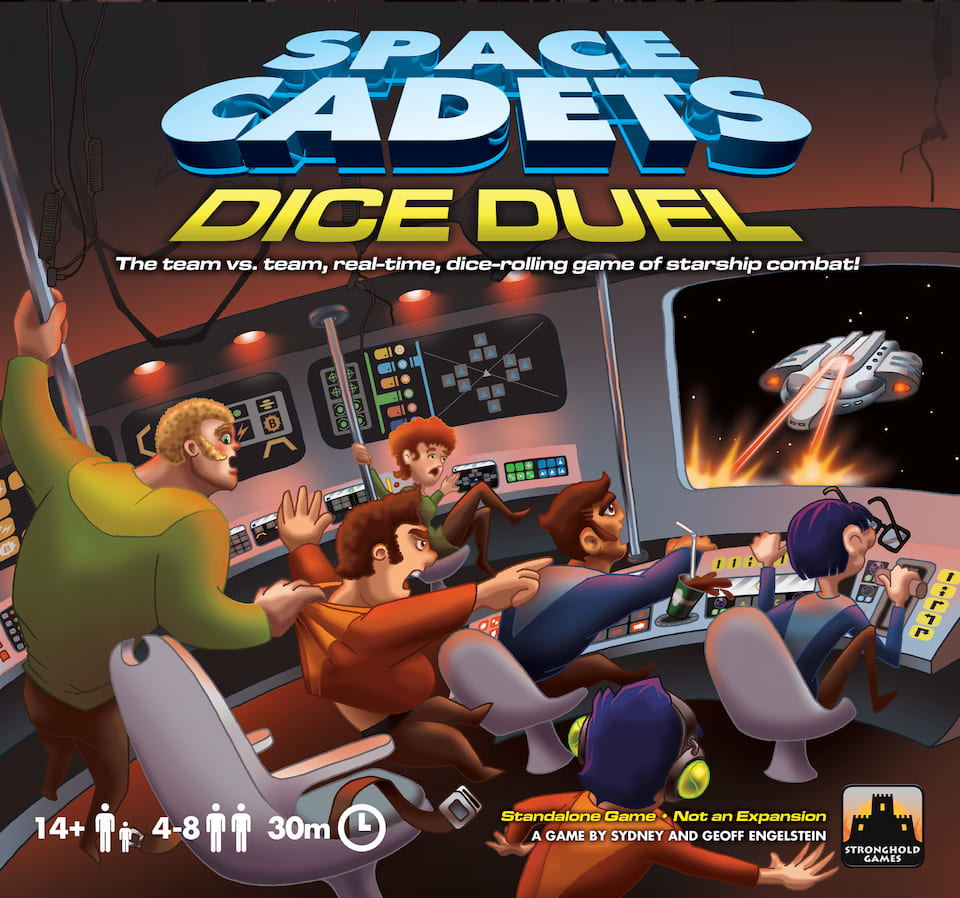
Space Cadets: Dice Duel is a fast, real-time game where two starship teams fight on a grid map. Each team crews one ship, with players sharing stations and dice. There are no turns: play continues until one side causes four damage to the other ship through torpedoes or mines, which destroys it and wins the game.
Spielaufbau
Split the players into two teams of equal size. Each team sits on one side of the table, close enough to pass dice to teammates, with Engineering in the middle of the team.
Each player takes the stations assigned to them, in their ship's color, along with that station's dice. Place both mine tokens on the Tractor Beam display. Put each starship miniature and the six crystals on their marked map squares. Teams then take turns placing the asteroid and nebula tokens anywhere they like on either side, ideally spread out fairly evenly. Leave the wormhole tokens aside until you have played a few games.
Station assignments for a first game:
- 2 players per team: Player A takes Helm, Shields and Tractor Beams; Player B takes Weapons and Sensors; Engineering is shared by both.
- 3 players per team: Player A takes Helm, Shields and Tractor Beams; Player B takes Weapons and Sensors; Player C takes Engineering.
- 4 players per team: the fourth player is the Captain, who takes no station and directs the team, while the other three split the stations as in the 3-player setup.
When someone calls start, Engineering rolls the energy dice and play begins.
Ein Spielzug
There are no turns. Players act as quickly as they can, and the game only pauses for specific actions.
- Energy: Engineering rolls the white energy dice, re-rolling as often as wanted. A die showing a number matching a station is passed to that station's Energy section. Sixes have no slot and must be re-rolled.
- Station dice: A station may roll one of its dice for each energy die it holds. Dice can be re-rolled freely until placed. Once placed on a display, a die can no longer be re-rolled, though it can be removed later. When a station places a die, it returns an equal number of energy dice to Engineering, which can roll them again right away.
- Helm: Place one die in each of slots A, B and C. The ship moves only after all three are placed, resolving A, then B, then C. Afterwards the Helm dice are cleared. Moving onto an obstacle applies its effect: asteroids remove two Shield dice, and nebulae remove two Sensor dice, chosen by the station's officer. Ships may share a square, and the moving ship is placed in the half nearest the side it entered from. A Helm die that would take the ship off the map is ignored for movement, but its turn still applies.
- Weapons: Load torpedoes with a Nose, Body and Tail die each. The ship has two front and two rear tubes, so up to two torpedoes can be loaded at once, on either or both sides.
- Sensors: Lock dice generate lock points used to aim. Jammer dice generate jammer points that make the enemy harder to hit. Each icon on a die counts as one point.
- Shields: Four sectors, one per side of the ship. Shield dice are placed in the sector matching their number, and any number may share a sector.
- Firing: The Captain (or the Weapons player if there is no Captain) calls Fire 1 or Fire 2. The action stops while the launch resolves. A hit needs all three conditions: the enemy is in a front or rear arc, a torpedo is loaded on that side, and the lock points are at least the range plus the enemy's jammer points. Range is counted only straight, not diagonally. Whether or not it hits, the used Weapon and Lock dice are removed, and the target's Jammers are removed if the shot came from a front or rear arc with a torpedo on that side.
- Damage: If a torpedo hits, the sector hit decides the result. An empty sector takes one damage. Three shield dice block it completely. With one or two shield dice, the Weapons player rolls a Weapon die per torpedo, looking for one or two blasts as needed. Each damage costs the target one energy die, placed on its damage track. Shield dice in the hit sector are removed after any hit.
- Tractor Beams: Tractor dice generate strength equal to their icons. To succeed, strength must be at least double the range (zero range still needs one strength). Tractor Beam dice are discarded after each use. Captured crystals go to the team's crystal area. Tractoring the enemy ship moves it one square and triggers any penalty there.
- Mines: Roll a Mine A or Mine B result to activate a mine, then release it on the ship's current square once the ship has stopped moving. A square can hold only one mine, and each ship can place at most two. A ship takes one damage when it enters a mine square. Shields do not block mines, and any torpedo hit destroys a mine token.
- Crystals: Used crystals return to the map after the next torpedo launch. Options include Station Override (1 crystal: place a station die on any face you choose), Warp Jump (1 crystal, and more crystals can be spent to roll more options, moving your ship to a crystal space), and Energy Surge (2 crystals, only after taking damage, to regain one energy die).
Spielende
The game ends immediately when one ship causes its fourth damage. A ship that has lost its fourth energy die explodes, and the opposing team wins.
Varianten
- Two-player teams: Engineering is shared between both players, who may each roll the energy dice and pass them to stations.
- Captain: A fourth player on a team takes no station and directs the others.
- Wormholes (advanced): Place both wormhole tokens, ideally symmetrically relative to the starting squares. A ship that enters a wormhole, by movement or tractor beam, is instantly moved to the other wormhole without changing facing and without using a Helm move. Range is counted through a wormhole as if it were not there.
- Space Cadets map tiles: If you own the original Space Cadets, you can use its map tiles instead of the game board. Crystals are marked with shield tokens numbered 1 to 6, and rifts force the loss of all shield dice when moved through and block weapon fire.
- Multiple ships per side: Each ship gets a crew of 2 to 4 players and is placed in the same row. Torpedoes must name a target, and you may tractor a friendly ship but not fire at one. Each ship keeps its own crystal area.
- Four-ship free-for-all: Each ship starts in a corner of the board, and every ship fights for itself. This version is noted as not for the faint of heart.
Änderungen
- Varianten, von dem Entwurf aus der Anleitung, 23. November 2026 (wird jetzt angezeigt)
- Spielende, von dem Entwurf aus der Anleitung, 23. November 2026 (wird jetzt angezeigt)
- Ein Spielzug, von dem Entwurf aus der Anleitung, 23. November 2026 (wird jetzt angezeigt)
- Spielaufbau, von dem Entwurf aus der Anleitung, 23. November 2026 (wird jetzt angezeigt)
- Überblick, von dem Entwurf aus der Anleitung, 23. November 2026 (wird jetzt angezeigt)