Regeln von Steam: Auf Schienen zum Ruhm
Überblick
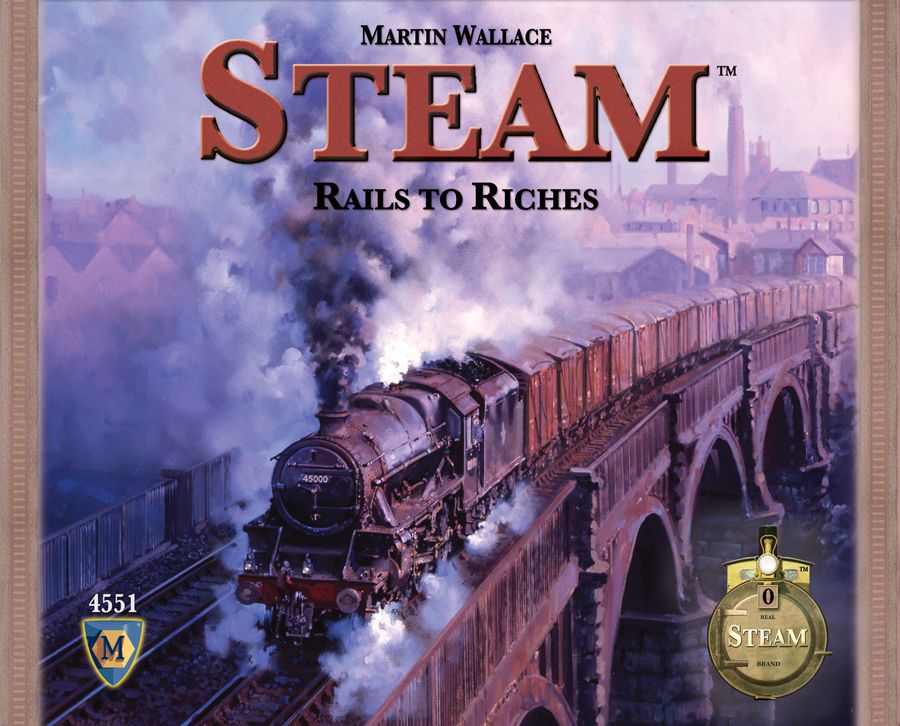
Steam is a railway-building game in which players lay track between towns and cities, move Goods cubes along their links to matching-color cities, and score points as income or victory points. The player with the most Victory Points at the end wins.
Spielaufbau
Place all Goods cubes in the bag, then randomly draw them onto each city in the number shown on the city hex, and place three randomly drawn cubes on each Goods Supply space (one fewer on each with three players). Place City Growth markers and New City tiles beside the map. Each player takes a color of tokens and places one on the 0 of the Income Track, one on the 0 of the Victory Point Track, and one on Locomotive Level 1. Appoint a banker with the Money supply. Place the turn marker on turn 1. Players may choose a scenario map to place on top of the board.
Ein Spielzug
A turn has six phases:
- Select Action Tiles: in turn order, each player takes one Action tile. Tile values set next turn's order.
- Build Track: in turn order, build up to three track tiles (four with the Engineer tile). Track costs $1 per exit, plus $1 for a town, $1 for a river, and $2 for a hills hex. Urbanization and City Growth must be carried out unless passed.
- Move Goods or Improve Locomotive: two cycles in turn order. Each cycle, a player either improves the locomotive (not twice in one turn), moves one Goods cube, or passes. A cube can move along at most as many links as the locomotive level, must end at the first matching-color city, and must use at least one of the mover's own links.
- Collect Income & Pay Expenses: in player order, receive positive income or pay negative income. Money can be raised from the bank by lowering income, and then by lowering VPs at -$10 income.
- Determine Turn Order: order players from lowest to highest action value.
- Set Up New Turn: return Action tiles and advance the turn marker.
Spielende
The game ends after phase 4 of the final turn. The number of turns is 10 with three players, 8 with four players, and 7 with five or six players. On the final turn, phases 5 and 6 are skipped. A player with no cash, no VPs and income of -$10 who still owes money goes bankrupt and is removed; the remaining players keep the game going.
Wertung
At game end, each player gains one VP for every two dollars of positive income, rounded down, or loses twice the negative income amount. Incomplete links are removed, and each completed link owned earns one VP. Points from deliveries are added during play. The player with the most VPs wins. A tie goes to the tied player with the highest income level, and if still tied, to the player who took the lowest numbered Action tile on the final turn.
Varianten
Standard Game: a more complex version that uses a different structure. Players buy capital once per turn in phase 1, which is the only time money may be raised from the bank. Turn order is bid every turn, with the Turn Order tile allowing one pass without dropping out. Locomotive upkeep is paid every turn at $1 per level, and Action tiles have no cost or value. Other Base Game rules stay in effect.
For the first game, the rulebook suggests random turn order instead of auction, with players given starting cash of $1 for second place, $2 for third, and so on. Base Game turn order may also be set by auction at the start. The Standard Game uses a three-player and five-player setting per the standard turn counts.
Änderungen
- Varianten, von dem Entwurf aus der Anleitung, 23. November 2026 (wird jetzt angezeigt)
- Wertung, von dem Entwurf aus der Anleitung, 23. November 2026 (wird jetzt angezeigt)
- Spielende, von dem Entwurf aus der Anleitung, 23. November 2026 (wird jetzt angezeigt)
- Ein Spielzug, von dem Entwurf aus der Anleitung, 23. November 2026 (wird jetzt angezeigt)
- Spielaufbau, von dem Entwurf aus der Anleitung, 23. November 2026 (wird jetzt angezeigt)
- Überblick, von dem Entwurf aus der Anleitung, 23. November 2026 (wird jetzt angezeigt)