Regeln von Tabannusi: Builders of Ur
Überblick
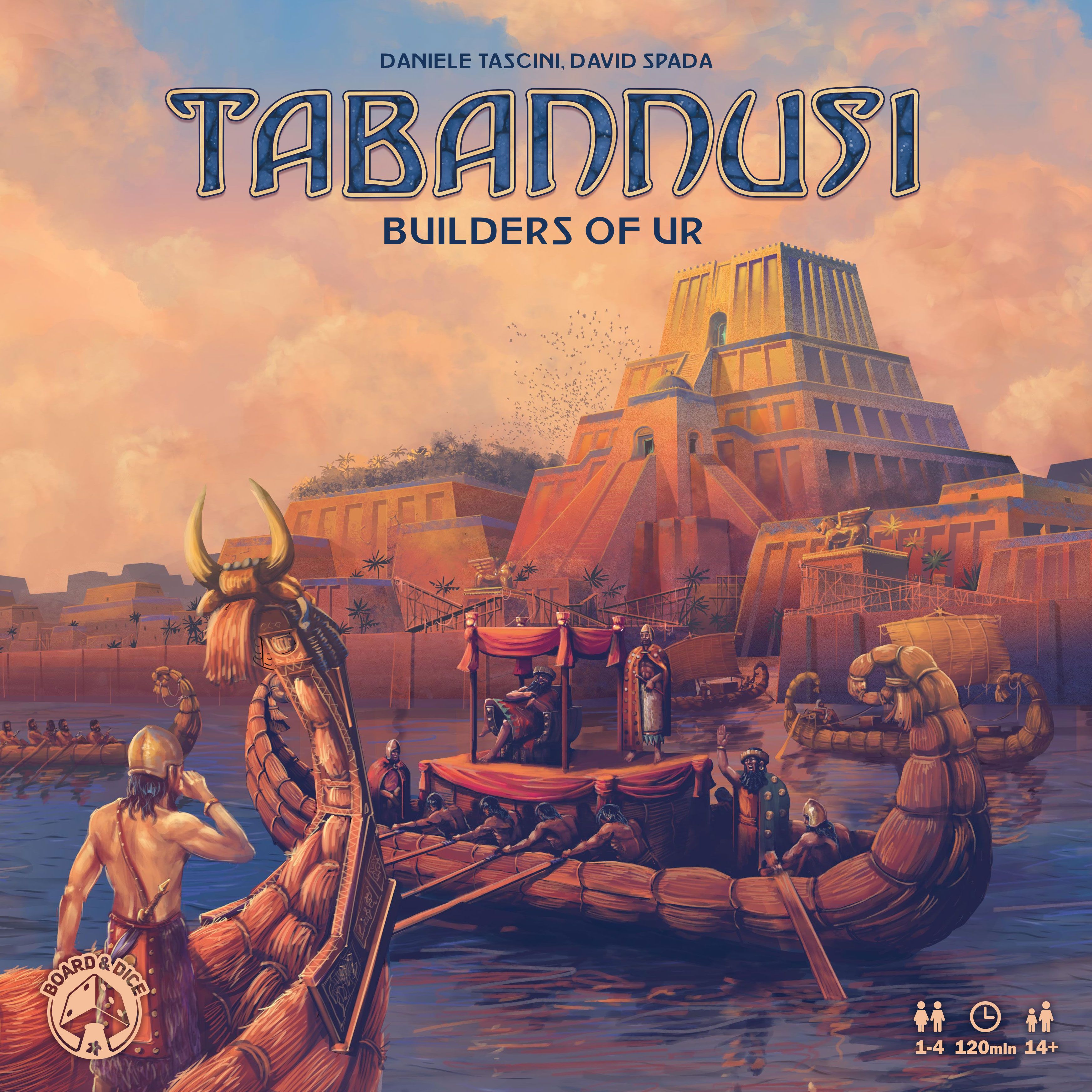
Tabannusi is a city-building game for 1 to 4 players set in the ancient city of Ur. Players act as architects who place Buildings across the districts, claim Ships, gardens and project tiles, and use Resource dice and special abilities to gain an edge. Victory Points are earned along the way and when districts are scored, and the player with the most Victory Points at the end wins.
Spielaufbau
- Place the main board with the side matching the number of players. For a first game, skip the Barge tile step; otherwise shuffle the Barge tiles, place one on each Barge space, and cover each district's Property Cost space with the matching Property Cost tile.
- For each color, roll the Resource dice (5, 6 or 7 for 2, 3 or 4 players) and place them on the Barge of the same color. Return unused dice to the box.
- Place one Gold on each Time track space, and set the remaining Gold nearby.
- Shuffle and randomly place the Ship, Harbormaster and Crate tiles on their spaces on the board. Set aside the unused ones.
- Prepare the Water tiles (regular and special), the Garden tiles, the Action tiles, and the Ziggurat tiles, placing them on their spaces as shown in the rules. Return unused Ziggurat tiles to the box.
- Place Decree cards equal to the number of players, chosen so each symbol type appears at least once. Shuffle the Urban cards into a draw deck and sort the Project tiles by color into three stacks.
- Each player takes a color, with its Architect, Assistant, markers and Houses. Houses go on the Player board, and each player keeps 5 Claim markers in their player area and the rest in the supply.
- Each player receives 2 Gold, one random Crate tile, and one Urban card kept secret from opponents. Each player puts a Mastery marker on the bottom space of each Mastery track and places their Scoring marker on the 10 space of the Victory Point track.
- Choose the starting player, who takes the Starting Player token. Going counterclockwise from the last player, each player places one Building piece in a district of their choice, gains any reward there, and marks it with a House from the matching row of their Player board.
Ein Spielzug
On your turn, you perform these steps in order:
- Resource and movement: Take one Resource die from the district where your Architect and Assistant are present. Then move your Architect to the district numbered the same as the die's value. A die matching your current district keeps the Architect in place, and a 6 lets you move to any district not already reachable by other dice. You may instead pay 1 Gold to ignore the die value and move anywhere.
- Actions: In the district where your Assistant is, perform up to two actions, which may be the same or different. Available actions include placing a Project tile, constructing a Building (in districts 1 to 3), gardening (buying and placing Water and Garden tiles), placing a House in the Port or Ziggurat district, claiming a Ship, and a few other actions.
- Scoring and movement: If any Barge is now empty, score that district at the end of your turn. Then move your Assistant to join your Architect. Play then passes clockwise.
Free actions can be taken at any point during your turn, as many as you like within their limits. These include refilling face-down Crate tiles by returning any one Resource, and scoring Decree cards whose requirements you meet.
Spielende
The game ends when the last Gold is taken from the Time track. Once that happens, play continues until every player has had the same number of turns, ending with the player to the right of the starting player, and then one more round is played.
After the final round, each district (1 to 5) is scored one last time, and each player reveals their Urban cards and scores those they completed. Once the game end is triggered, an empty Barge no longer causes a normal district scoring.
Wertung
When a Barge runs out of its last die, its district is scored. The active player first takes 1 Gold, which can trigger the game end. Then every player returns the district's local Resources, which can advance the matching Mastery track or give a Water or Garden tile. Players then score Victory Points:
- Districts 1 to 3: each Building scores its size multiplied by the Victory Point value shown at the position of the owner's Mastery marker on the matching track. Adjacent Garden tiles count as extra spaces for the Building.
- Port District (4): each player scores 1 point per Claim marker sharing a row or column with one of their Houses, and 2 points if it shares both.
- Ziggurat District (5): each player scores each Ziggurat tile where they have a Claim marker, using the rightmost marker and the conditions printed on that tile.
After scoring, the active player rolls the local Resources and returns them to the Barge.
At the end of the game, each unused Harbormaster tile is worth 3 Victory Points.
The player with the most Victory Points wins. If players are tied, the tied player with more Gold wins. If still tied, the tied players share the victory.
Varianten
Solo mode: You play against an automated opponent called the Bot, using a King card and a set of Automa cards. Setup follows the two-player rules with changes: the Bot starts with 3 Gold instead of a Crate, Decree cards are chosen by the King card's rules, and a separate bag of Automa Project tiles and Number tiles is prepared. On each of its turns the Bot follows the Automa turn sequence, drawing Automa cards to decide its district, its actions and the colors it chooses, and it uses its own simplified rules for Gold, Crates, Ships and Gardens. The Bot wins ties. The solo rules say you should learn the multiplayer rules first, and the solo rules are exceptions to them.
Änderungen
- Varianten, von dem Entwurf aus der Anleitung, 23. November 2026 (wird jetzt angezeigt)
- Wertung, von dem Entwurf aus der Anleitung, 23. November 2026 (wird jetzt angezeigt)
- Spielende, von dem Entwurf aus der Anleitung, 23. November 2026 (wird jetzt angezeigt)
- Ein Spielzug, von dem Entwurf aus der Anleitung, 23. November 2026 (wird jetzt angezeigt)
- Spielaufbau, von dem Entwurf aus der Anleitung, 23. November 2026 (wird jetzt angezeigt)
- Überblick, von dem Entwurf aus der Anleitung, 23. November 2026 (wird jetzt angezeigt)