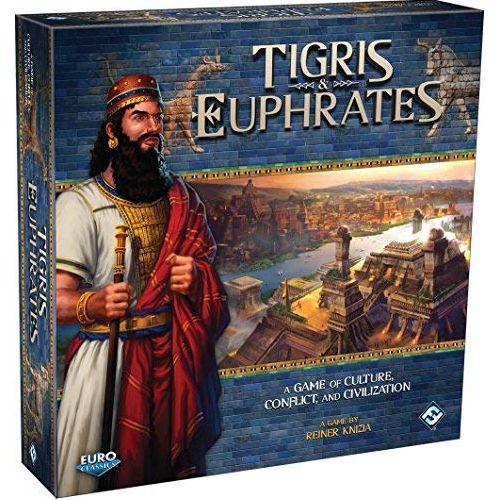
Regeln von Euphrat & Tigris
Überblick
Tigris & Euphrates is a game about building civilization along two rivers. Players develop four spheres (settlements, temples, farms, and markets) by positioning leaders, placing tiles, and resolving conflicts. The player whose lowest sphere holds the most victory points wins.
Spielaufbau
- Place the board with the gold border side up. Put a temple on each of the ten Shedu-marked spaces, then put a treasure token on each temple.
- Shuffle all remaining civilization tiles into the bag. Return unused treasure tokens to the box and set the monuments by the board. Sort the victory point tokens by color and place them beside the board.
- Each player chooses a dynasty of four leaders sharing one dynastic symbol, in four colors. Each player takes the unification tile and two catastrophe tiles with his symbol, plus his screen. Return spare pieces to the box. Each player draws six tiles from the bag and keeps them hidden behind his screen, while his leaders, catastrophe tiles and unification tile stay in view.
- Assemble the six two-piece monuments, making sure no two are alike. Choose a starting player at random by drawing one of the face-down unification tiles. Play proceeds clockwise.
Ein Spielzug
On a turn, the active player may resolve up to two actions in any order, and may repeat the same action. The actions are:
- Position a leader: place, move, or withdraw one of your leaders. A leader must go on an empty non-river space next to a temple and cannot unite kingdoms.
- Place a tile: put a tile from your hand on an empty space. Farms go only on river spaces; other tiles cannot go on rivers. A tile cannot unite more than two kingdoms. Placed tiles cannot be moved.
- Play a catastrophe tile: permanently block an empty space or cover an existing tile, which is then removed. It cannot go on a treasure, a monument, or a leader.
- Replace up to six tiles: return tiles from your hand to the box and draw the same number from the bag.
Placing a tile or a leader can trigger conflicts, monument building, or treasure distribution, and the action is not finished until these are resolved. When a tile is placed in a kingdom with a leader of its color, the controller of that leader gains a victory point of the tile's color; if there is no such leader, a king in the kingdom grants the point. Points are taken as 1-point tokens, which may be exchanged for a 5-point token at any time during the turn. At the end of the turn, a player refreshes his hand to six tiles, and other players with fewer than six also refresh.
Spielende
The game ends when either of the following happens:
- At the end of a player's turn, only one or two treasures remain on the board.
- A player needs to draw a tile but the bag is empty.
At that point, players lower their screens.
Wertung
Each player finds the sphere (settlements, temples, farms, or markets) in which he has the fewest victory points, after freely assigning his treasures to any spheres. The player whose lowest sphere has the most points wins. If players tie, they compare their second-lowest spheres, and so on. Players who are equal in all four spheres share the victory.
Varianten
Advanced game: use the other side of the board (blue border), which has a different map and four extra treasures. Place a treasure-bearing temple on each of the fourteen Shedu spaces, then follow the original rules. Civilization buildings (palace, library, market hall, granary) are placed on lines of three or more matching tiles; a building in a kingdom raises the reward for that color's leader or king from one to two points. Players must resolve conflicts before building placement.
English variant: the attacker may commit extra tiles only if that makes his total exceed the defender's current strength. The defender may commit extra tiles only to tie the conflict.
Wonder variant: a player who creates a cross of five same-colored tiles may replace them with the wonder tile, which cannot be destroyed. At the end of a turn, a player with a king in a kingdom containing the wonder gains one victory point token of his choice. The Shedu idol is placed on the wonder tile.
Änderungen
- Varianten, von dem Entwurf aus der Anleitung, 23. November 2026 (wird jetzt angezeigt)
- Wertung, von dem Entwurf aus der Anleitung, 23. November 2026 (wird jetzt angezeigt)
- Spielende, von dem Entwurf aus der Anleitung, 23. November 2026 (wird jetzt angezeigt)
- Ein Spielzug, von dem Entwurf aus der Anleitung, 23. November 2026 (wird jetzt angezeigt)
- Spielaufbau, von dem Entwurf aus der Anleitung, 23. November 2026 (wird jetzt angezeigt)
- Überblick, von dem Entwurf aus der Anleitung, 23. November 2026 (wird jetzt angezeigt)