Regeln von Tikal II: The Lost Temple
Überblick
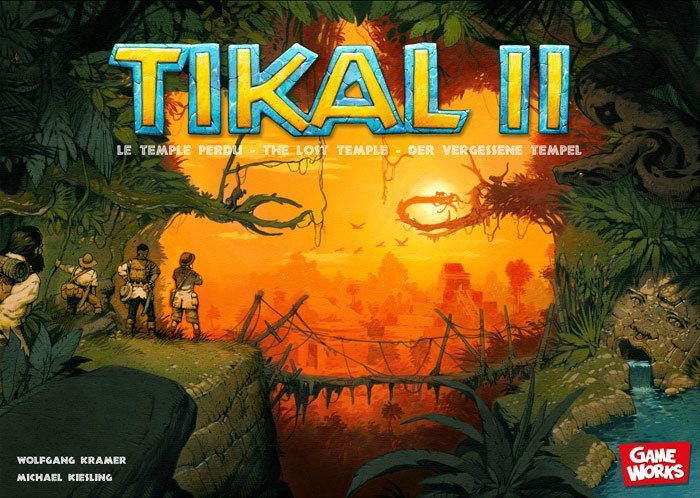
A game of expedition in which each player is an explorer searching a lost temple over two rounds. Points come from excavating rooms, collecting keys and altars, and delivering treasures at seaplanes. The player with the most points after the final scoring wins.
Spielaufbau
Place the board in the middle of the table. Each player takes a colour, a camp, 20 flags and a tent, and places the tent beside the camp with the flag and key side up, pointing left. Put each explorer outside the temple, each equipment chest on the 0/100 space of the scoring track, and each pirogue on the orange starting site.
Shuffle the 24 action tiles and place them on the six sites. With 4 players, put 4 face up on each site. With 3 players, first remove the three tiles with a 4 on the back. With 2 players, first remove the eight tiles with a 3 or 4 on the back. Shuffle the remaining tiles and distribute them among the six sites as the rulebook's diagram shows.
Shuffle the 6 sanctuaries into a face-up pile, put the treasure room underneath, and place the pile on its space. Put the price wheel on its circle with the numbers lined up against the five treasure symbols. Shuffle the 10 light-coloured rooms into a face-down pile. Sort the 35 keys by colour into five face-up piles beside the board. Shuffle the 13 special cards into a face-down draw pile. Make a pile of the 8 secret passage tokens. Shuffle the 25 treasure tokens into three roughly equal face-down piles, chest side up.
Starting with the first player, each player chooses 2 keys from the stock and places them face up in front of his camp as his backpack.
Ein Spielzug
Each turn has two phases.
1) Pirogue phase (mandatory). Take one action tile still on the board and apply its effects. You may take a tile on your current site, or sail clockwise along the river to another site. Sailing is free, but you may not go more than 5 sites in one move. Each time your pirogue passes through the forest, pay one key from your backpack to the stock. If you cannot pay, move your equipment chest back 10 spaces. Each time your pirogue passes a seaplane, you may deliver treasures: discard as many treasures of one type as you like, score the value shown on the price wheel, then turn the wheel one space clockwise. Delivery requires moving your pirogue past a seaplane. If a tile has several actions, you may do them in any order.
2) Explorer phase (optional, but strongly advised). First move your explorer through discovered rooms to a room where you have no flag. You may pass through a door only if you have a key of that colour in your backpack, and keys are not spent for doors. You cannot move through empty temple spaces. Then excavate: choose an unoccupied bonus space in that room and place a flag on it to gain its points, special card or treasure. Placing a flag ends your movement. You may place only one flag of your colour per room.
Light-coloured rooms score extra: 1 point for each door in the new room and 1 point for each door of the same colour in rooms where you already have a flag.
Secret passages let you cross one wall or one door without a key, but each token is returned to the stock when used. Stopping in the room or leaving the same way you entered must follow the rules shown in the examples.
If you cannot make any new excavation, you may buy a key for 10 points, which is subtracted from your score.
Spielende
The first round ends when all six sites are empty of action tiles. The player who took the last tile finishes his turn, then an intermediate scoring takes place. The first player for the second round is the player who played last in round one, and play goes in the opposite direction. Pirogues return to the orange start site, explorers stay where they are, and the action tiles are gathered, reshuffled and redistributed as shown on the rulebook's page.
The second round ends the same way. Then each explorer makes one final move to place a last flag and score. After that, the final scoring takes place and the game ends.
Wertung
Intermediate and final scoring each count the following:
- Keys: only keys in the camp count. Keys in the backpack never score. Scoring uses a table by number of different keys, with a maximum of 15 points for a full set of five.
- Altars: for each sanctuary, among players with a flag in that room, the player with the most keys of the matching colour scores 3 points. Ties share the 3 points. If no flag holder has a key of that colour, each flag holder scores 3 points. Doubles are counted separately. The multicoloured altar counts all keys regardless of colour.
The final scoring also includes:
- Undelivered treasures: 1 point each.
- End-of-game special cards: points as shown on the cards.
- The treasure room, which scores a large number of points.
Keys hidden face down are turned up for scoring at the end. The player with the most points wins. If players tie, they share the victory.
Varianten
Additional exploration/key option: once per round, using the option shown on the tent, a player may either make an extra exploration at any point in his turn, or take a key into his backpack. Turn the tent over after using it so it can be used again next round.
Short game: play without the additional exploration/key option, using only the neutral side of the tents. This shortens the game but removes some tactical depth.
More control variant: use two treasure draw piles and place 3 treasures face up on the board. A player may take one of the face-up treasures instead of taking from a pile. A taken face-up treasure is immediately replaced from the top of either pile.
Änderungen
- Varianten, von dem Entwurf aus der Anleitung, 23. November 2026 (wird jetzt angezeigt)
- Wertung, von dem Entwurf aus der Anleitung, 23. November 2026 (wird jetzt angezeigt)
- Spielende, von dem Entwurf aus der Anleitung, 23. November 2026 (wird jetzt angezeigt)
- Ein Spielzug, von dem Entwurf aus der Anleitung, 23. November 2026 (wird jetzt angezeigt)
- Spielaufbau, von dem Entwurf aus der Anleitung, 23. November 2026 (wird jetzt angezeigt)
- Überblick, von dem Entwurf aus der Anleitung, 23. November 2026 (wird jetzt angezeigt)