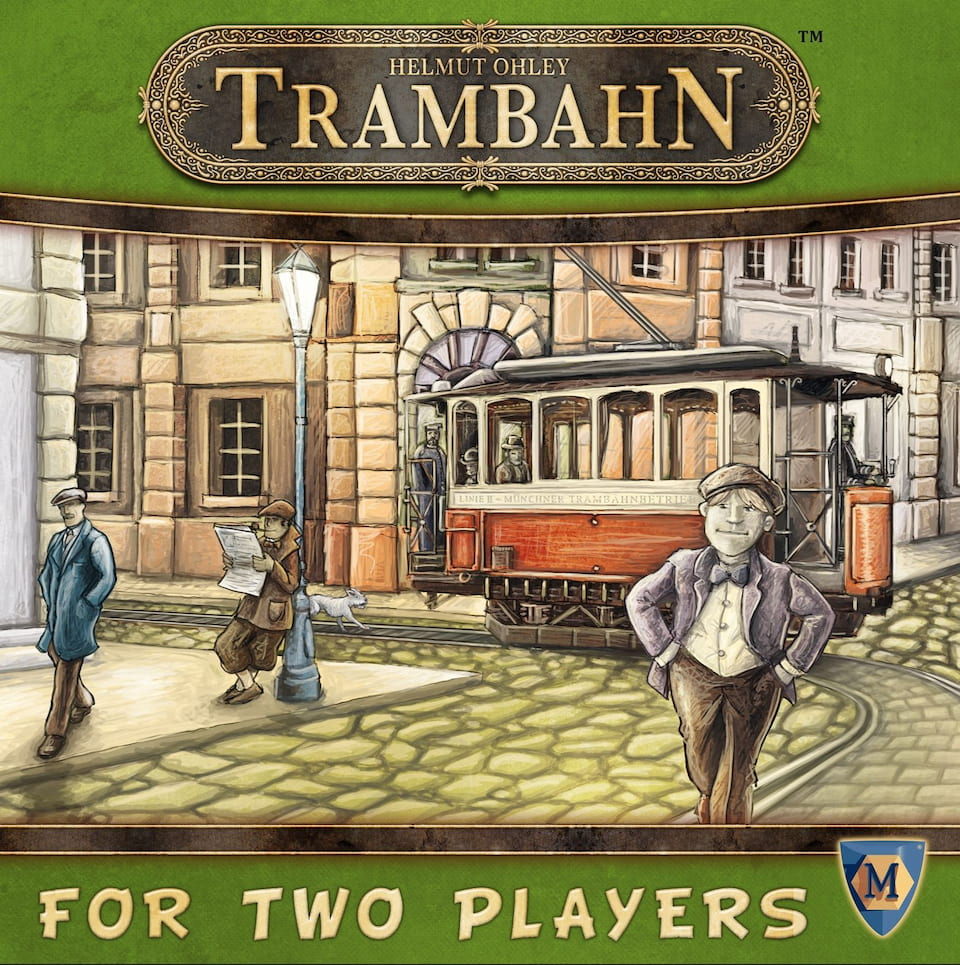
Regeln von Trambahn
Überblick
Two players run rival tramway companies. Each turn they add passengers to color rows and build station columns in ascending value order, and they buy tramway cards to score those columns. A scoring is triggered when a color row reaches four passengers or a column reaches eight cards. After 10 regular scorings and any extra tours, the player with the most victory points wins.
Spielaufbau
Shuffle the station and conductor cards and place them face down as the draw pile, money side up. Sort the tramway cards into stacks by value, with the electric (4) cards at the bottom, the steam (3) cards in the middle and the horse (2) cards on top.
The player who most recently used a tram starts and takes the scoring pad and a pen. The start player takes 12 cards from the draw pile as a face-down money pile. The other player takes 15 cards the same way. Each player then draws 6 cards as a hand. Keep hands secret, and do not look at the money cards.
Place the four terminal station cards in a line, leaving room beside each one for a row of passengers. Leave space in front of each player for their route columns.
Ein Spielzug
On your turn, carry out these steps in order:
- Place passengers: Play one or two cards from your hand as passengers, adding each to the row next to the terminal station of the matching color. Two cards need not share a color. Conductor cards may go into any row. If a row reaches its fourth passenger, scoring for that color happens immediately.
- Place stations: Play any number of cards from your hand to your columns. Each column holds one color, and its cards must increase in value, though you may skip values. If a card cannot join an existing column, start a new one. A column is complete when a value 10 card is added. Conductor cards may be added to any column that is not complete. If a column reaches its eighth card, an extra tour is triggered immediately.
- Income: Place any number of cards from your hand on your money pile. Each card is worth 1,000 marks.
- Purchase trains: Buy any number of available tramway cards by paying their cost from your money pile only. Discard the cards used. Each purchased tramway card must be assigned at once to one of your columns that has no tramway card yet, and it cannot be moved later. Each column needs its own tramway card. Refill the tramway supply only at the end of your turn.
- Draw new cards: Remove any columns still lacking a tramway card and place their cards on your money pile. Then draw until you hold 6 cards. When the draw pile runs out, both players discard half of their money pile (rounded down), and the discard pile is shuffled to form a new draw pile.
Spielende
The game ends immediately after the 10th regular scoring. Extra tours do not count as regular scorings and cannot trigger the end of the game. An extra tour cannot be scored in the same action that triggers the end of the game.
Wertung
When a color row gets its fourth passenger, both players score all their columns of that color, then discard that row's four passengers. Columns stay in play.
To score a column, add the values of its station and conductor cards and multiply by the value of its tramway card (2, 3 or 4). Conductor cards have no value of their own, but they count toward the eight-card total. Tramway cards do not count toward the eight cards.
When a column reaches eight cards, score it immediately as an extra tour. Each column can give only one extra tour. Adding more cards later does not trigger another.
Keep score on the pad. Each player adds their regular scores and their extra tour scores. The highest total wins. If the totals are tied, the player with the bigger money pile wins. If still tied, play again to decide the winner.
Änderungen
- Wertung, von dem Entwurf aus der Anleitung, 22. November 2026 (wird jetzt angezeigt)
- Spielende, von dem Entwurf aus der Anleitung, 22. November 2026 (wird jetzt angezeigt)
- Ein Spielzug, von dem Entwurf aus der Anleitung, 22. November 2026 (wird jetzt angezeigt)
- Spielaufbau, von dem Entwurf aus der Anleitung, 22. November 2026 (wird jetzt angezeigt)
- Überblick, von dem Entwurf aus der Anleitung, 22. November 2026 (wird jetzt angezeigt)