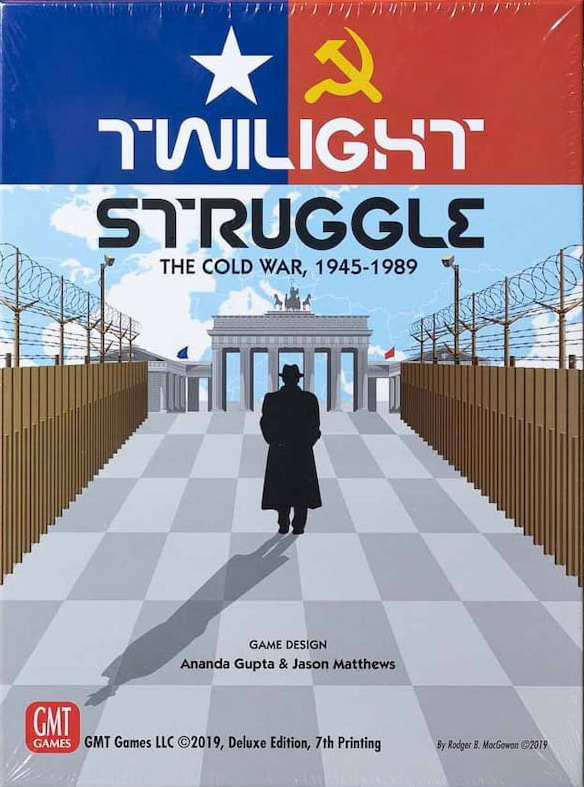
Regeln von Gleichgewicht des Schreckens
Überblick
Twilight Struggle is a two-player card-driven game of Cold War rivalry between the USSR and the US, played over ten turns. Players spend cards as Events or Operations to place Influence, contest countries, and score Victory Points through regional scoring and other effects. A player wins by reaching 20 VP or by controlling Europe when its scoring card is played, while nuclear war at DEFCON 1 ends the game immediately in the phasing player's loss.
Ein Spielzug
Each turn follows a fixed order:
- Improve DEFCON by one level if it is below 5.
- Deal cards up to a hand size of 8 (turns 1-3) or 9 (turns 4-10). The China Card does not count toward the hand.
- Headline Phase: each player secretly picks a card, then both are revealed and their Events resolve. The higher Operations value goes first, with a tie going to the US. Scoring cards count as zero and resolve second. The China Card cannot be played here.
- Action Rounds: the USSR goes first, then the US, alternating one card each. Six rounds in turns 1-3, seven in turns 4-10. Each card is played either as an Event or for Operations, and a player may not skip a play. One card is normally held at the end of the turn, but scoring cards cannot be held.
- Check Military Operations: a player who spent fewer Military Operations than the current DEFCON number gives the opponent 1 VP per missing point. Then reset Military Operations markers to zero.
- Optional in tournament play: reveal held cards.
- Flip The China Card face up if it was passed face down.
- Advance the Turn marker. Mid War cards are added after turn 3 and Late War cards after turn 7.
Operations points may be spent on one of four uses: placing Influence (1 point per marker in a friendly or uncontrolled country, 2 in an enemy-controlled country, with markers placed adjacent to existing friendly markers), Realignment rolls (1 point; each player rolls a die with modifiers, and the higher roller removes the difference from the opponent's Influence), Coup attempts (roll a die, add the card's Operations value, and compare against twice the target's Stability), or one Space Race attempt. Coups and War Events also advance the Military Operations track.
Spielende
The game ends immediately if DEFCON reaches 1; the phasing player who caused it loses. A player reaching 20 VP wins at once. Controlling Europe when the Europe Scoring card is played also wins instantly. If none of these happens by the end of turn 10, the final scoring is performed.
Wertung
Regional scoring happens when a region's scoring card is played, or for every region at the end of turn 10. A superpower has Presence in a region if it controls at least one country there. It has Domination if it controls more countries than its opponent and more Battleground countries, and at least one non-Battleground and one Battleground country. It has Control if it controls more countries and all of the region's Battlegrounds. Points are awarded for Domination (scored per the region's rules), for each controlled Battleground country, and for each controlled country adjacent to the enemy superpower. Each player's points are totalled and the difference is moved on the VP track toward the higher scorer. Other VP come from certain Events, the Space Race (where the first to reach a box gets the larger number, the second the smaller), and failed Military Operations. Where both players earn points from the same card, only the difference counts. At the end of turn 10, if the VP marker is positive the US wins, if negative the USSR wins, and zero is a draw.
Varianten
- Tournament play (optional): all held cards are revealed at the Reveal Held Card step, and a player holding a scoring card loses at once. Sides and starting VP can be decided by a bidding process: a randomly chosen player bids VP for a side, the opponent may counter-bid, and once both pass the winning bid is applied to the VP track.
- The rulebook also describes a playing-time-saving option through shorter scenarios implied by the game length, but no separate solo or team rules are given.
Änderungen
- Varianten, von dem Entwurf aus der Anleitung, 22. November 2026 (wird jetzt angezeigt)
- Wertung, von dem Entwurf aus der Anleitung, 22. November 2026 (wird jetzt angezeigt)
- Spielende, von dem Entwurf aus der Anleitung, 22. November 2026 (wird jetzt angezeigt)
- Ein Spielzug, von dem Entwurf aus der Anleitung, 22. November 2026 (wird jetzt angezeigt)
- Überblick, von dem Entwurf aus der Anleitung, 22. November 2026 (wird jetzt angezeigt)