Regeln von Valdora
Überblick
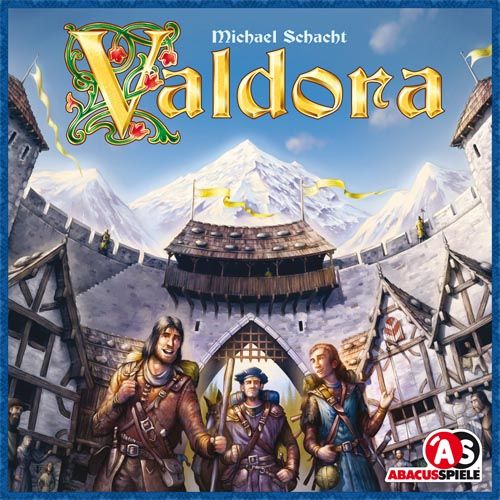
Valdora is a game for 3 to 5 players in which you travel between cities, buying equipment and commissions, loading gemstones, and delivering them to patrons. Completing commissions earns victory points and craftsmen, and craftsmen let you open workshops. The player with the most points at the end wins.
Spielaufbau
Place the gameboard in the middle of the table and put the gemstones into a bag, mix them, then draw 6 at random for each road space. Shuffle each pile of equipment and commission cards separately, have another player cut each pile, and place them on the book frames: equipment on the two cities with rucksacks (A and B), commissions on the two cities with parchments (C and D). Sort the craftsman tiles by color around the craftsman board, and with 3 players remove one violet, red, blue and green tile. Place the workshop and bonus tiles face-up as a supply, and put the summary card beside the board.
Each player takes a pawn and places it on the city with the harbor, plus both start cards in their color, a player aid and an adventurer card with the side without provisions face-up. Place the adventurer's equipment start card to its left and show the 3 commissions and 6 coins printed along the card's bottom edge as a reminder. Return unused components to the box. Agree on a start player, who takes 1 coin from the bank. Going clockwise, each other player takes one more coin than the previous player. Keep the remaining coins as the bank.
Ein Spielzug
On your turn, first move your pawn along a road in any direction, but not beyond the next city, and not ending on the space you started on. If you hold provisions, you may pass through one city and then move again up to the next city, and turning your adventurer card to the side without provisions uses them up.
If you end on a space with other pawns, pay each of those players 1 coin, unless you are on a silver mine. If you cannot pay, you may not move there. A player cannot hold more than 6 coins, and any excess paid goes to the bank.
Then carry out exactly one action:
- Purchase at a city with books: buy any number of equipment (1 gold each, placed to the left of your adventurer card, at most one of each item) or commissions (1 coin each, placed to the right, at most 3 incomplete at a time). You may only buy the topmost visible card, or turn pages: the first page each turn is free, and each further page costs 1 coin. Turning a page counts as this action.
- Load gemstones on a road or harbor space: place a gemstone onto an empty matching equipment card, paying any coin cost shown. On a harbor space you may only take gemstones from the discard space, up to the number of ships there. You may also unload a gemstone you carry to the discard space and reload.
- Complete commissions at a patron's house: pay the gemstones and coins required for any of your incomplete commissions for that house. Gemstones go to the discard space and coins to the bank, and completed commissions go beneath your adventurer card. Each completed commission also hires a craftsman of the patron's color from the craftsman board, and if you own the matching workshop you receive a bonus tile.
- Replenish silver at a silver mine: raise your coins to 6.
- Take provisions at any city: turn your adventurer card to the side with provisions.
Spielende
The game ends when only craftsman tiles of one color remain next to the craftsman board. The current round is finished so that every player has had the same number of turns, and then scoring takes place.
Wertung
Each player returns their incomplete commissions to the box. Then count points:
- Each completed commission: the points printed on it.
- Each color in which you have at least one craftsman: 10 points.
- Each workshop you own: the points printed on it.
- Each bonus tile: 10 points.
- Each gemstone on your equipment cards: 1 point.
The player with the most points wins. If players tie, the tied player with the most coins wins. If there is still a tie, the tied players share the victory.
Änderungen
- Wertung, von dem Entwurf aus der Anleitung, 23. November 2026 (wird jetzt angezeigt)
- Spielende, von dem Entwurf aus der Anleitung, 23. November 2026 (wird jetzt angezeigt)
- Ein Spielzug, von dem Entwurf aus der Anleitung, 23. November 2026 (wird jetzt angezeigt)
- Spielaufbau, von dem Entwurf aus der Anleitung, 23. November 2026 (wird jetzt angezeigt)
- Überblick, von dem Entwurf aus der Anleitung, 23. November 2026 (wird jetzt angezeigt)