Regeln von Viscounts of the West Kingdom
Überblick
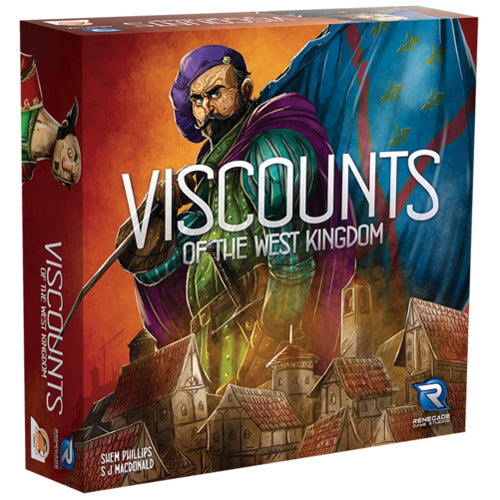
Viscounts of the West Kingdom is set in a declining kingdom where each player is a viscount competing for influence. Players earn victory points (VP) by constructing buildings, transcribing manuscripts, placing workers in the castle and acquiring deeds. The player with the most VP at the end wins.
Spielaufbau
- Assemble the 5 main board segments faceup on the correct side for the player count, shuffle them and join them in a circle. Lock the castle into the middle in a random orientation.
- Shuffle the neutral townsfolk cards into 5 roughly equal piles and place one on each marked space. Build 5 manuscript piles of 7 each, with the grey-backed manuscript showing on top, and place them on the marked spaces. Do not look through the piles.
- Place silver, ink wells, gold, stone and multiplier cards in a main supply, with the cleric bonus cards and castle leader card nearby.
- Each player takes a player board and the pieces in their colour: workers, viscount, trading posts, guildhalls, workshops, corruption and virtue markers, and 8 starting townsfolk cards plus starting icons. Randomly choose a start player and give them the start player marker.
- Shuffle the player cards and lay out one more than the number of players, each with a hero townsfolk card below it. In reverse turn order, each player picks a pair, places their viscount on the matching numbered space, gains the resources, silver, debts and deeds listed on the player card, and resolves any extra steps at the bottom of the card. Each player then forms a draw pile from their hero card, their 8 starting townsfolk and any neutral townsfolk gained, and draws a starting hand of 3.
- Place the poverty and prosperity cards to one side. Stack debt cards on and below the poverty card, and deed cards on and below the prosperity card, with the number on top set by player count.
Ein Spielzug
Players take turns clockwise from the start player. Each turn has six phases, laid out left to right on the player board.
- Card management: Shift every townsfolk card on your board one space right. Cards pushed off the edge go to your discard pile and resolve any drop-off effect. Then play one card from your hand to the left-most space. Criminal cards give corruption for each criminal icon on your board. Resolve any immediate effect. You must always keep at least 3 cards.
- Movement: Move your viscount clockwise along the board for at least the silver value shown on the card you just played. You may pay 1 silver per extra space. You cannot move backwards. If you finish on a space with another viscount, that opponent may rearrange their cards.
3. Primary action: Take one of four actions:
- Trade (outside path): count merchant icons and criminal icons, then spend silver or the adjacent townsfolk's dismiss cost. Exchange as you can afford: silver, ink wells, gold or stone, destroying cards, or flipping debts and deeds.
- Construct a building (outside path): count builder icons and criminals, spend stone or dismiss an adjacent townsfolk. Build in an empty spot on your viscount's side of the river, gaining the spot's effect and any link effects.
- Place workers (inside path): count noble icons and criminals, spend gold or dismiss a townsfolk. Place 1, 2, 3 or 4 workers for 1, 3, 5 or 8 noble icons. Groups of 3 or more of your workers in castle sections move inward or around the castle, with rewards.
- Transcribe a manuscript (inside path): count cleric icons and criminals, spend ink wells or dismiss a townsfolk. Meet the manuscript's icon requirement to collect it.
Dismissing a matching townsfolk card (once per turn) lets you use its icons for that action and gain its top-right effect, then remove it from the game.
- Recruit: Pay the silver cost of the townsfolk card next to your viscount to hire it into your discard pile, once per turn. Resolve its immediate effect.
- Resolve collision: If your virtue and corruption markers share a space, resolve the collision effects in order: workshop bonuses, townsfolk collision effects, your rewards above the markers, then opponents' rewards below. Then reset both markers to the far ends.
- Draw cards: Draw up to your hand limit (starting at 3). If your draw pile is empty, shuffle your discards to form a new one. Then gain 1 corruption if you have criminal icons, or 1 virtue if you do not.
Spielende
The game ends once the poverty card or the prosperity card is revealed. The current round finishes, then one final round is played so every player has the same number of turns.
If both cards are revealed, the kingdom is divided and both are scored. Ongoing effects on townsfolk cards do nothing during final scoring.
Wertung
Add up each player's points from:
- Constructed buildings, as printed along the top of the player board, based on how many of each type were built.
- Workers in the castle: each worker scores the value of its tier.
- Transcribed manuscripts: printed points on certain manuscripts, plus points for sets of different ribbon colours.
- The castle leader card (5 VP) and cleric bonus cards (3 VP each).
- Unpaid debts: -2 VP each.
- Acquired deeds: 1 VP each.
- Approved deeds: 3 VP each.
- Poverty card, if revealed: the players with the most, second-most and third-most flipped deeds receive 12, 8 and 4 VP. A player needs at least one flipped deed to qualify. Ties split the tied places' points evenly.
- Prosperity card, if revealed: scored the same way, using flipped debts instead of deeds.
In games with fewer than 3 players, the middle reward (8 VP) is ignored for both cards.
The highest total wins. A tie is broken by the most remaining silver and resources. If still tied, the tied players share the victory.
Varianten
Solo play pits one player against an AI opponent, with the AI taking the final turn of each game. Setup changes as follows:
- Flip a player board to its AI side and place the AI's buildings, workers, markers, viscount and reference card.
- Remove one pair of player cards and hero cards from the standard setup, so 2 pairs remain for a standard solo game.
- Set up the AI's starting scheme cards and future scheme cards, using the AI board's left card space to decide which schemes to remove.
On the AI's turn, flip the top scheme card from its draw pile and resolve its effects from top to bottom. The AI follows priority charts and the AI reference card when choosing resources, flipping cards, placing workers and constructing buildings. The AI scores VP as a human does, plus 1 VP per leftover resource.
To make the AI harder, shuffle 1, 2 or 3 future scheme cards into its scheme draw pile during setup. The rulebook includes four different AI opponents to try against.
Änderungen
- Varianten, von dem Entwurf aus der Anleitung, 22. November 2026 (wird jetzt angezeigt)
- Wertung, von dem Entwurf aus der Anleitung, 22. November 2026 (wird jetzt angezeigt)
- Spielende, von dem Entwurf aus der Anleitung, 22. November 2026 (wird jetzt angezeigt)
- Ein Spielzug, von dem Entwurf aus der Anleitung, 22. November 2026 (wird jetzt angezeigt)
- Spielaufbau, von dem Entwurf aus der Anleitung, 22. November 2026 (wird jetzt angezeigt)
- Überblick, von dem Entwurf aus der Anleitung, 22. November 2026 (wird jetzt angezeigt)