Regeln von YINSH
Überblick
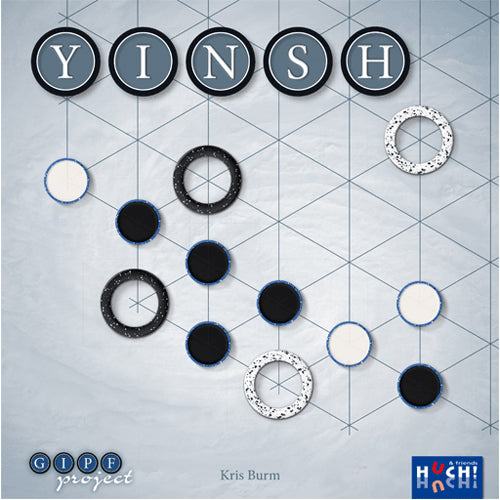
YINSH is a two-player game about moving rings on a board, flipping markers they jump over, and forming rows of five markers in your own color. Each row you form costs you a ring, and the first player to remove three rings wins.
Spielaufbau
- Place the board between the players so the lettered lines run from one player to the other. Each player has room for three rings on their side.
Draw lots to decide who starts. The starting player takes the five white rings and plays white; the other player takes the five black rings.
Put the markers beside the board where both players can reach them. This supply is the pool.
Starting from an empty board, players take turns placing one ring at a time on any intersection, including edge intersections, until each has placed all five rings.
Ein Spielzug
On your turn, take a marker from the pool and place it color-side up in one of your rings. Then move that ring (leaving the marker where it is) in a straight line to an empty space. A ring may move over one or more empty spaces, or it may jump over one or more markers of either color in an unbroken line, landing in the first empty space directly after them. A ring may not jump over other rings. A ring that moves over empty spaces first may then jump, but after jumping it cannot move further over empty spaces.
If the ring jumped no markers, the turn ends. If it jumped markers, flip every jumped marker to its opposite color, including your opponent's markers. Do not flip the marker you placed in the ring at the start of the move. Markers are never moved, only flipped.
A row is five markers of your color in a straight, adjacent line; rings do not count. When you form a row, remove those five markers to the pool, then remove one of your rings and place it on one of the three spaces on your side. If a move forms a longer line, you choose which five consecutive markers to remove. If one move forms two rows that do not intersect, remove both and two rings. If they intersect, you choose which one to remove, and the other is no longer complete, so only one ring is removed.
You may form a row for your opponent, who must then remove that row and a ring before making their move, choosing which ring. If one move forms rows for both players, resolve your own row first, then your opponent removes theirs.
Spielende
The game ends as soon as a player has removed three rings from the board, which means they have formed three rows and win.
If one move forms both players' third rows, the player making the move wins, because they can remove their third ring first.
If all markers are placed on the board before anyone has won, the game ends and the player who has removed more rings wins.
Wertung
There is no points system. Rings removed are the score: the player who has removed three rings wins outright. If all markers are placed and no one has three rings out, the player with more removed rings wins. If both players have removed the same number, the game is a draw.
Varianten
Blitz version: the aim is simpler. You play the normal rules, but the first player to form a single row of five markers in their color wins. The rulebook suggests this for short games and for learning the game.
Änderungen
- Varianten, von dem Entwurf aus der Anleitung, 23. November 2026 (wird jetzt angezeigt)
- Wertung, von dem Entwurf aus der Anleitung, 23. November 2026 (wird jetzt angezeigt)
- Spielende, von dem Entwurf aus der Anleitung, 23. November 2026 (wird jetzt angezeigt)
- Ein Spielzug, von dem Entwurf aus der Anleitung, 23. November 2026 (wird jetzt angezeigt)
- Spielaufbau, von dem Entwurf aus der Anleitung, 23. November 2026 (wird jetzt angezeigt)
- Überblick, von dem Entwurf aus der Anleitung, 23. November 2026 (wird jetzt angezeigt)