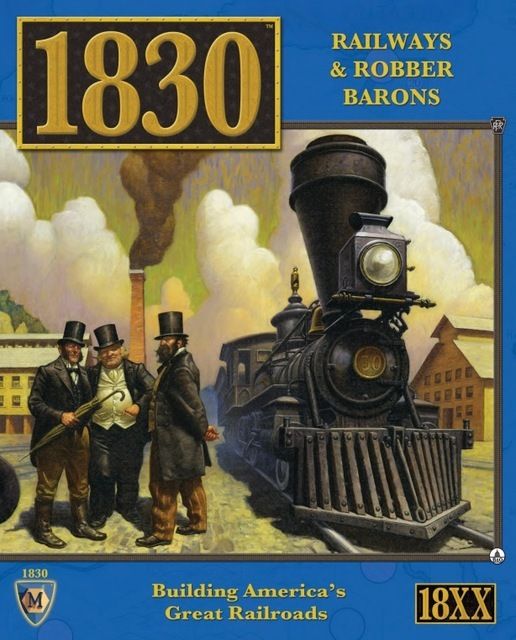
Reglas de 1830: The Game of Railroads and Robber Barons
Resumen
1830 is a railroad investment and building game in which players buy and sell shares in eight railroad corporations, build track, and run trains to earn revenue. Each player's aim is to end the game with the most wealth, counted as cash plus the value of their stock and any private companies they still hold. Owning the largest stake in a corporation makes you its president, who controls its operations.
Preparación
Choose a banker by agreement; if no agreement, the most experienced player takes the role. The banker hands out starting money by player count: $1200 for 2 players, $800 for 3, $600 for 4, $480 for 5, and $400 for 6. Seating is decided by the banker dealing numbered markers, and the player with marker 1 takes the priority deal card. Place the six private company certificates face up by the board and stack each corporation's shares with its president's certificate on top as the initial offering. Stack the trains with the lowest types on top and place the corporation charters beside the board. Then, starting with the priority holder and going clockwise, each player takes a buy-bid turn until all private companies are bought. On a turn you may pass, pay face value for the unsold private company with the lowest face value, or bid on another one. A bid must beat the face value or the current bid by at least $5. If the lowest-value company has bids, it is auctioned among the bidders, with the lowest bidder opening. If every player passes without a sale, the Schuylkill Valley price drops by $5 each round until someone takes it, and it is free at $0. Once all private companies are sold, the first stock round begins.
Un turno
In a stock round, starting with the priority deal card holder and going clockwise, each player either passes or takes a turn. On your turn you may sell any of your certificates, buy one certificate, and sell again. The first purchase in a corporation must be its president's certificate, which you pay for at a starting share value you choose, equal to twice that value. Certificates may not be sold in the first stock round, and you cannot buy a corporation you already sold in the same round. Sold shares go to the bank pool and push that corporation's share price down. The stock round ends when all players pass in succession. The player to the left of the last buyer or seller receives the priority deal card. In an operating round, private companies pay their revenue first. Then each floated corporation operates in order of share value, with ties resolved by token position. When a corporation operates, its president may lay or upgrade one track tile, place a station token, run each train on a route of up to its train type in cities, collect revenue, pay dividends or keep the money in the treasury, adjust the share price, and buy trains. A corporation floats once 60% of its shares have left the initial offering. Trains are bought in order of type, and each new train type starts a new phase that changes allowed tiles, train limits, and the number of operating rounds between stock rounds.
Fin de la partida
The game ends when the bank runs out of money. If the bank runs dry during a stock round, that round is finished, then the next set of operating rounds is completed, and the game ends. If it runs dry during an operating round, the current set of operating rounds is completed first. A player who goes bankrupt, meaning they cannot raise enough money to force a train purchase even after selling all their shares, ends the game immediately.
Puntuación
Each player's wealth is their personal cash, plus the total value of their shares (number of shares times the corporation's current share value), plus the face value of any private companies they still own that have not been closed. Private companies owned by a corporation or already closed count for nothing. The wealthiest player wins. The rulebook does not state a tie-breaking rule.
Variantes
The 1830+ board, printed on the reverse of the game board, is a larger map extended to the south with more cities and some altered hexes, and it adds a third tier of landscape costs. The rulebook says it can be used for standard play, though a shortage of yellow tiles is likely. The bank's total money can be changed to make the game shorter or longer. The player-count table sets starting money and certificate limits for 2 to 6 players. The rulebook specifies the Sell-Buy-Sell order within a turn, and says variants may allow Buy-Sell or Sell-Buy instead. Optional revenue tracking markers may be used with a separate revenue board.
Cambios
- Variantes, por el borrador del reglamento, 23 de noviembre de 2026 (se muestra ahora)
- Puntuación, por el borrador del reglamento, 23 de noviembre de 2026 (se muestra ahora)
- Fin de la partida, por el borrador del reglamento, 23 de noviembre de 2026 (se muestra ahora)
- Un turno, por el borrador del reglamento, 23 de noviembre de 2026 (se muestra ahora)
- Preparación, por el borrador del reglamento, 23 de noviembre de 2026 (se muestra ahora)
- Resumen, por el borrador del reglamento, 23 de noviembre de 2026 (se muestra ahora)