Reglas de Alhambra
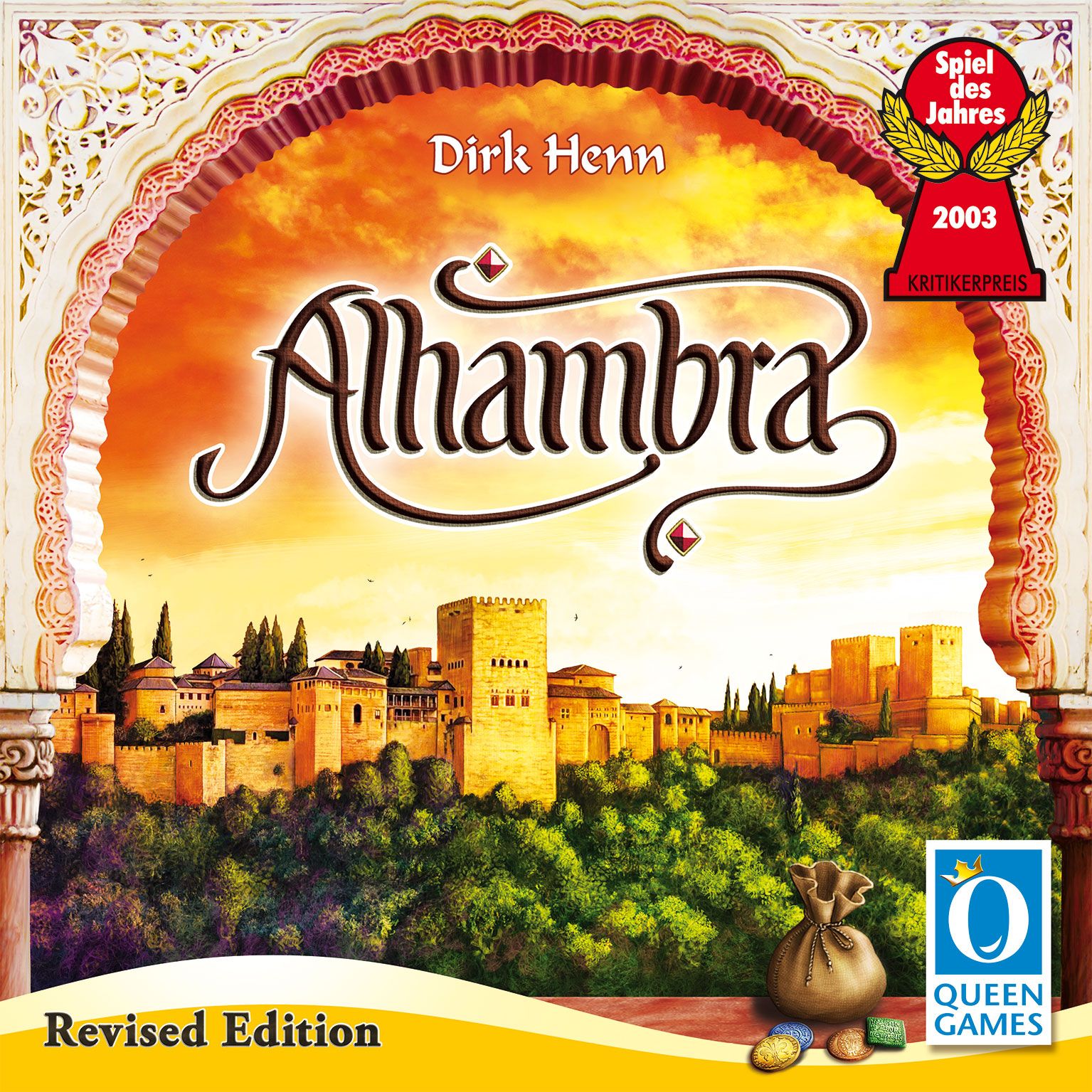
Resumen
Alhambra is a game where players buy building tiles with money cards and construct their own Alhambra. Points come from having the most of each building kind during scoring rounds, plus the longest outer wall around your Alhambra. The player with the most points at the end wins.
Preparación
- Each player gets a starting tile and two counters of one colour. Place one counter on the starting tile and one in the bottom left corner of the scoring board.
- Put the 54 building tiles in the bag. Draw 4 at random and place them on market squares 1 to 4 in order.
- Each player gets a reserve board and places it in front of them.
- Set aside the two scoring cards. Shuffle the other money cards and deal them face-up to each player, one card at a time, until each player's total is 20 or more. Players then pick up their cards and keep their money secret.
- The starting player has the fewest cards. Ties go to the lowest money total, then to the youngest player.
- Place 4 money cards face-up beside the market.
- Divide the remaining money into five roughly equal piles. Put the 1st scoring card in the second pile and the 2nd scoring card in the fourth pile. Stack the piles with the fifth at the bottom and the first at the top, then place the stack face-down beside the market.
Un turno
Play goes clockwise. On your turn, choose one of three actions:
- Take money: take one face-up money card, or several whose total does not exceed 5.
- Buy and place a building tile: pay at least the tile's price using the currency shown beside it in the market. No change is given, and the money you used goes to a discard pile. If you pay exactly, you get another action. Otherwise your turn ends. The market is not refilled during your turn.
- Redesign your Alhambra: see the rules below.
A bought tile goes into your Alhambra or onto your reserve board, which can hold any number of tiles. Bought tiles are normally placed at the end of your turn, in any order.
Building rules:
- Tiles must be upright, the same way round as your starting tile.
- Adjoining sides must match: wall meets wall, and open side meets open side.
- Every tile must be reachable on foot from the starting tile without crossing a wall or leaving the tiles.
- Each new tile must share at least one full side with your Alhambra, not just a corner.
- You may not leave enclosed empty spaces.
Redesign options (all must follow the building rules):
- Move a tile from your reserve board into your Alhambra.
- Move a tile from your Alhambra to your reserve board.
- Swap a reserve board tile with an Alhambra tile, placing it in exactly the same spot.
You may never remove or swap the starting tile. Redesigning ends your turn.
At the end of your turn, refill the market to four tiles and the money row to four cards. Then the next player begins.
Fin de la partida
The game ends at the end of a player's turn when there are not enough tiles left in the bag to refill the market to four.
The remaining market tiles go to the players holding the most money in that tile's currency. Players who tie for the most leave that tile on the market. Players may add tiles received this way to their Alhambra under the normal building rules.
Then the third and final scoring round is played. If two players are level at the top of the scoring board, the game is a draw.
Puntuación
Scoring rounds happen when a scoring card is drawn. The first two occur during play and the third at the end. Scores are calculated before the next player's turn.
Building points: for each building kind, the player with the most tiles of that kind scores the first-place points shown on the scoring card. Only the first round awards first place alone.
- Round 1: first place only.
- Round 2: first and second place.
- Round 3 (end of game): first, second and third place.
If players tie, they share the points for the places involved, adding those place values together and dividing by the number of tied players. Round down. You must have at least one tile of a kind to score it. Tiles on reserve boards do not count, and price does not matter.
Wall points: each wall segment on the outer edge of your longest connected outer wall scores 1 point. Internal walls, where two walls meet back to back, do not count. Record points on the scoring board by moving your counter one space per point.
All points are rounded down.
Variantes
Two players:
- Use three copies of each money card, but remove one copy of each, so 72 cards are used.
- An imaginary third player, Dirk, collects tiles but has no turns and builds no Alhambra. At the start, draw 6 random tiles from the bag and set them aside for Dirk, visible to both players.
- Directly after the first scoring round, Dirk receives 6 more random tiles from the bag.
- After the second scoring round, Dirk receives a third of the tiles remaining in the bag, rounded down.
- In scoring rounds, Dirk scores for having the most of each building kind, but not for a wall.
- When buying a tile, a player may give it to Dirk instead of placing it in their Alhambra or on their reserve board. Everything else follows the normal rules.
Cambios
- Variantes, por el borrador del reglamento, 23 de noviembre de 2026 (se muestra ahora)
- Puntuación, por el borrador del reglamento, 23 de noviembre de 2026 (se muestra ahora)
- Fin de la partida, por el borrador del reglamento, 23 de noviembre de 2026 (se muestra ahora)
- Un turno, por el borrador del reglamento, 23 de noviembre de 2026 (se muestra ahora)
- Preparación, por el borrador del reglamento, 23 de noviembre de 2026 (se muestra ahora)
- Resumen, por el borrador del reglamento, 23 de noviembre de 2026 (se muestra ahora)