Reglas de Artifacts, Inc.
Resumen
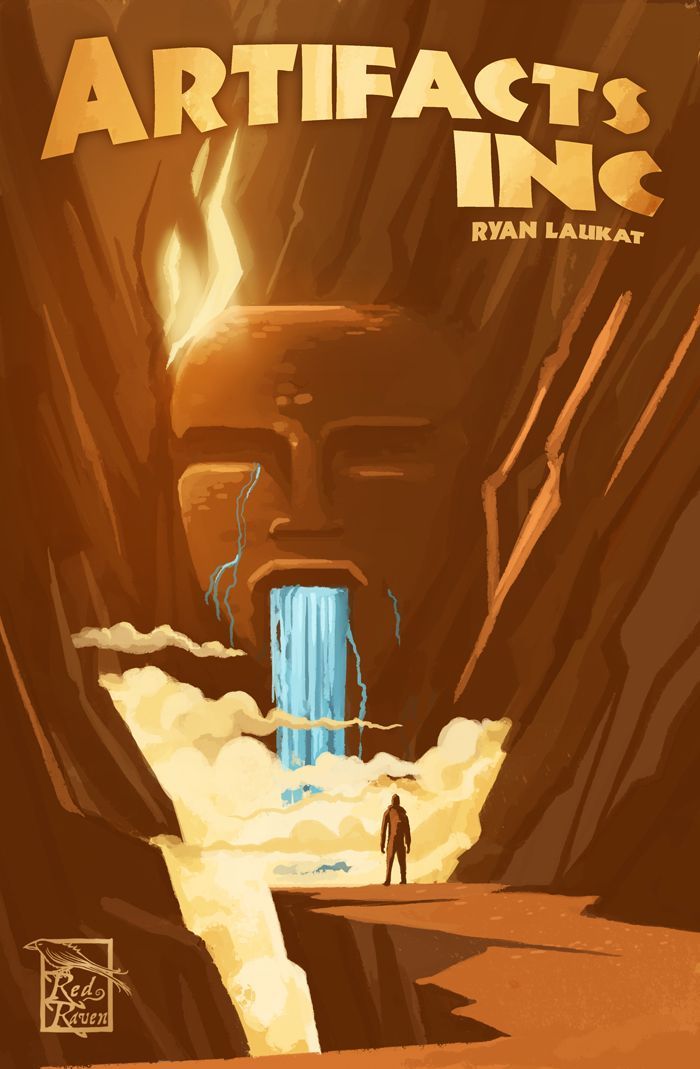
Artifacts, Inc. is a game for 2 to 4 players who run rival archeology companies in 1929 New York. Players roll adventurer dice, place them on cards to find artifacts, sell those artifacts to museums, and buy company assets. The first player to reach 20 reputation starts the end of the game, and the player with the most total reputation wins.
Preparación
- Separate the cards by type. The six public cards (4 Museums, Private Collectors, and Guide Work) have no type in the top right corner.
- Place the Reputation Board in the middle of the table. Stack the Underwater (U) cards in numerical order, lowest on the bottom, with the 2 on top. Put the dollar tokens and dice nearby as the supply. Cubes and dollars are unlimited; use something else to track them if they run out.
- Put the public cards in a row above the board. With 3 or 4 players, Museums use the 9-box side. With 2 players, use the 6-box side.
- Set the Level 1 sides of the asset cards face up. Shuffle each asset pile except the S pile. Put the A pile below the board, then B, then C, and deal 3 cards from each pile into a row beside it so 4 are visible. Put the D and E piles to the right of the board.
- Give each player the four S cards (Desert Expedition, Canyon Expedition, Headquarters, Adventurers) on their Level 1 sides, in one row. These cannot be moved later. Give each player a set of cubes.
- Roll 2 dice each to decide the first player; the highest sum goes first, and play goes clockwise. The 1st player takes 2 dollars, the 2nd and 3rd take 3 each, and the 4th takes 4. Each player puts a cube beside the board as their reputation marker.
Un turno
On your turn, roll a number of adventurer dice equal to the adventurer symbols on the cards you own. Then place the dice on actions. Each action holds one die that meets its requirement, and you perform the action right away. Dice can go on your asset cards, on public cards, or on the Dive space of the Reputation Board.
Asset actions:
- Expedition: place a cube on the card to gain one artifact. A card can hold any number of artifacts.
- Buy: buy one asset card from the center rows (A to E), or upgrade one owned card to its Level 2 side by paying its cost again. You may look at the back of available cards before buying, but only after placing a die here. Pay the cost in dollars to the supply. If the cost also lists a scroll, remove one cube from a Desert Expedition card you own. Place a new card next to one of your owned asset cards in your card rows. Upgraded cards keep any dice or cubes on them. Mark any reputation gained on the board.
Public actions:
- Museums: complete an order on a Museum card that matches its artifact type by discarding that many artifacts. Put a cube on the order so it is no longer available. Gain 1 dollar per artifact, plus the sale bonus listed on the card.
- Guide Work: gain 1 dollar.
- Private Collectors: sell any artifacts you own, of any mix of types. Gain 1 dollar per artifact discarded, plus 1 dollar for each type beyond the first.
- Dive: place one or more dice whose total is at least the number on the top Underwater card. This is the only action that lets you combine dice. You may gain at most one Underwater card per turn.
When all your dice are placed and their actions are done, take the dice back and pass the turn to the next player.
Fin de la partida
The game ends when one player reaches 20 reputation on the Reputation Board. Each remaining player in that round gets one more turn, so everyone has the same number of turns. If the player who reached 20 is last in turn order, the game ends immediately.
Puntuación
After the final turn, award Museum majority bonuses. On each Museum card, the player with the most cubes gets the reputation shown in the top right corner. If players tie on cubes, the player whose cube sits in the highest-ranked order box wins. Order boxes are ranked starting at the top left and moving left to right in ascending numerical order.
The player with the most total reputation wins. A player's reputation total is the sum of the visible reputation on their face-up asset cards, their Underwater cards, and any reputation from actions. If players tie on reputation, the player with the most dollars wins.
Cambios
- Puntuación, por el borrador del reglamento, 23 de noviembre de 2026 (se muestra ahora)
- Fin de la partida, por el borrador del reglamento, 23 de noviembre de 2026 (se muestra ahora)
- Un turno, por el borrador del reglamento, 23 de noviembre de 2026 (se muestra ahora)
- Preparación, por el borrador del reglamento, 23 de noviembre de 2026 (se muestra ahora)
- Resumen, por el borrador del reglamento, 23 de noviembre de 2026 (se muestra ahora)