Reglas de Assyria
Resumen
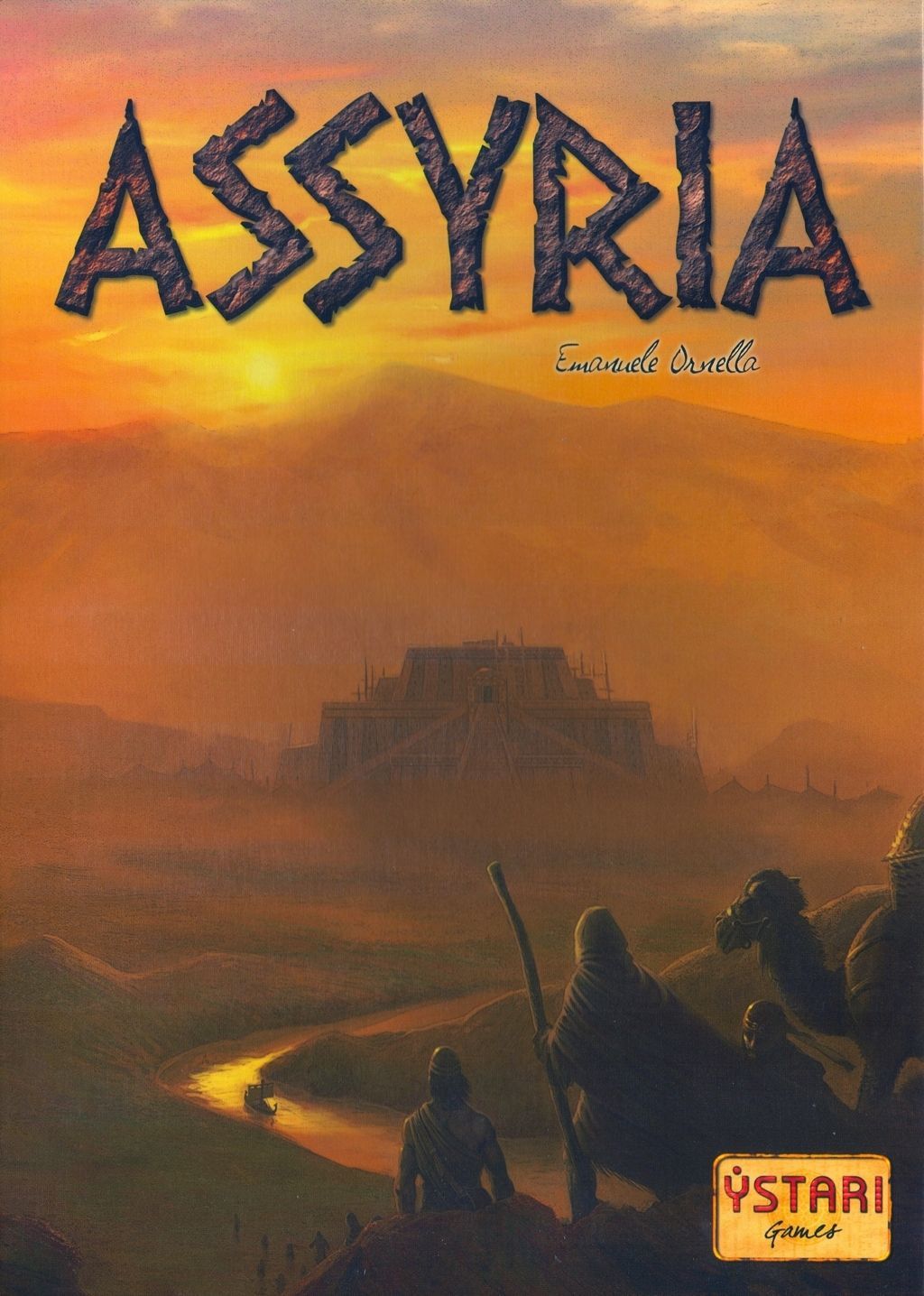
Players lead nomadic tribes in ancient Mesopotamia. Over three reigns they gather food, place huts and wells, and build ziggurats, then compete for control of Assur. The most advanced player on the score track takes control of Assur and wins.
Preparación
Place the board in the middle of the play area and set the grey wells beside it. Each player takes the pieces in their color and one Plow card, then places a disc at the start of the score track, the camel track and the offerings track. Shuffle the other discs onto the turn order track at random.
Shuffle the Food cards face down beside the board and put the Bonus card next to them. Place an Expansion card showing 4 in the first expansion slot, then shuffle the remaining Expansion cards face down beside the board.
The first player sets up the Food cards for sowing. Following turn order, each player chooses one of the four starting spaces and places a ziggurat base there.
Initial draft: the last player in turn order draws 4 Food cards, keeps one face up in front of them, and passes the rest to the next player, who does the same. This continues until the first player receives the final card. Then play the first turn's harvest.
Un turno
A game turn has three parts.
I - Farming: The first player draws 5 Food cards, one at a time, and lays them in a row by number of symbols (Wild cards on the right), then draws 5 more to form a second row, making 5 columns of 2 cards. In turn order, each player places their disc on a column and takes its 2 cards. The new turn order is then set by disc position, from left to right.
II - Expansion: Each player, in turn order, does the following:
1. New huts: Take huts equal to the current Expansion value (or all remaining) and place them on empty hexagons adjacent to your own huts or ziggurats.
2. Resupplying (mandatory): Discard Food cards to resupply huts showing a matching symbol. Each symbol resupplies one hut. Plow and Wild cards resupply one hut of any symbol. Extra symbols are lost. Resupplied huts are moved to the center of their hexagon. Played Plow cards go to their space on the board. Unused cards are kept.
3. Famine: Remove all huts that were not resupplied and return them to your stock.
4. Wells (optional): Place wells at the intersection of three hexagons where you have huts. Wells cannot be next to a ziggurat, between the two rivers, or on another well, and you cannot exceed the wells in stock.
5. Revenue and prestige: For each river, your first hut yields 3 camels and each later hut on that river yields 2, up to a maximum of 10 camels per turn. Advance your camel disc accordingly. Prestige: each hut between the rivers scores 2 points, each hut outside them scores 1, huts on a river score nothing, each ziggurat tile scores 1, and wells score 6, 5 or 4 points in the first, second or third reign. Wells score only in the turn they are built.
III - Actions: In turn order, each player spends camels, in whole or in part, on any of these:
- Build a ziggurat: costs 6 camels; place a base on one of your huts on a non-river hexagon not next to a well, returning that hut to stock.
- Extend a ziggurat: one level per ziggurat per turn. A center costs 3 camels and a roof costs 2. Each tile must go on the tile one size smaller.
- Create intrigue in Assur: place a hut on a dignitary for 4 (higher), 3 (middle) or 2 (lower) camels. You take the highest free space of that dignitary.
- Make an offering: spend 1 to 3 camels and advance your offerings disc by the same number of spaces.
- Buy a card: buy one available Food card for 1 or 2 camels (only one per turn), and a Plow card if you have none (at most one).
Camels may be saved for later turns.
End of turn: If the reign continues, the first player places a new Expansion card below the previous one. Players move their huts back to the bottom of their hexagons. If it was the last turn of the reign, a Flood happens first (see below).
Flood: I) All huts on river hexagons return to their owners' stock. II) Assur: players are ranked by influence and score points. III) Dignitaries: bonuses are paid, then dignitary huts return to stock. IV) Offerings: points are scored. V) Next reign: before the 2nd and 3rd reigns, the Bonus card is placed on its spot. The first player places a new Expansion card in the first slot.
Fin de la partida
The game ends after the flood at the end of the third reign. The reigns last 2, 3 and 3 turns.
Puntuación
Assur: each player's influence is 3 per hut on the higher dignitary, 2 per hut on the middle and 1 per hut on the lower. Players are ranked by influence and score points from the Expansion cards of the reign. The top player takes the sum of the Expansion cards, discards the highest card, and the next player scores the new total, and so on. Players with no hut on any dignitary are not ranked and score nothing. A tie in influence goes to the player with more huts placed on dignitaries, and then to the player with the highest hut on the board.
Dignitary bonuses: higher dignitary grants 1 point for 1 hut, 4 for 2 huts and 8 for 3 huts. Middle dignitary grants a Plow card to each supporting player, up to the limit of one per player. Lower dignitary grants 1 camel for each hut, moving the camel disc accordingly.
Offerings: each player scores their number of ziggurat sites multiplied by their position on the offerings track. Discs then return to the start.
Final bonus: 1 point per ziggurat tile, 1 point per Plow card, and 1 point per group of two remaining camels.
Winner: the player furthest along the score track takes control of Assur and wins. If several players tie for first place, all of them win.
Variantes
Three players: Use the cropped board with the marked starting places. Use 12 wells and 3 Plow cards. Draw 3 Food cards for the initial draft. During sowing, draw 4 Food cards twice.
Two players: Use the cropped board. Each player may choose any of the four starting places. Use 8 wells and 2 Plow cards. Draw 2 Food cards for the initial draft. During sowing, draw 3 Food cards twice. In Assur, the player with the most influence takes all the points: the second player scores nothing in the first reign and the value of the lowest card in the other two reigns.
Cambios
- Variantes, por el borrador del reglamento, 23 de noviembre de 2026 (se muestra ahora)
- Puntuación, por el borrador del reglamento, 23 de noviembre de 2026 (se muestra ahora)
- Fin de la partida, por el borrador del reglamento, 23 de noviembre de 2026 (se muestra ahora)
- Un turno, por el borrador del reglamento, 23 de noviembre de 2026 (se muestra ahora)
- Preparación, por el borrador del reglamento, 23 de noviembre de 2026 (se muestra ahora)
- Resumen, por el borrador del reglamento, 23 de noviembre de 2026 (se muestra ahora)