Reglas de Big City
Resumen
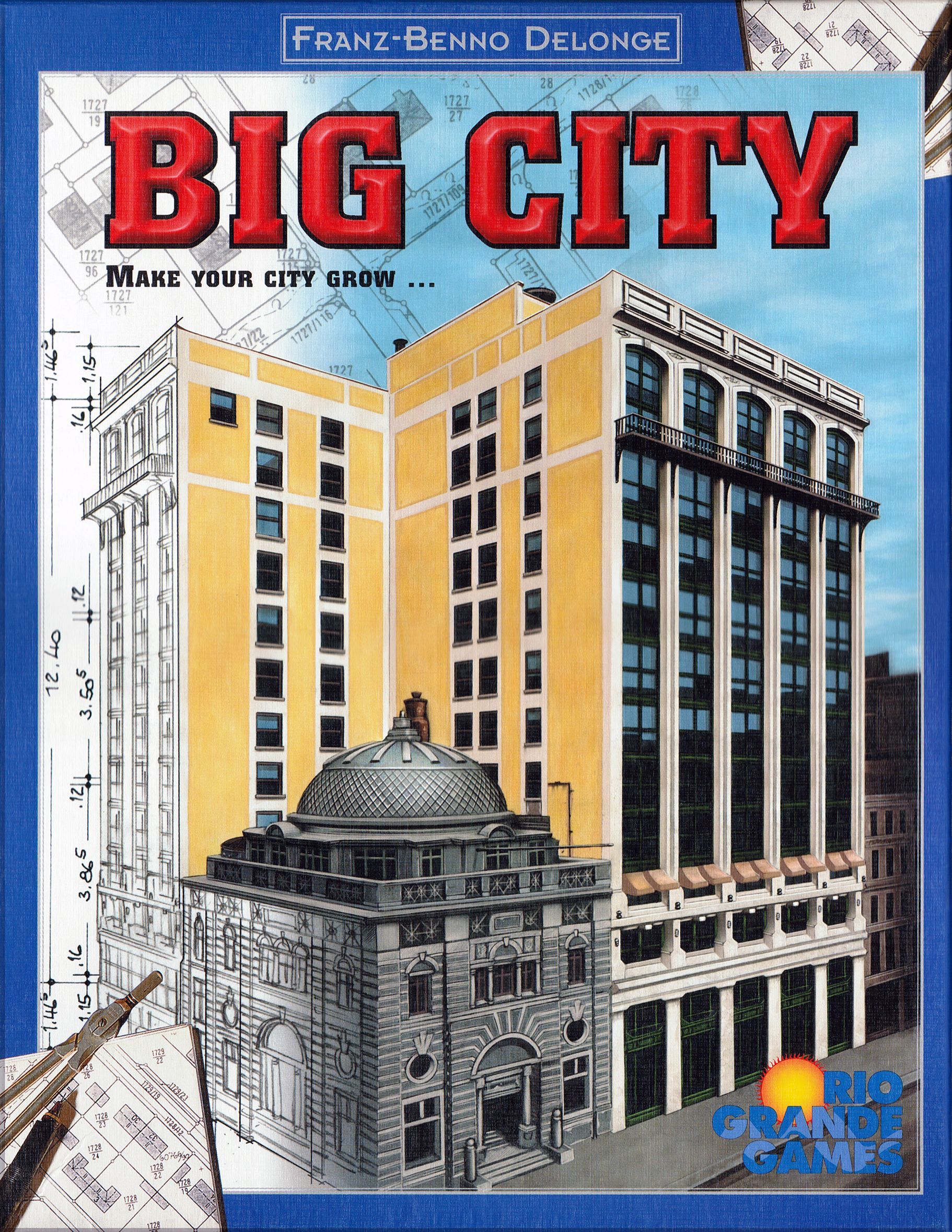
Big City is a building game for 2 to 5 players in which everyone builds a shared city on property they collect and trade. Players place buildings one at a time and score points for each one. The player with the most points at the end wins.
Preparación
Place the buildings, streetcars, and scoring track where everyone can reach them. Sort the 72 property cards into eight stacks by neighborhood, shuffle each stack, and place them face down. Each player draws one card from each of stacks 1 to 5, and with 5 players also one from stack 6. Each player picks a color, places a scoring marker on 0, and takes a 100 point token and a summary sheet. Return unused components to the box. Place neighborhood 1 in the middle of the table and choose a starting player. Players then take turns adding neighborhoods to form the starting city, taking the neighborhoods in clockwise order. With 2 players each places 2 neighborhoods, which gives neighborhoods 1 to 5. With 3 players the starting city uses neighborhoods 1 to 4, with 4 players 1 to 5, and with 5 players 1 to 6. Each new neighborhood must touch the city so that at least two of its properties are adjacent to two properties already in the city, and neighborhoods may not overlap. Set aside the remaining neighborhoods nearby.
Un turno
Players take turns clockwise, starting with the starting player. On a turn, a player chooses one of these actions:
- Place a building, park or factory: Check the building's placement requirements, play the matching property cards from hand face up, place the building on those properties, score it, and then discard the cards and draw replacements. Replacement cards may come from any stack, but no more than two from any single stack. Buildings stay in place for the whole game and cannot be upgraded or removed. A park or factory is placed by playing its card and placing the matching piece on free properties where it fits. It scores no points. Parks and factories may not be placed on top of buildings or streetcars.
- Start or add to the streetcar line: This needs city hall to be placed first. The first streetcar may go on any street. After that, a player may add up to two streetcars per turn, extending the line. Streetcars may not cross properties or buildings.
- Place a new neighborhood: This needs city hall to be placed first. The placement rules are the same as for the starting city.
- Exchange cards: Put any number of property cards from hand face down at the bottom of their stacks, then draw back up to 5 cards, or up to 6 with 5 players. No more than two cards may come from any single stack.
- Pass: Do nothing, even if a legal move exists.
Buildings score when placed. Residences and businesses come in single, double and triple sizes. City hall scores nothing. A church scores a fixed 15 points, and a shopping center a fixed 30.
Fin de la partida
The game ends when all neighborhoods have been placed and buildings are on all properties, or when all players pass in a row. If only one player can still play cards near the end, that player keeps taking turns while the others pass, until they can no longer play or choose to stop.
Puntuación
A player's points come from the buildings they placed. Each building's score is worked out when it is placed, and later placements do not change it. Bonuses and penalties are added or subtracted first, and multipliers are applied afterwards. A building scoring 0 is worth 1 point. Players move their scoring marker forward by each building's score. When a total passes 99, the player places their 100 point token on 0 and continues counting, adding 100. Parks, factories, streetcars and city hall score no points for the player who places them. The player with the most points at the end wins. The rulebook does not say how ties are broken.
Variantes
The rulebook suggests these optional variants, which may be combined:
- Trade cards: A player may trade one or two property cards with other players, or exchange up to two cards with the stacks if no trade can be arranged. Only the trading player may propose trades.
- Useless cards must be exchanged: Cards made useless by a park or factory must be exchanged on a turn rather than discarded.
- Single streetcar line: The line may only grow from its two ends, and it may not form a closed loop.
- Limited streetcar line: A streetcar may only be placed next to a building already in the city.
- Limited card drawing: Cards may only be drawn from neighborhoods already placed in the city.
- New buildings: Players may design additional building types with their own requirements and scoring.
Cambios
- Variantes, por el borrador del reglamento, 23 de noviembre de 2026 (se muestra ahora)
- Puntuación, por el borrador del reglamento, 23 de noviembre de 2026 (se muestra ahora)
- Fin de la partida, por el borrador del reglamento, 23 de noviembre de 2026 (se muestra ahora)
- Un turno, por el borrador del reglamento, 23 de noviembre de 2026 (se muestra ahora)
- Preparación, por el borrador del reglamento, 23 de noviembre de 2026 (se muestra ahora)
- Resumen, por el borrador del reglamento, 23 de noviembre de 2026 (se muestra ahora)