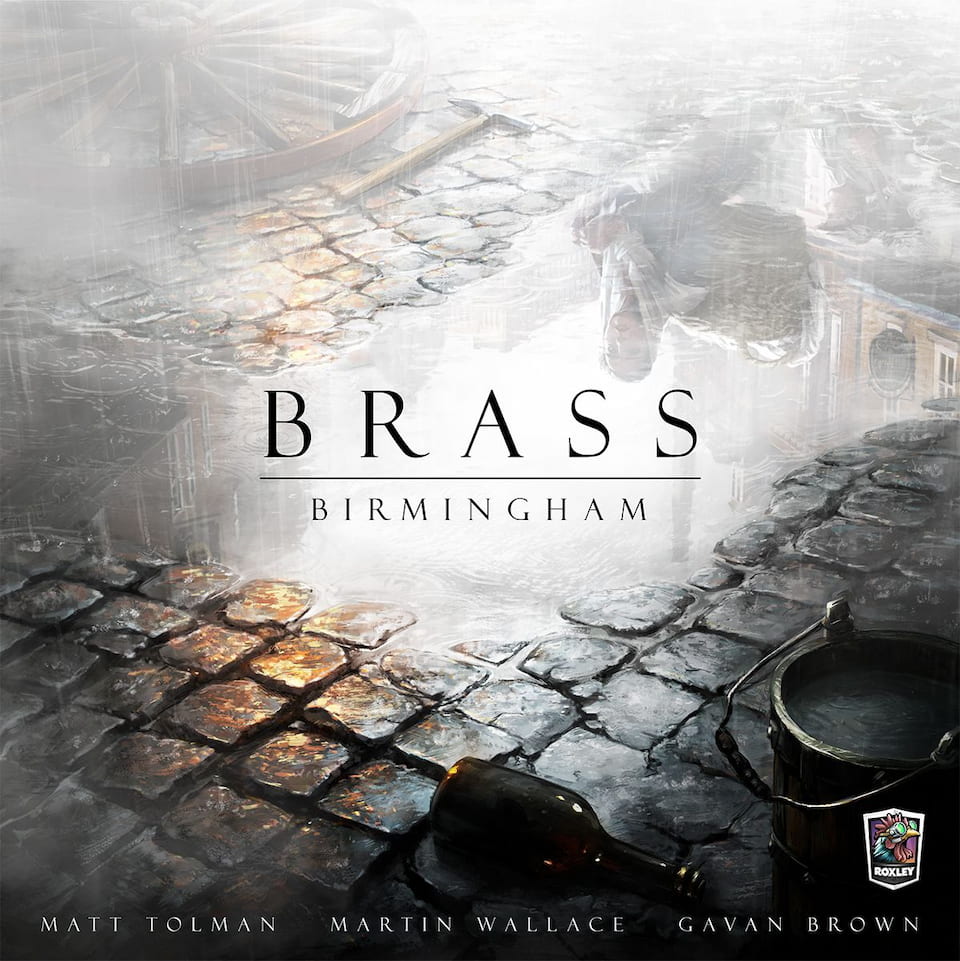
Reglas de Brass: Birmingham
Resumen
Brass: Birmingham is a game about competing entrepreneurs in the West Midlands during England's Industrial Revolution, from 1770 to 1870. Players expand canal and rail networks and build industries such as Cotton Mills, Coal Mines, Iron Works, Manufacturers, Potteries and Breweries. The rulebook's winner is the player with the most Victory Points (VPs) after the Rail Era.
Preparación
- Place the board on either the day or night side. For fewer than 4 players, remove cards and Merchant tiles marked for higher player counts.
- Set aside the Wild Location and Wild Industry cards on two Card Draw Areas, shuffle the other cards into the Draw Deck, and place Merchant tiles on the matching spaces. Fill the Coal and Iron Markets, place beer barrels beside Merchant tiles, and set up the General Supply and Bank.
- Remove Location cards in the banner colours listed for your player count from the Draw Deck (2 players: blue and teal; 3 players: teal).
- Each player takes a Player Mat and £17, chooses a Character tile, takes the matching Link and Industry tiles, places a VP Marker on 0 and an Income Marker on 10, and draws 8 cards as a Hand.
- Each player then draws 1 extra card face down as their Discard Pile. Shuffle the Character tiles and place them in random order on the Turn Order Track.
Un turno
Each round, players take turns in Turn Order Track order. On a turn you normally perform 2 actions, but in the first round of the Canal Era each player performs only 1.
For each action, discard a card from your Hand face up to your Discard Pile (Wild cards return to their Card Draw Area instead). You may choose one of these actions, and may repeat the same action:
- Build an Industry tile using a matching Location or Industry card.
- Network to place Link tiles.
- Develop to remove your lowest-level Industry tiles from your Player Mat.
- Sell to flip Cotton Mills, Manufacturers or Potteries at a Merchant.
- Loan to take £30 and move your Income Marker back 3 income levels.
- Scout to discard 2 more cards and take a Wild Location and Wild Industry card.
You may also pass, but must still discard a card for each action passed.
Money spent during the turn goes onto your Character tile. At the end of the round, reorder the Turn Order Track so the player who spent least goes first (ties keep their order), then return the spent money to the Bank. Refill your Hand to 8 cards at the end of your turn, and take income from the Bank equal to your income level. A negative income level means you pay that amount.
Fin de la partida
Each era ends after the round in which all players use their final cards. The Canal Era runs from 1770 to 1830, and the Rail Era from 1830 to 1870. Between eras, Industry tiles at level 1 are removed from the board, and players reset Merchant beer and reshuffle discards into a new Draw Deck.
The game lasts exactly 8, 9 or 10 rounds per era, depending on player count. Income is not collected in the final round of the game.
Puntuación
At the end of each era, score VPs for your Link tiles adjacent to displayed locations, then remove those Link tiles. After that, score the VP value of your flipped Industry tiles. Unflipped tiles score nothing. Scores above 100 continue on another loop of the Progress Track.
After Rail Era scoring, the player with the most VPs wins. Ties are broken first by highest income, then by most money remaining. If still tied, the tied players share the win.
Variantes
Introductory game: play only the Canal Era, then add extra scoring at the end. Players score 1 VP for every £4 they hold (maximum 15 VPs), add VPs equal to their income level (subtracting if negative), and score level 2 or higher Industry tiles a second time.
The rulebook also gives beginner tips and extra rules, but no further official variants such as solo or team play.
Cambios
- Variantes, por el borrador del reglamento, 22 de noviembre de 2026 (se muestra ahora)
- Puntuación, por el borrador del reglamento, 22 de noviembre de 2026 (se muestra ahora)
- Fin de la partida, por el borrador del reglamento, 22 de noviembre de 2026 (se muestra ahora)
- Un turno, por el borrador del reglamento, 22 de noviembre de 2026 (se muestra ahora)
- Preparación, por el borrador del reglamento, 22 de noviembre de 2026 (se muestra ahora)
- Resumen, por el borrador del reglamento, 22 de noviembre de 2026 (se muestra ahora)