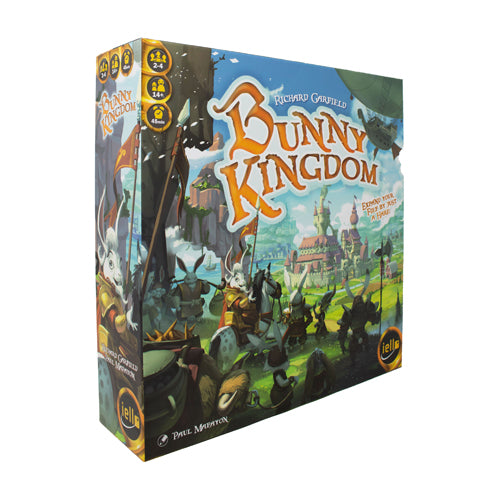
Reglas de Bunny Kingdom
Resumen
Bunny Kingdom is a drafting and placement game for 2 to 4 players, played over 4 Rounds. Players are Rabbit Lords claiming Territories, building Fiefs with Cities and Farms, and collecting Golden Carrots. The player with the most Golden Carrots after the final scoring wins and is named 'Big Ears'.
Preparación
- Place the New World board in the middle of the table and put one Strength 1 City on each City space.
- Each player chooses a color, takes the 36 Rabbits of that color, and places one Rabbit on space 0 of the Score Track.
- Set the remaining Cities and tokens beside the board.
- Shuffle all Exploration cards into a face-down deck beside the board.
- Deal each player 12 cards in a 3-player game or 10 cards in a 4-player game, without looking at them.
Un turno
The game lasts 4 Rounds. Each Round has three phases that all players carry out at the same time.
1. Exploration Phase: Look at your hand and choose 2 cards to play, placing them face-down. Pass the rest face-down to a neighbor: to the left in Rounds 1 and 3, to the right in Rounds 2 and 4. Then play your 2 chosen cards:
- Parchment: keep it face-down and secret until the end of the game.
- Territory: place one of your Rabbits on the matching space and discard the card. If the space holds an opponent's Camp, remove their Rabbit and Camp first.
- Building: place it face-up in front of you and discard it when it is placed.
- Provisions: immediately draw and play 2 cards from the deck, then discard the Provisions card.
Repeat the draft and play steps with the cards you received until every card in your hand is played.
- Construction Phase: Place some, all, or none of your Buildings on Territories you control. Camps may go on empty Territories instead. Buildings must meet any placement requirements, cannot be moved, and only one Building fits on a Territory. A Building on a basic-producing Territory keeps that production. Camps have priority numbers: a player with a lower-numbered Camp may interrupt to play theirs first. Playing a Camp on a Territory an opponent controls through their Camp replaces their Rabbit with yours.
- Harvest Phase: Score each Fief for Golden Carrots (see Scoring). Move your Rabbit on the Score Track accordingly. Then begin the next Round, dealing 10 or 12 new cards depending on player count.
Fin de la partida
The game ends after the Harvest Phase of Round 4. All players then reveal their Parchment cards and score them one at a time for the final scoring.
Puntuación
- Harvest: Each Fief gives Golden Carrots equal to its Strength multiplied by its Wealth. Strength is the total number of Towers on its Cities, where a Strength 1 City has 1 Tower, a Strength 2 City has 2, and a Strength 3 City has 3. Wealth is the number of different Resources the Fief produces. A Fief with no City or no Resource gives nothing.
- Final scoring: Treasure Parchments give their listed Golden Carrots automatically. Mission Parchments give Golden Carrots only if their conditions are met, based on Territories, Fiefs, Cities, Buildings, Resources, or other Parchments. Special cards such as Liberal, Socialist, Gloves, and Little Prince copy or repeat effects as their text describes.
- Trading Posts keep the Resource they produced at the end of Round 4 when Missions are checked.
- The player with the most Golden Carrots wins. If players are tied, they share the victory.
Variantes
- 2-player game: Each Round, each player takes 10 cards into a Reserve, face-down and unseen. Before each draft, draw 1 card from the Reserve into your hand. Then, instead of playing 2 cards, choose 1 card to play and 1 card to discard face-down. Pass the remaining cards to your opponent face-down. The Play Cards step works as normal.
Cambios
- Variantes, por el borrador del reglamento, 22 de noviembre de 2026 (se muestra ahora)
- Puntuación, por el borrador del reglamento, 22 de noviembre de 2026 (se muestra ahora)
- Fin de la partida, por el borrador del reglamento, 22 de noviembre de 2026 (se muestra ahora)
- Un turno, por el borrador del reglamento, 22 de noviembre de 2026 (se muestra ahora)
- Preparación, por el borrador del reglamento, 22 de noviembre de 2026 (se muestra ahora)
- Resumen, por el borrador del reglamento, 22 de noviembre de 2026 (se muestra ahora)