Reglas de Carnegie
Resumen
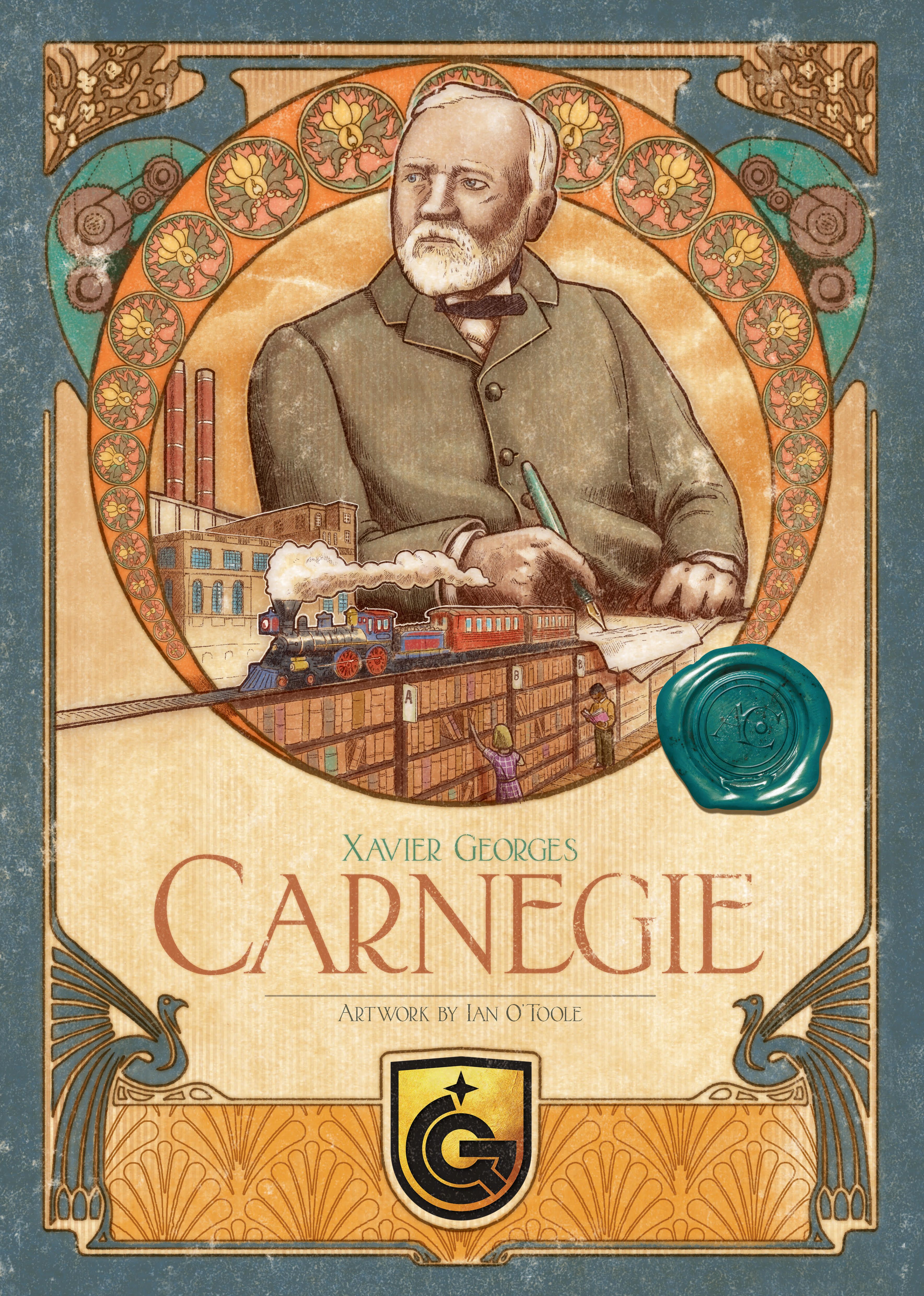
Carnegie is a game inspired by Andrew Carnegie in which players run competing companies across the United States, recruiting employees, building projects, developing transport, and making donations. The game lasts 20 rounds, and the player with the most victory points at the end wins.
Preparación
Place the main board in the center and shuffle the 8 Timeline tiles, drawing 4 at random to frame between the Start and End tiles, returning the unused ones to the box. Place the four action markers at the far left of the Timeline. Remove Department tiles at random so that 16 remain for a 2-player game (fewer removed as player count drops; 4 players use 4 removed to keep 16 options aside by player count as stated), and place the rest face-up. Give each player 4 goods cubes, $12, a Company board with a set of project tabs slid under the board with matching colors and icons, 10 employees (one standing on each of their 5 Departments and five lying down in the Lobby), and 30 disks: one on the score track's 0, one on the first space of each regional transport track, one on each of the three project tab locations (Housing, Commerce, Industry), and the rest as personal supply. The most daring player becomes first player and takes the first-player marker and Timeline marker. Action Choice tiles go to each player in a 4-player game and to the third player in a 3-player game. In a 2- or 3-player game, extra disks are placed on the donation chart and construction sites using solo action cards, and players then place their Housing disks and rearrange employees by up to 6 orthogonal steps, starting with the first player clockwise.
Un turno
Each round has four parts. First, the first player places the Timeline marker to the right of one action marker (Human Resources, Management, Construction, or R&D), then turns over the marker on the row below that can still move forward, which triggers the event on its right. Second, events occur: a Mission area becomes active and players may return employees for transport and project income, or donations may be made. Third, Departments are used, with the first player going first and then clockwise; each active employee lets its Department be used once, and Departments must be finished before moving to another. Fourth, at the end of the round, players may pay to activate inactive employees, the turned-over action marker returns face-up and advances one space, and the Timeline marker and locomotive pass clockwise.
Fin de la partida
The game ends after 20 rounds, once all four action markers have reached the final spaces of their Timelines and all players have finished their actions.
Puntuación
Players keep immediate VP earned during play and add end-game VP for: unused Action Choice tiles (3 each); each active employee (1 each, not counting employees on Missions or the permanent starting Human Resources employee); each Department built (2 or 3 each, depending on the row); project tab VP up to a maximum per type; connections between major cities up to 36 VP, with only the highest-scoring connection counting; construction projects in cities (0-3 each); and donations (up to 12 VP each). Donation bonuses for Welfare may be paid for during final scoring. The highest score wins. Ties are not broken: tied players share the victory.
Variantes
Solo game: the player faces Andrew Carnegie as a virtual opponent. Setup uses 16 Departments, and Andrew receives disks, victory-point cards, and an action deck. Each round, the player and Andrew alternate choosing the Timeline row, using the locomotive to show whose turn it is. Andrew's actions follow the action card drawn each round, and his score is calculated from his cards, Departments, transport tracks, construction, and donations, with the player's actions affecting his donation scoring. The player compares scores, and the highest total wins.
Cambios
- Variantes, por el borrador del reglamento, 22 de noviembre de 2026 (se muestra ahora)
- Puntuación, por el borrador del reglamento, 22 de noviembre de 2026 (se muestra ahora)
- Fin de la partida, por el borrador del reglamento, 22 de noviembre de 2026 (se muestra ahora)
- Un turno, por el borrador del reglamento, 22 de noviembre de 2026 (se muestra ahora)
- Preparación, por el borrador del reglamento, 22 de noviembre de 2026 (se muestra ahora)
- Resumen, por el borrador del reglamento, 22 de noviembre de 2026 (se muestra ahora)