Reglas de Caverna: Los Granjeros Trogloditas
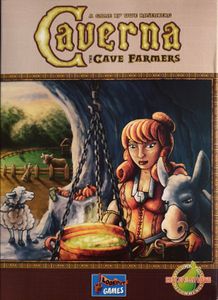
Resumen
Caverna is a development strategy game for 1 to 7 players in which dwarfs dig caves for ore and rubies, furnish caverns, and farm food from the forest they clear. Players place their dwarfs on shared action spaces each round and try to gather Gold points through their Home boards, animals, crops, weapons and expeditions. The player with the most Gold points at the end of the game wins.
Preparación
Each player takes a Home board, the 5 dwarfs and 3 stables of one color, and one of each Overview card. Place 2 dwarfs in the entry-level dwelling and keep the other 3 dwarfs and stables as your supply.
Choose a starting player at random and give them the starting player token. The starting player and the player to their left get 1 Food, the third player gets 2 Food, and each other player gets 3 Food.
Place the basic game boards for rounds 1 to 3 and 4 to 12 side by side, and the third basic board to the left, on the side matching the player count. Add the required additional boards to the left of these.
Shuffle the 7 Harvest markers and place them face-down on round spaces 6 to 12, one per space. In a 2-player game, remove the marker with a green leaf and leave round space 9 empty. Place the Harvest events card next to the boards.
Shuffle the Action space cards and stack them face-down: the stage 4 cards at the bottom, then the stage 3 cards, then the ordinary stage 2 cards, then the round 4 card, and the stage 1 cards on top. In a 2-player game use only 11 Action space cards by removing the level 4 expedition card.
Sort the Furnishing tiles onto the supply boards and sort the landscape tiles and goods into separate supplies next to the boards.
Un turno
The game is played over 12 rounds, each with five phases.
- Add a new Action space: Turn over the top Action space card and place it on the lowest-numbered empty round space. From round 6, also turn the Harvest marker on that space face-up.
- Replenish accumulating spaces: Put the goods shown on each accumulating space back on it. Some spaces only refill with a smaller amount if they still hold goods.
- Work phase: Starting with the starting player and going clockwise, each player places one dwarf from their cave on an unoccupied action space and carries out its actions at once. Continue until all dwarfs are placed. Each action space holds only one dwarf per round. Dwarfs must be placed in order: unarmed dwarfs first, then armed dwarfs by ascending weapon strength. Rubies can be spent to bypass this order for one dwarf.
- Return home: Return all dwarfs to their dwellings.
5. Harvest time: Only some rounds end with a harvest (see the end section and the Harvest markers). A harvest has three sub-phases in this order:
- Field phase: Take 1 grain or vegetable from each sown field into your supply.
- Feeding phase: Pay 2 Food per dwarf. Newborn dwarfs from this round only need 1 Food now. You may convert goods to Food or take Begging markers for any Food you cannot pay.
- Breeding phase: If you have at least 2 farm animals of one type, you get 1 baby of that type, if it fits on your Home board.
Fin de la partida
The game ends after round 12. In a 2-player game there are only 11 rounds.
Rounds 1 to 4: There is no harvest at the end of rounds 1 and 2. At the end of round 4 there is no field or breeding phase, but each player pays 1 Food per dwarf.
Rounds 5 to 12: Each of these rounds normally ends with a full harvest. A revealed red question mark on a Harvest marker changes this, as shown on the Harvest events card. The first question mark means no harvest that round. The second means each player pays 1 Food per dwarf instead of a harvest. The third means each player chooses either the field phase or the breeding phase, and the feeding phase is still played.
Puntuación
At the end of the game, each player totals Gold points on the scoring pad. The player with the most Gold points wins. If players tie, they share the win.
- Each farm animal and each Dog: 1 Gold each.
- Missing a farm animal type (Sheep, Donkey, Wild boar or Cattle): minus 2 Gold per missing type.
- Grain: half a Gold per grain, rounded up, counting grain in supply and on fields.
- Vegetables: 1 Gold each, counting vegetables in supply and on fields.
- Rubies: 1 Gold each.
- Dwarfs: 1 Gold each.
- Unused Home board spaces: minus 1 Gold per space with no tile or stable. Pre-printed caverns count as used, even if unfurnished.
- Furnishing tiles, pastures and mines: the printed points on each tile. Small pastures are worth 2, large pastures 4, ore mines 3, and ruby mines 4.
- Some Parlors, Storages and Chambers give bonus points under their listed conditions, each on its own scoring line.
- Gold coins: their total value. Each Begging marker takes away 3 Gold.
Some tiles, such as the Writing chamber, reduce minus points. Some tiles let you exchange goods for Gold before scoring.
Variantes
Solo game: Use the 2-player boards and cover some action spaces with Overview cards and Action space cards as shown in the rulebook table. Start with 2 Food. There are no Harvest events, a harvest occurs at the end of every round from round 5, and round 9 is skipped. Rubies accumulate on the Ruby mining space from round 1, and accumulating spaces are capped at 6 goods unless you pay a Ruby to keep them. The goal is to score as high as you can, ideally above a magical score of 100 points.
Introductory game: Use the introductory side of the supply boards and put unused Furnishing tiles back in the box. The Full game uses the other side with more variety.
2-player game: Use the 2-player action space boards, remove the level 4 expedition card and skip round 9, which is covered with a Dwarf card. The game lasts 11 rounds.
Cambios
- Variantes, por el borrador del reglamento, 22 de noviembre de 2026 (se muestra ahora)
- Puntuación, por el borrador del reglamento, 22 de noviembre de 2026 (se muestra ahora)
- Fin de la partida, por el borrador del reglamento, 22 de noviembre de 2026 (se muestra ahora)
- Un turno, por el borrador del reglamento, 22 de noviembre de 2026 (se muestra ahora)
- Preparación, por el borrador del reglamento, 22 de noviembre de 2026 (se muestra ahora)
- Resumen, por el borrador del reglamento, 22 de noviembre de 2026 (se muestra ahora)