Reglas de Civilization: A New Dawn
Resumen
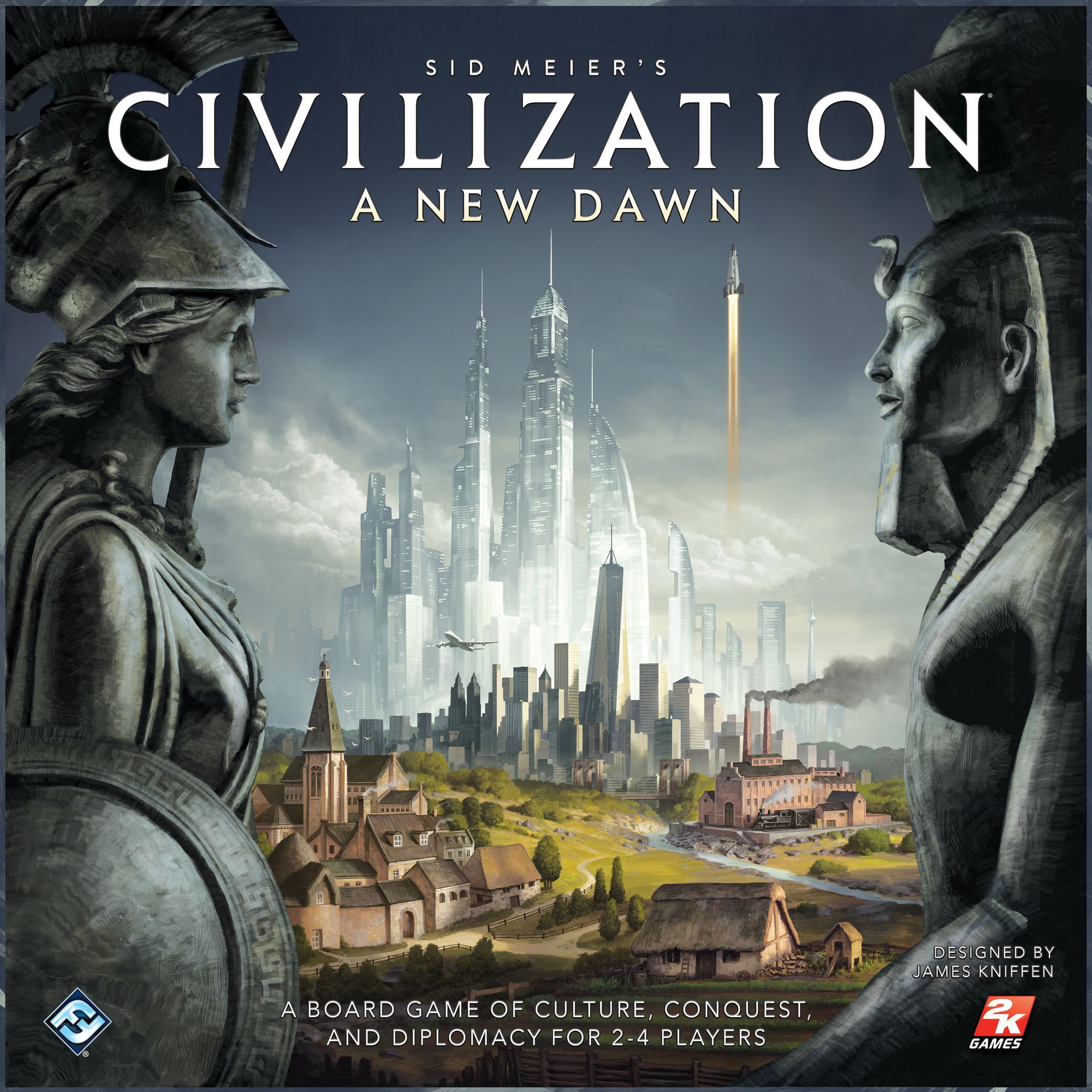
Sid Meier's Civilization: A New Dawn is a strategy game for two to four players, each leading a historic civilization. Players expand territory, gain technologies, and build world wonders. A player wins by completing one agenda on each victory card in play.
Preparación
- Each player takes a random leader sheet, a player color with its cities, caravans, control tokens, tech dial, diplomacy cards and focus cards, and sets the tech dial pointer to 0.
- Each player places their focus bar below the leader sheet, then places the five starting focus cards marked with the I side in the slot order shown on the leader sheet. Place one caravan on the Foreign Trade card.
- Build the map. The first game uses a fixed map from the rulebook. Later games use the advanced map-building rules.
- Place one token from the supply on each icon space: barbarian tokens with matching letters and city-state tokens with matching icons.
- For each city-state on the map, stack both of its diplomacy cards and place them beside the map. Return unused city-state cards to the box.
- Place the barbarian direction token against any map edge. Then place the event dial beside the leader sheet with the pointer on the helmet-with-star icon.
- Separate the world wonder cards into four piles by type. In a three-player game, remove one random ancient card from each pile. In a two-player game, remove one random ancient and one random medieval card from each pile. Return removed cards without looking at them.
- For each pile, stack the cards facedown in era order: modern at the bottom, then medieval, then ancient on top. Flip the top card faceup.
- Place each type's matching wonder tokens beside its deck.
- Place three random victory cards faceup beside the map and return the rest to the box.
- Form the supply from the trade tokens and remaining resource tokens.
Un turno
The player who holds the event dial goes first, and turns pass clockwise.
On a turn, a player:
1. Chooses one of the five cards in their focus row and offsets it to mark it as chosen.
2. Resolves the chosen card's effect. The effect depends on the card's type (culture, science, economy, industry, or military) and on its slot number, which sets the terrain allowed or the strength of the effect. Trade tokens can be spent on the card to boost it.
3. Resets the card: picks it up, shifts every card in a lower slot one slot toward the first slot, and places the chosen card in the first slot.
Before the first player begins each turn except the first, the first player turns the event dial's pointer clockwise to the next section and resolves any icon there. Event icons cover barbarian movement, barbarian respawn, and trade, where each player gains trade tokens for each mature city.
Fin de la partida
The game ends at the start of the first player's turn. If a player has completed one agenda on every victory card in play, that player wins. Completing an agenda is marked by placing a control token beside that card, and the mark stays even if the player later stops meeting the agenda.
Variantes
Epic game (optional, for experienced players): place four victory cards beside the map during setup instead of three. The winning condition stays the same.
Advanced map building: used for every game after the first. Players build the core from random tiles, then take turns adding tiles that must touch the existing map, which gives a different map each game.
Cambios
- Variantes, por el borrador del reglamento, 22 de noviembre de 2026 (se muestra ahora)
- Fin de la partida, por el borrador del reglamento, 22 de noviembre de 2026 (se muestra ahora)
- Un turno, por el borrador del reglamento, 22 de noviembre de 2026 (se muestra ahora)
- Preparación, por el borrador del reglamento, 22 de noviembre de 2026 (se muestra ahora)
- Resumen, por el borrador del reglamento, 22 de noviembre de 2026 (se muestra ahora)