Reglas de Dream Home
Resumen
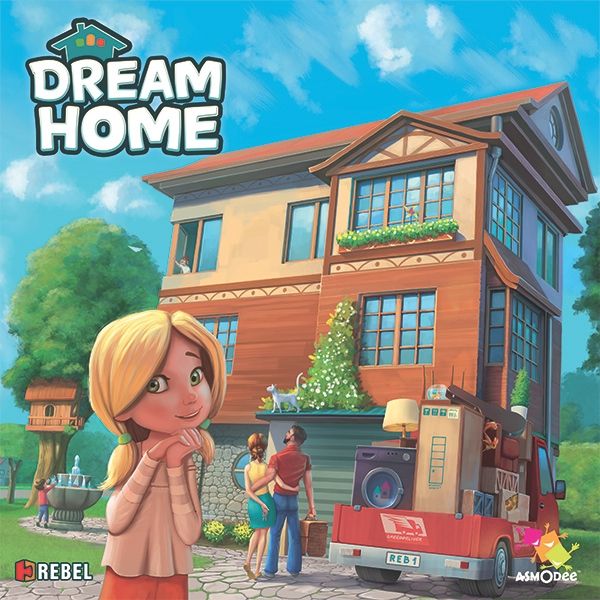
Players build a custom dream home over twelve rounds by adding room cards, décor, and roof cards to their home board, while collecting resource cards that give special effects. When the deck runs out, the game ends and the player with the most points wins.
Un turno
The game lasts 12 rounds. The player with the first player marker starts each round, and play moves clockwise.
On your turn, choose a column on the game board and take both cards in it: one room card and one resource card. If you choose the leftmost column, you take the bottom card and the first player marker instead.
Place the room card on your home board, ideally next to similar rooms. Resource cards are handled as described below.
- Room placement: A room card cannot have an empty space directly below it. Basement cards go on the two basement spaces. Normal and unique room cards go on the top two floors. A room cannot grow beyond its maximum size. Spaces can be left empty between rooms on the same floor.
- Finished rooms: A room at its maximum size, or with a décor token, is finished and cannot be expanded. You cannot place a room beside a finished room of the same type.
- Empty rooms: If you cannot or do not want to place a room card, place it facedown as an empty room, worth 0 points.
- Décor cards: Place the matching token on one of your rooms of the indicated type that has no token, then discard the card. If no such room is available, discard the card.
- Roof cards: Place facedown on your roof space. You may not look at them until the end of the game.
- Helper and tool cards: Keep helpers faceup near your board for use at scoring. Use tools as their text says, then discard them.
After every player has taken a turn, discard any cards left on the board and refill the rows: 4 resource cards on the top row and 5 room cards on the bottom row. If nobody took the leftmost column, the current first player keeps the marker.
Fin de la partida
The game ends when the decks are empty, after the 12th round. Each home should then have 12 rooms. Before scoring, use any helper cards that apply: Supplier, Handyman, and Roofer.
Puntuación
Add up your points from:
- Rooms: Points depend on how many cards make up a room, counted horizontally. The value is shown on each card. Some rooms have special scoring text, such as the Pantry, which scores extra beside a Kitchen.
- Décor: Each décor token has a point value. The Interior Designer adds 1 point per token.
- Home functionality: +3 for a bathroom on each of the top two floors, and +3 for having a bathroom, kitchen, and bedroom. The Architect raises each of these bonuses to 4 and gives 1 point per empty room.
- Roof: Reveal your roof cards and choose four. A complete uniform roof (four cards of one color) is worth 8 points. A complete mismatched roof is worth 3 points. An incomplete roof is worth 0. Extra roof cards are worth 0. Each window on a complete roof adds 1 point.
The player with the most points wins. If players tie, count the children hidden in the artwork of their rooms. The tied player with the most children wins. If still tied, the tied players share the victory.
Variantes
Two- or three-player game: Set up as normal. At the start of each round, before the first player's turn, the first player chooses a column of cards and discards that pair. The first player cannot discard the leftmost column. For younger players, this discard rule may be left out.
Cambios
- Variantes, por el borrador del reglamento, 22 de noviembre de 2026 (se muestra ahora)
- Puntuación, por el borrador del reglamento, 22 de noviembre de 2026 (se muestra ahora)
- Fin de la partida, por el borrador del reglamento, 22 de noviembre de 2026 (se muestra ahora)
- Un turno, por el borrador del reglamento, 22 de noviembre de 2026 (se muestra ahora)
- Resumen, por el borrador del reglamento, 22 de noviembre de 2026 (se muestra ahora)