Reglas de El Grande
Resumen
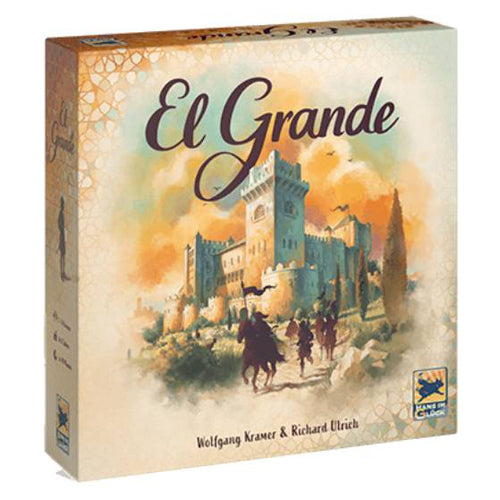
El Grande is a game for 2 to 5 players in which each player is a Grande, the leader of a home region, backed by Caballeros. Players try to extend their influence across Spain by holding the majority of Caballeros in as many regions as possible, and they score points at three general scorings. The player who progresses furthest along the success track at the end wins the title of El Grande.
Preparación
- Place the Castillo on its space on the board.
- Shuffle the nine region cards, turn the top card up and place the King in that region.
- Each player draws a region card to determine his home region.
- Each player chooses a color, takes the Grande of that color and places it in his home region.
- Each player takes his 10 Caballeros. Place 2 next to his Grande in the home region, 1 on the first space of the success track, and keep the other 7 in front of him as his court. The rest stay in the provinces, a reserve on the table.
- Each player takes a secret disk and his 13 power cards.
- Sort the action cards into five stacks by the number of Caballeros on their backs (stack 1 has 11 cards, stack 2 has 11, and so on up to stack 5, which holds only the King card). Shuffle each stack separately and place them face down beside the board.
- Place the two mobile scoreboards beside the board.
- Place the round marker on space 1 of the round track.
Un turno
Each round proceeds as follows:
- Move the round marker forward one space on the round track.
- Turn the top card of each action stack face up.
- Players play power cards face up, one at a time, starting with the player who started the previous round (the first round's starter is chosen), then going clockwise. Each value may be played only once per round. The played cards stay in a face-up pile and are not returned to hand.
The power cards set the turn order (highest value goes first) and the number of Caballeros each player may move from the provinces to his court.
On a turn, a player does these steps in order:
1. Move up to the number on his power card from the provinces to his court. If he lacks Caballeros in the provinces, he may remove his own Caballeros from the board to make up the difference.
2. Choose one face-up action card that no earlier player has laid aside. Each card gives two actions, which the player may order as he likes:
- Move up to the number shown at the bottom of the card from his court onto the board. Caballeros may go only into regions adjacent to the King's region or into the Castillo.
- Carry out or prevent the special action on the card.
3. Lay the chosen card aside so later players cannot take it.
At the end of the round, discard the remaining face-up action cards. The King card is turned up each round and is never permanently discarded.
Fin de la partida
The game ends after the third general scoring, which follows round 9 (or round 6 in the short game).
Puntuación
General scorings take place after rounds 3, 6, and 9.
- Choose regions secretly: each player uses his secret disk to pick one region for his Castillo Caballeros. The King's region may not be chosen. Disks are placed face down.
- Score the Castillo: once all disks are down, the Castillo is lifted and its Caballeros are counted and scored like a region.
- Move Castillo Caballeros: disks are revealed and all Caballeros from the Castillo go to the chosen region. Any player who chose the King's region returns his Caballeros to his court instead.
- Score the regions: the round marker moves along the scoring track so that each region is scored once, in order. Grandes are not counted.
In each region, the player with the most Caballeros earns the first value on the scoreboard, the second most earns the second value, and so on. Points are recorded by moving pieces along the success track.
Ties: when players tie for a rank, the tied players slide back one place and take that place's points. If that place has no value, they get nothing.
Bonuses:
- King's bonus: the player with the most Caballeros in the King's region gets +2 when that region is scored. No bonus if tied for first.
- Home region bonus: a player with the majority in his Grande's region gets +2 when it is scored. No bonus if tied for first.
Player count: with 2 players, only the first value of each scoreboard is used. With 3 players, the first two values are used.
Special scorings from action cards follow the same method, using the printed scoreboard values unless a mobile scoreboard covers them.
Variantes
- Short game: play 6 rounds instead of 9 by skipping rounds 1, 4, and 7. The round marker starts on space 2.
- Intrigue & the King (expansion): replaces the basic power and action cards with a deck of 31 cards per player, from which each player chooses 13. Turn order and special actions use these cards, the King may be moved to any region, and an Intrigue card is given to the player with the lowest action card.
- Grand Inquisitor & the Colonies (expansion): adds four new regions (France, Mediterranean, America, and the Ship), the Grand Inquisitor, Limit tables, and new action cards in two extra stacks.
- The King & the Colonies (combined expansion): combines Intrigue & the King cards with the new regions and action cards of Grand Inquisitor & the Colonies.
- Grandissimo (expansion): adds ships, a jail, Portugal, the Queen, the Court Jester, and new action cards in two extra stacks.
Cambios
- Variantes, por el borrador del reglamento, 23 de noviembre de 2026 (se muestra ahora)
- Puntuación, por el borrador del reglamento, 23 de noviembre de 2026 (se muestra ahora)
- Fin de la partida, por el borrador del reglamento, 23 de noviembre de 2026 (se muestra ahora)
- Un turno, por el borrador del reglamento, 23 de noviembre de 2026 (se muestra ahora)
- Preparación, por el borrador del reglamento, 23 de noviembre de 2026 (se muestra ahora)
- Resumen, por el borrador del reglamento, 23 de noviembre de 2026 (se muestra ahora)