Reglas de Ginkgopolis
Resumen
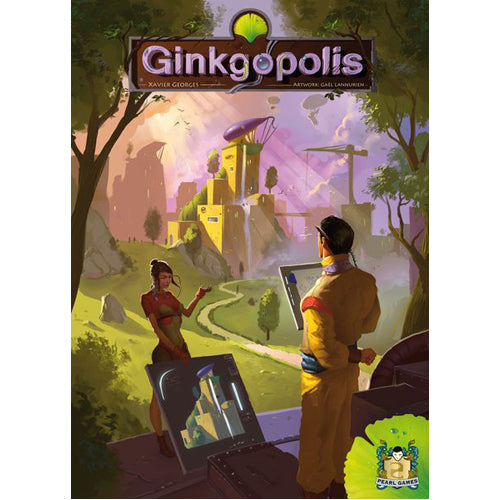
Ginkgopolis is a city-building game for 1 to 5 players in which you operate, expand and rebuild urban buildings to earn success points. The player with the most success points at the end of the game wins.
Preparación
Place the nine starting tiles (numbers 1 to 3 in each color) as a 3x3 square and lay the 12 Urbanization tokens A to L around it in alphabetical order. Shuffle the remaining tiles into face-down piles; with 2 or 3 players, remove 6 random tiles unseen. Put the success points and Construction Site pawns nearby. Each player picks a color, takes a screen and 2 New Hand tokens, and takes resources in that color: 25 each with 2 players, 20 with 3, 18 with 4, 16 with 5. Form the deck from the 12 Urbanization cards and the 9 cards for the starting buildings; with 2 or 3 players, set 7 cards aside face-up. Sort the Building cards numbered 4 to 20 into three stacks by color. Characters: in an introductory game each player gets a random matching set of 3; in a normal game each player is dealt 4, keeps one secretly, passes the rest left, and repeats until everyone holds 3. Each player takes the tiles, resources and success points shown at the top-left of her characters and keeps them behind her screen. The player who most recently planted a tree takes the First Player card and deals 4 cards to each player.
Un turno
Each round has three steps. 1) Choose: all players simultaneously pick one card from their hand and place it face-down. To urbanize or construct a floor, also place a tile from behind your screen on that card. Unused cards stay in front of your screen; the First Player card goes on top of them. New Hand: twice per game you may announce a new hand, discard a New Hand token and redraw 4 cards; players who announce in the same round act in announcement order. 2) Resolve: starting with the first player and going clockwise, reveal and resolve each action, then discard the played card. Exploit (card alone): an Urbanization card gives one resource or one tile from the supply; a Building card operates that building and gives one item per floor, by color: red gives resources, blue gives tiles, yellow gives success points. Then add items from your Exploiting bonus cards. Urbanize (Urbanization card plus tile): place the tile on the matching token, add one of your resources and a Construction Site pawn, move the token to an empty orthogonally adjacent space, then gain items from the orthogonally adjacent buildings as if played alone, then add your Urbanizing bonuses. Construct a floor (Building card plus tile): return the resources on the target building to their owner, who gains 1 success point per resource if it is another player. Place the tile on top; if its number is lower than the covered tile, pay the difference in success points; if its color differs, discard one resource. Then place one resource per floor and a Construction Site pawn, add your Constructing a floor bonuses, and keep the card face-up as a bonus card. If you cannot pay for the tile, take it back and resolve the action as if the card were played alone. 3) Prepare: each player takes the unused cards of her right-hand neighbor, then in player order, starting with the new first player, each draws to 4 cards. If the deck runs out, rebuild it: add to the discard the Building cards matching tiles that have Construction Site pawns, shuffle the discard into a new deck, with 2 or 3 players discard the top 7, then remove all pawns.
Fin de la partida
When the tile supply runs out for the first time, each player may secretly prepare any number of tiles behind her screen; all reveal simultaneously and gain 1 success point per tile revealed. The revealed tiles are shuffled into a new supply and play continues. The game ends after the round in which either the tile supply runs out for the second time, or a player has placed all her resources in the city (even if she later gets some back, the game still ends).
Puntuación
Add up: success points gained during play, success points from endgame bonus cards (marked with the equals icon), 2 success points per unused New Hand token, and district points. A district is at least 2 orthogonally adjacent buildings of the same color; an isolated building is not a district. In each district, the player with the most resources (all colors counted) gets that total in success points; second place gets the number of her own color's resources there. If players tie for a place, the player with the tallest building in the district wins the tie, then the player whose tallest building shows the higher number. If one player holds all the resources of a district, she earns both first and second place. The player with the most success points wins; the rulebook gives no separate tiebreak for the overall result.
Variantes
Solitaire against a virtual player named Hal, who is treated as a second player. Setup: you start with 6 resources, 6 tiles and 6 success points but no characters or New Hand tokens; Hal uses the general supply as his own and starts with nothing. You are always first. Each round, draw 3 cards, give one face-down to Hal, choose your action normally, then reveal Hal's card and draw a random tile for him. When Hal urbanizes, he gains 1 success point per item produced by adjacent buildings, but no tiles or resources; when he constructs a floor, he keeps the card but gets no card bonuses. Constructing on Hal's buildings returns his resources and gives him 1 success point each; building on yours works as normal. You cannot change your cards. When Hal urbanizes, you move his token. The game ends at the end of the turn when the tile supply runs out, when you have placed all your resources, or when Hal runs out of resources; if Hal cannot pay for a construction, that action is skipped and the game ends. Hal scores success points, endgame cards and districts like a normal player. Expert level: if Hal's card is an Urbanization card, draw another card; Hal uses the new card if it is a Building card or an Urbanization card that would give him more points than the original.
Cambios
- Variantes, por el borrador del reglamento, 23 de noviembre de 2026 (se muestra ahora)
- Puntuación, por el borrador del reglamento, 23 de noviembre de 2026 (se muestra ahora)
- Fin de la partida, por el borrador del reglamento, 23 de noviembre de 2026 (se muestra ahora)
- Un turno, por el borrador del reglamento, 23 de noviembre de 2026 (se muestra ahora)
- Preparación, por el borrador del reglamento, 23 de noviembre de 2026 (se muestra ahora)
- Resumen, por el borrador del reglamento, 23 de noviembre de 2026 (se muestra ahora)