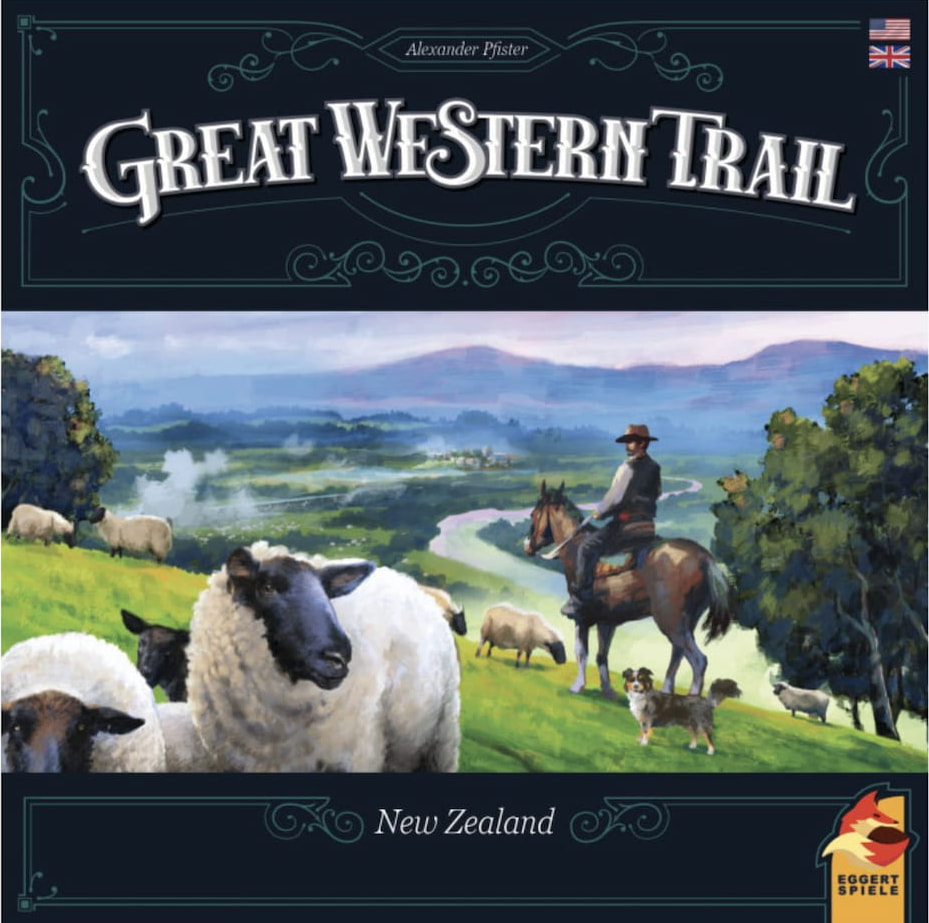
Reglas de Great Western Trail: New Zealand
Resumen
Great Western Trail New Zealand is a deck-building and worker-placement style game in which each player leads a runholder along a trail toward Wellington, using local actions on tiles to build their flock, deliver sheep to trading posts, and gather victory points. The player with the most victory points at the end of the game wins.
Preparación
Place the game board in the middle of the table with the sea routes board above it. Shuffle the harbourmaster tiles and place five face-up on the harbourmaster spaces, returning the rest to the box. Place the eight neutral building tiles face-up on the neutral spaces, matching letters A to H in a first game or shuffling them at random in later games. Place the bonus tiles market token on the top dashed space of the bonus tiles market. Sort the worker, hazard and bonus tiles into bags by the letter on their back to form the Wellington supply. Fill the job market with one worker tile per column in the highest-cost free space, fill the hazard sections, fill the bonus tiles market according to player count, and fill the Wellington foresight spaces and the job market top row as the rulebook describes. Shuffle the 37 market sheep cards, draw a number depending on player count (9 for 2 players, 11 for 3, 14 for 4) and lay them out by colour in the sheep market. Shuffle the 24 objective cards, place them face-down and reveal four as the general objective display. Place the deck-building cards on the left side of the board. Pick one white-star card from each of the 10 bonus card sets, draw four at random, add cards from their sets according to player count, and form the bonus cards supply under the four bonus card tiles. Each player takes a colour, the matching player board, the player count tile and fee tile, the discs, storehouses, ship, runholder and markers, and their 14 flock sheep cards as a face-down personal draw stack. Players receive starting pounds, cards and an exchange token according to their turn order (7 pounds and 4 cards for the first player, up to 10 pounds and 7 cards for the fourth). Each player places one disc on pathfinder space 0 and their runholder on a neutral building tile before the first turn, after discarding down to four cards.
Un turno
Starting with the starting player and continuing clockwise, each turn has three phases.
Phase A: Move your runholder forward along the trail. Move at least one step and no more than your current step limit, counting only locations (tiles), not empty spaces. You may not pass Wellington. Stepping on a black or green hand fee requires paying that fee: to the bank for hazard tiles, to the owner for other players' private buildings. If you cannot pay, you still move and do not pay later.
Phase B: Use the location where your runholder stopped. On a neutral or your own private building, either perform each of its local actions once in any order, or perform one single auxiliary action if you perform none of them. On another player's building or a hazard tile, you may only perform one single auxiliary action. On Wellington, carry out the four Wellington subphases in order: income (reveal sheep of different types to gain pounds, then discard them), delivery (place a disc on a trading post and pay transport costs, triggering its reward), and the two foresight subphases that take tiles from Wellington foresight spaces.
Phase C: Draw up to your hand limit from your personal draw stack. If the stack is empty, shuffle your personal discard pile to form a new draw stack. Cards acquired during the turn are not played until later.
Fin de la partida
The game ends when the bonus tiles market token is moved off the bottom row along the red arrow, which happens when a bonus tile is placed on the last market space during a Wellington subphase. Take the token and place it in front of you. Each other player then has one final turn, moving and using their reached location, and does not perform phase C. When the last player has finished, the game ends and final scoring takes place.
Puntuación
Each player adds up victory points from many sources: certificates, objective cards in their personal objective area, pathfinder track advancement, private buildings on the board and their printed points, hazard tiles, bonus and sheep cards with points in their deck, harbourmaster tile tasks, cleared disc spaces and workers on the fifth space of a row, storehouse pairs, gold and pounds, trading post discs, and harbour points on the sea routes board. Objective cards are scored by fulfilled tasks, with unmet tasks subtracting their negative points. The scoring pad is used to record each category for each player. The player with the most victory points wins. If players are tied, the victory is shared.
Variantes
The rulebook gives a variant for choosing private building tile sides: one player randomly chooses the sides and the others copy them, so all players share the same sides, and no one may flip a tile deliberately. The rulebook also describes the Garth Automa variant only as an acknowledgement, with no rules given. Solo mode components are listed in the components section, but solo rules are not explained in the text provided.
Cambios
- Variantes, por el borrador del reglamento, 22 de noviembre de 2026 (se muestra ahora)
- Puntuación, por el borrador del reglamento, 22 de noviembre de 2026 (se muestra ahora)
- Fin de la partida, por el borrador del reglamento, 22 de noviembre de 2026 (se muestra ahora)
- Un turno, por el borrador del reglamento, 22 de noviembre de 2026 (se muestra ahora)
- Preparación, por el borrador del reglamento, 22 de noviembre de 2026 (se muestra ahora)
- Resumen, por el borrador del reglamento, 22 de noviembre de 2026 (se muestra ahora)