Reglas de Hamburgum
Resumen
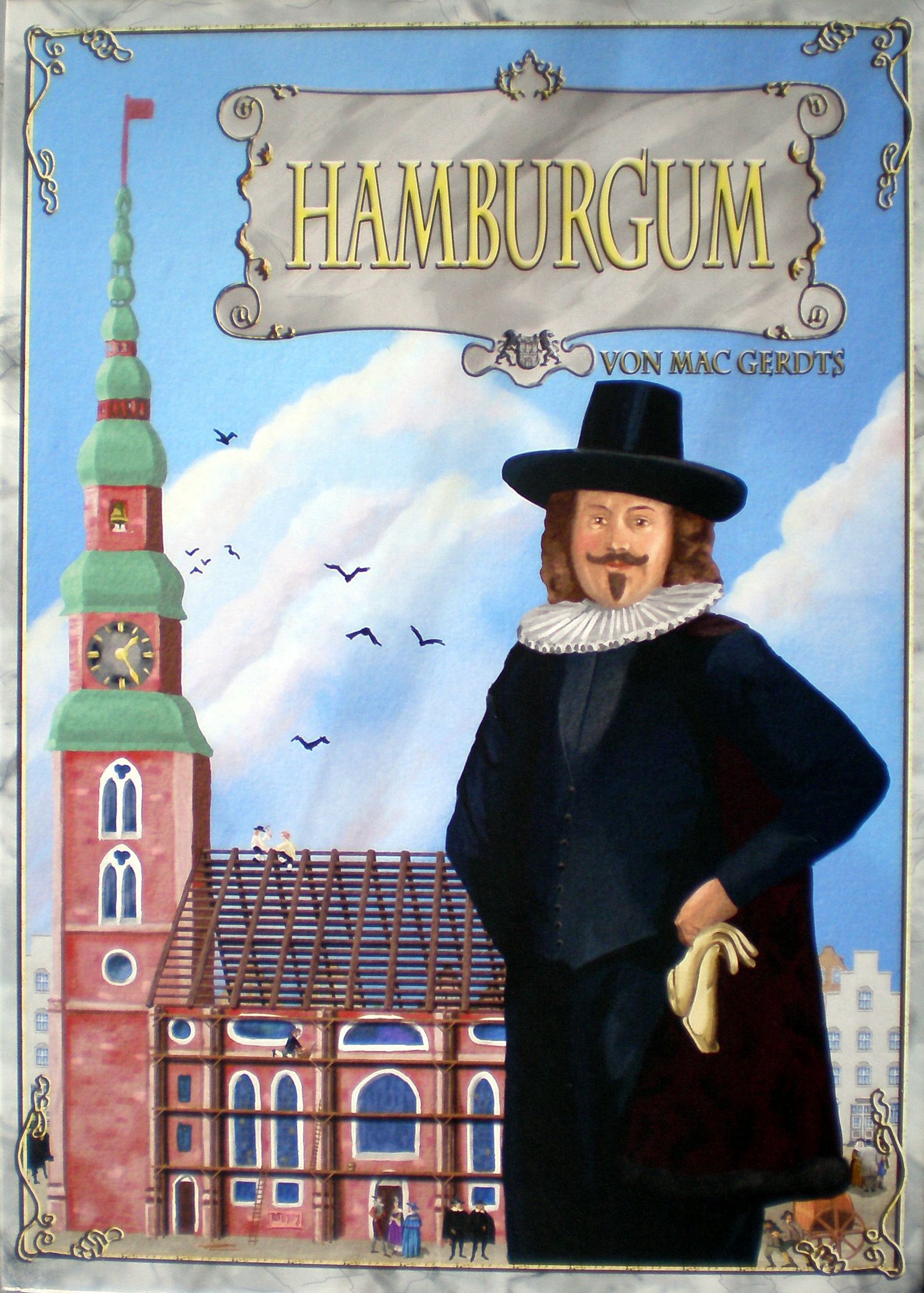
Hamburgum is a strategy game for 2 to 5 players set in 17th-century Hamburg, with no luck from cards or dice. Players produce beer, sugar and cloth, trade goods and building materials, and donate to churches to earn prestige points. The player with the most prestige points at the end wins.
Preparación
Each player takes a colour and its citizens, ships and game markers, and starts with 1 beer, 1 sugar, 1 cloth, 1 timber and 1 brick. Each player places one ship in the harbour berth marked 3 and their octagonal marker in the middle of the rondel. Each of the six churches is placed on the church builder bonus chart. The five donation tokens for each church are placed on its church painting, with the 5-point token on top, points face up and church side face down. Starting prices of 100 £ are set for beer, sugar and cloth. The 7 blue officials' buildings are removed from the game, and the other 28 buildings are stacked on the right of the board with officials at the top in the order Lord Mayor, Vicar, Councilman. The player who last visited a church becomes start player and receives 1 prestige point and 10 £. Each following player in clockwise order receives one more prestige point and 10 £ more than the previous player.
Un turno
Players act in clockwise order from the start player. On the first turn a player may move their marker to any action field on the rondel. On later turns they may move 1, 2 or 3 fields forward for free; each further field costs 1 prestige point, and a player must always move forward. The actions are:
- Beer, Sugar, Cloth: produce one unit of the good for free, plus one for each matching production building owned.
- Trade: either sell goods abroad using your own ships, or buy building materials from the bank, but not both in one turn. Ships in berth 3, 2 or 1 can sell up to 3, 2 or 1 units of one type of good. Extra goods can be sold to the bank for 30 £ each.
- Dockyard: pay 1 timber per new ship and place it in berth 3. When berth 3 is full, all ships shift down a berth, and ships leaving berth 1 return to supply.
- Church: first make donations to one church, paying the required bricks, timber, bells and money and placing a disk for each one. The first donation always gives the 5-point token. Then you may score donation tokens, turning them face down and adding their points. At the end of the action you may keep at most one unscored token of each type.
- Guildhall: pay 1 timber and 1 brick per building and place a citizen on its site. Buildings must be next to a church where you have a donation or next to a previously placed citizen. Only one officials' building may be built per turn. Production buildings also lower the goods price, and most buildings give a one-time benefit when built.
Fin de la partida
The game ends as soon as all six churches are completed. At that point all unscored donation tokens are scored. Each remaining good and building material is then sold to the bank for 50 £.
Puntuación
After the end, players gain one prestige point for every 100 £ they have. The player with the most prestige points wins. If players are tied, the tied player with the most leftover money wins.
Variantes
Two advanced variants use the seven blue officials' buildings in place of the regular officials. In Variant I, blue officials can be chosen freely from the stack, one per turn. In Variant II, they are shuffled and only the top one is visible each turn. Blue officials give personal rewards such as money for goods, ships, donations, churches or citizens, and their benefits happen immediately and only once. The rulebook does not recommend these variants for first games. The rulebook also describes a quick introduction example and a version using the reverse Londinium side of the board, but it gives no rules for that side.
Cambios
- Variantes, por el borrador del reglamento, 23 de noviembre de 2026 (se muestra ahora)
- Puntuación, por el borrador del reglamento, 23 de noviembre de 2026 (se muestra ahora)
- Fin de la partida, por el borrador del reglamento, 23 de noviembre de 2026 (se muestra ahora)
- Un turno, por el borrador del reglamento, 23 de noviembre de 2026 (se muestra ahora)
- Preparación, por el borrador del reglamento, 23 de noviembre de 2026 (se muestra ahora)
- Resumen, por el borrador del reglamento, 23 de noviembre de 2026 (se muestra ahora)