Reglas de Hannibal: Rome vs. Carthage
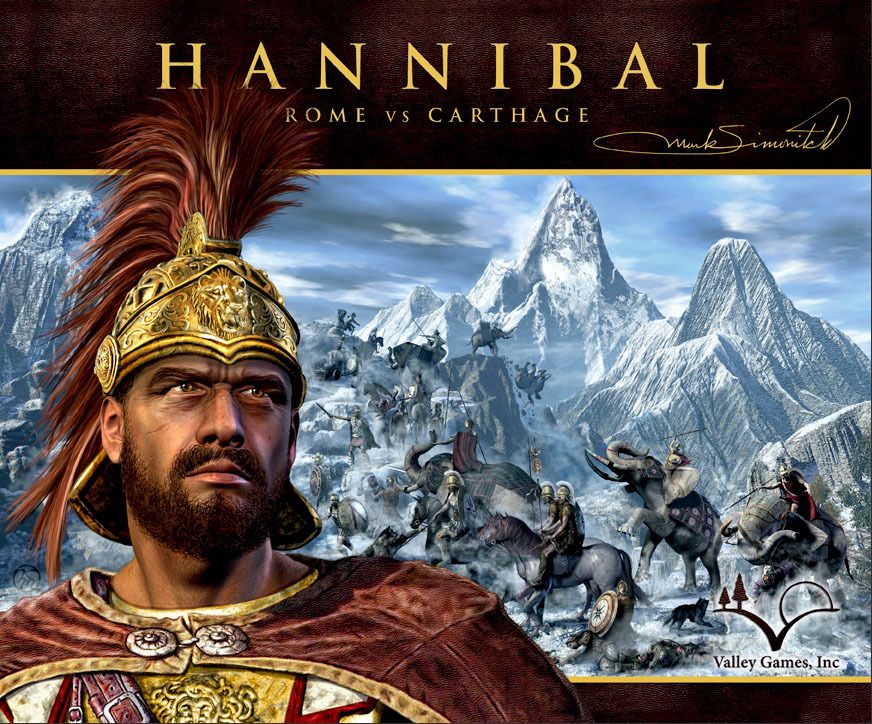
Resumen
Hannibal: Rome vs. Carthage is a two-player game set in the Second Punic War, with one player commanding the Romans and the other the Carthaginians. Players move generals and combat units, place political control markers, fight battles and sieges, and score political points at the end of each turn. The rulebook describes a sudden death victory (for example, taking Carthage or Rome, or the opponent suing for peace) and a points-based win at the end of the last turn.
Preparación
Place the turn marker on turn 1 (218 B.C.) on the Turn Record Track. Roman player: place 8 CUs and the consul Publius Cornelius Scipio in Rome, and 8 CUs and the consul Tiberius Longus in Agrigentum; place Roman PC markers in the black spaces, using round markers in round spaces and Walled City markers in square spaces of matching name. Set the other seven Roman generals aside as later reinforcements and put the eight round Roman general markers in a cup for random draw.
Carthaginian player: place 4 CUs and Hanno in Carthage; 10 CUs (two of them with Elephants) and Hannibal in Saguntum, with Mago and H. Gisgo in Hannibal's Holding Box; 2 CUs and Hasdrubal in New Carthage. Place Carthaginian PC markers in the blue spaces, using the same marker rules as the Romans.
Place the eight hexagonal Tribe markers in the matching hexagonal spaces. Shuffle the 48 Battle Cards and the 64 Strategy Cards into two separate decks.
Un turno
Each turn follows this sequence:
- Reinforcement Phase (skipped on turn 1): the Carthaginian player places reinforcements, then returns any displaced generals. The Roman player places reinforcements, receives Scipio Africanus on turn 6, designates a proconsul, removes old consuls, and randomly draws two new consuls.
- Deal Strategy Cards: each player is dealt the number of cards shown on the Turn Record Track.
- Strategy Phase: players alternate playing one card at a time until both hands are empty. Each card is used either for its Operation Number or for its event, or discarded.
- Winter Attrition Phase: both players check their CUs for attrition.
- Political Isolation Removal Phase: the Roman player, then the Carthaginian player, removes isolated non-walled, non-tribal PC markers.
- Victory Check: both players count Political Points; the player with fewer loses PC markers equal to the difference.
- End of Turn: begin the next turn unless a sudden death victory has occurred or all turns are played.
Operation Number uses: a general can be moved if its Strategy Rating is no greater than the number, with up to four spaces (six with Force March); or the player places PC markers equal to the number in spaces with no enemy CU or PC marker. A 3 card may also raise troops.
Battles use Battle Cards: the attacker plays a card and the defender must match its type, with the first side unable to match losing. Losses are determined by attrition and retreat tables, and the loser retreats and removes PC markers based on CUs lost.
Fin de la partida
The game ends immediately with a Sudden Death Victory: the Romans win by controlling Carthage; the Carthaginians win by controlling Rome, or by controlling all Italian provinces except Latium during a Victory Check Phase; either player wins if the opponent sues for peace. A player sues for peace if he cannot remove enough PC markers to meet the political consequences of defeat in battle or during the Victory Check.
If no sudden death occurs, the game ends after the Victory Check Phase of the last turn.
Puntuación
During each Victory Check Phase, a player earns one Political Point for each politically significant province he controls. All provinces count except Gallia Transalpinia, Massilia, Liguria, and the Balearic Islands, for a maximum of 18 points.
If one player has fewer points, he must remove PC markers equal to the difference. In battle, the loser removes PC markers equal to half the CUs lost (rounded down).
At the end of the last turn, the player with more Political Points wins. If the totals are tied, the Carthaginian player wins.
Variantes
The rulebook gives a short-form variant for Strategy Card events and battle options only indirectly; no solo, team, or separate advanced or short rule set is described. The rulebook also notes that the Mountain Pass Attrition rule is optional.
Cambios
- Variantes, por el borrador del reglamento, 23 de noviembre de 2026 (se muestra ahora)
- Puntuación, por el borrador del reglamento, 23 de noviembre de 2026 (se muestra ahora)
- Fin de la partida, por el borrador del reglamento, 23 de noviembre de 2026 (se muestra ahora)
- Un turno, por el borrador del reglamento, 23 de noviembre de 2026 (se muestra ahora)
- Preparación, por el borrador del reglamento, 23 de noviembre de 2026 (se muestra ahora)
- Resumen, por el borrador del reglamento, 23 de noviembre de 2026 (se muestra ahora)