Reglas de Islebound
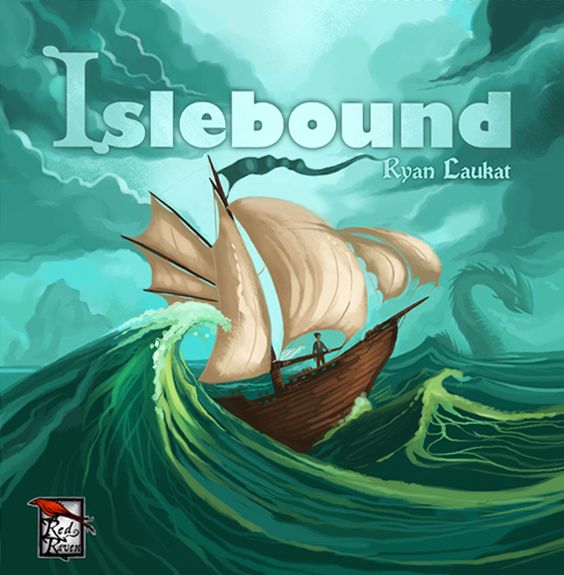
Resumen
Islebound is a sea-trading game where each player commands a ship and crew, sails among island towns, gathers fish, wood, coins and books, hires crew, buys buildings, and takes towns by attack or diplomacy. The player with the most renown at the end of the game wins.
Preparación
- Give each player a ship board, seven coins, a set of 20 cubes in one color, a matching ship, three starting crew (two with administrate and one with work), and a player-aid card. Place one cube on the '2' of the movement track.
- Choose the first player and give them the first-player card. Going in reverse turn order, each player places a cube beside a sea port's red banner to claim a home port and puts their ship there.
- Assemble the four sea boards into the basic shape and place the sea ports in the corners, using the front (standard) side of the sea boards.
- Set the renown board aside. Split the shuffled event cards and the shuffled reputation cards into two face-up piles each. Place two event markers on the map matching the visible event cards.
- Make a face-up pile of crew with two skill symbols, then reveal three into the crew row on the renown board. Shuffle the renown tokens into a pile on the renown board.
- Shuffle the building deck and reveal five cards in a row, placing building track tokens with three, two and one books above the first three. Put the four-book token in the box unless using the Six Buildings variant.
- Form a supply of coins, books, fish, wood, sea serpents, pirates and the Ichor card. In a two-player game, put a cube of an unused color on the two left-most influence slots, which are then unavailable.
Un turno
On your turn, first move your ship. You must move at least one region and may move up to your ship's speed, but you may not end in the region you started in. Fish tokens can add temporary speed.
If you end in a region with another ship, you must exhaust a crew member with administrate. If you cannot, you cannot end there, though you may pass through.
After moving, take exactly one action: Visit a town (paying its entry cost unless you own it), Attack a town with pirates or sea serpents, Diplomacy to pay influence for a town, or Hunt for Treasure to collect coins from the treasure map.
You may also take any number of free actions at any point in the turn: complete an active event in your region to gain influence cubes, or buy a building from the row by paying its coin cost.
Fin de la partida
The game ends when a player owns a set number of buildings: eight in a two- or three-player game, or seven in a four-player game. The alternative trigger is when the last renown token is taken from the stack.
When the trigger occurs, each player finishes their turn until it returns to the first player. Then each player takes one more turn, starting with the first player, and the game ends after that round.
Puntuación
Each player adds up their total renown from these sources:
- Renown marked on the renown track, plus 7 for each renown token owned.
- Each unspent coin, worth 1.
- Each building owned, worth its coin cost value.
- Any end-of-game renown from building abilities, such as Palace.
The player with the most renown wins. If players are tied, the player with the most fish and wood wins the tie.
Variantes
- Advanced Sea Boards: Use the opposite side of all sea boards for altered towns and strengths. Do not mix sides within one game. Sea ports have no advanced side.
- Trading: On your turn, you may trade fish, wood, books, pirates and sea serpents with players whose ships share your region. Every player in the trade must agree and gain something different. Coins, buildings, renown and Ichor cannot be traded.
- Close Quarters: For two players. Entering any region on the same sea board as the other player's ship requires exhausting an administrate crew member.
- Raid: As your main action, raid another player's ship in your region. Both players roll dice for combat crew and pirate cards, with results above three counting as hits. The player with more hits takes coins equal to the difference, if the loser has any.
- Six Buildings: Show six buildings in the row instead of five, using the four-book token with one coin. Buying the first card requires four books and grants a coin.
- Architect: Remove the book and building track tokens. Deal seven building cards to each player and draft them, passing the rest left. Players buy or build only cards in hand, and abilities that gain books or pay books draw or pay building cards instead.
Cambios
- Variantes, por el borrador del reglamento, 22 de noviembre de 2026 (se muestra ahora)
- Puntuación, por el borrador del reglamento, 22 de noviembre de 2026 (se muestra ahora)
- Fin de la partida, por el borrador del reglamento, 22 de noviembre de 2026 (se muestra ahora)
- Un turno, por el borrador del reglamento, 22 de noviembre de 2026 (se muestra ahora)
- Preparación, por el borrador del reglamento, 22 de noviembre de 2026 (se muestra ahora)
- Resumen, por el borrador del reglamento, 22 de noviembre de 2026 (se muestra ahora)