Reglas de Monasterium
Resumen
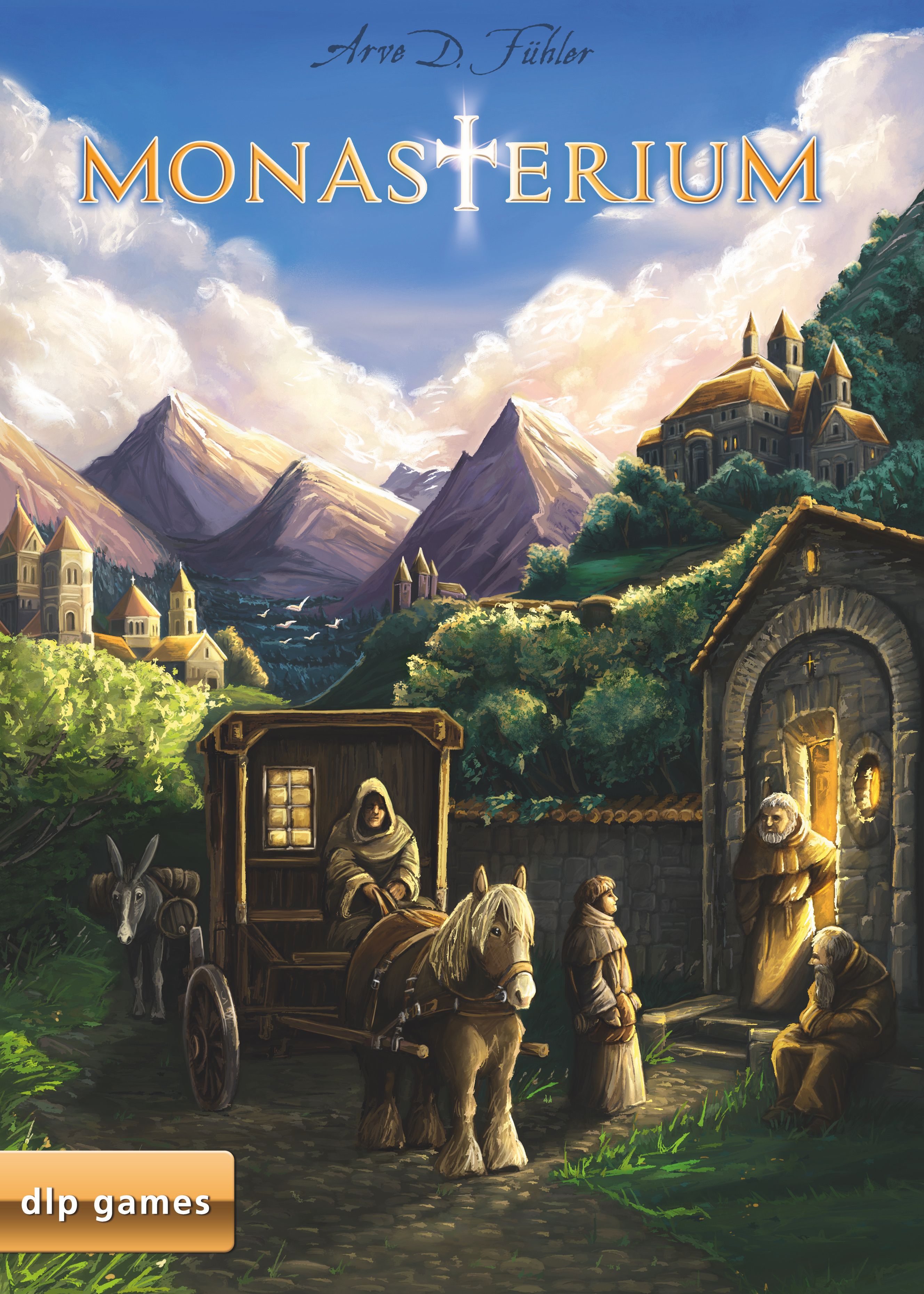
Monasterium is a dice-placement game in which you act as dean of a cathedral school, sending novices to five monasteries over three monastery years. Points come from novices placed in buildings, chapels and cloisters, completed missions, and a church window you build. The player with the most points at final scoring wins.
Preparación
Place the gameboard for your player count. In a 3-player game, put novices of the unused color on every space marked 4 to block them.
Shuffle the Mission cards by their A, B and C backs separately. Draw 2 from each pile, place them face up near the board, and remove the rest.
Each player takes a color set and joins the two parts of the player board. Place the Reroll tile on its active side above the Church Window area and lay the Action tiles in columns A to E on their white side. Put 20 novices on the Action spaces and 4 to the right of the rows. Place your messenger on the first road space and one marking disk on prestige space 0. Keep the other 6 disks.
Take one personal die and keep it. Split the neutral dice equally: 5 each in a 2-player game, 3 each in a 3-player game, 2 each in a 4-player game. Set the other two personal dice beside the board. Take 2 Influence tiles, 2 Soup tiles and 1 Rosary tile.
Place the Hourglass marker on the first monastery year. Put the general supply tiles beside the board. Sort the Church Window tiles by color and place 2 per player in each monastery chapel; remove the rest.
The player who last visited a monastery is the starting player and takes the Chalice marker. If nobody can say, the youngest player starts.
Un turno
A monastery year has as many rounds as there are players, so each player starts once per year. A round has three phases.
1. Dice placement: Starting with the starting player and going clockwise, each player rolls all of their available dice once, chooses one number, and places every die showing that number on the matching Dice space. You must place at least one die on each turn and cannot skip. Once everyone has placed all their dice, the action phase begins. You may use your Reroll tile once per round to reroll any number of dice from your last roll.
2. Action phase: Starting with the starting player and going clockwise, each player chooses one Dice space holding at least one of their personal dice or a neutral die. Take up to 3 dice from it (only 1 from the joker space). If the space holds your personal die and neutral dice, take your personal die first. You may never take another player's personal die. Place the taken dice on your Action tile and use each die for one action. A die that cannot be used is wasted, and you may not skip an available action. Play continues until all dice are used.
Each die gives one action from its column. Standard actions are: send a novice, take a Soup, Influence or Rosary tile, or move your messenger one space. A die showing 6 can be used for any action in its column.
Messenger: The messenger moves one way along the road and wraps back to the first space after the last. Entering or passing a bonus space gives the listed bonus at once. You must have the messenger on a road space connected to a monastery to send novices there, unless you already have a novice in that monastery's chapel.
Sending novices: Novices from rows I and II go to buildings, row III to chapels, and row IV to cloisters. Each building holds one novice. Each chapel has a maximum by player count (4, 6 or 8). Cloister spaces need one of your novices in an adjacent building. Each cost is paid in the matching tiles, as the overview card shows.
3. End of round: When no dice remain and no actions are possible, the round ends. Reset the Reroll tile, redistribute neutral dice, return personal dice to your supply, and pass the Chalice to the left.
Fin de la partida
The game ends after the third monastery year. Players do not prepare another round. Final scoring then takes place.
A monastery year ends when every player has been the starting player once, at which point the Hourglass moves forward.
Puntuación
Add up the points you earned during play, including those from missions and bonuses. Then score the following categories in this order:
- Monastery scoring: For each monastery, the player with the most novices there (in buildings, cloister and chapel) scores 5 points. Ties share the 5 points.
- Chapel scoring: Count the different monasteries where you have a novice in the chapel. 1 monastery gives 1 point, 2 give 3, 3 give 6, 4 give 10, and 5 give 15.
- Cloister scoring: For each monastery, multiply your novices in the cloister by your novices in the chapel, then double the result.
- Resource scoring: Each Tool tile is worth 1 point and each Book tile 2 points. Add your Soup, Influence and Rosary tiles together and divide by 2, rounding down.
The highest total wins. If players tie, all tied players share the win.
Variantes
The rulebook gives no solo or team variant. Its only changes depend on player count: in a 3-player game, the spaces marked 4 are blocked with novices of an unused color. Dice counts, chapel capacity and round counts also change with the number of players.
Cambios
- Variantes, por el borrador del reglamento, 22 de noviembre de 2026 (se muestra ahora)
- Puntuación, por el borrador del reglamento, 22 de noviembre de 2026 (se muestra ahora)
- Fin de la partida, por el borrador del reglamento, 22 de noviembre de 2026 (se muestra ahora)
- Un turno, por el borrador del reglamento, 22 de noviembre de 2026 (se muestra ahora)
- Preparación, por el borrador del reglamento, 22 de noviembre de 2026 (se muestra ahora)
- Resumen, por el borrador del reglamento, 22 de noviembre de 2026 (se muestra ahora)